


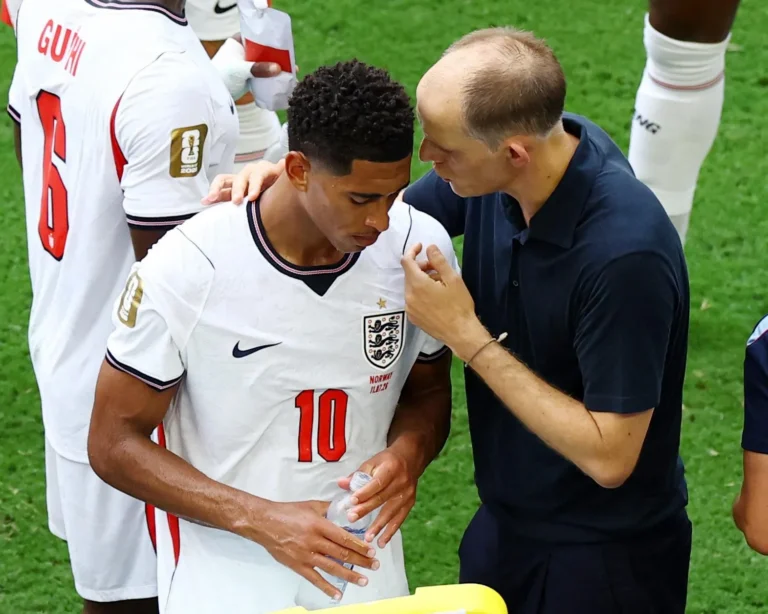
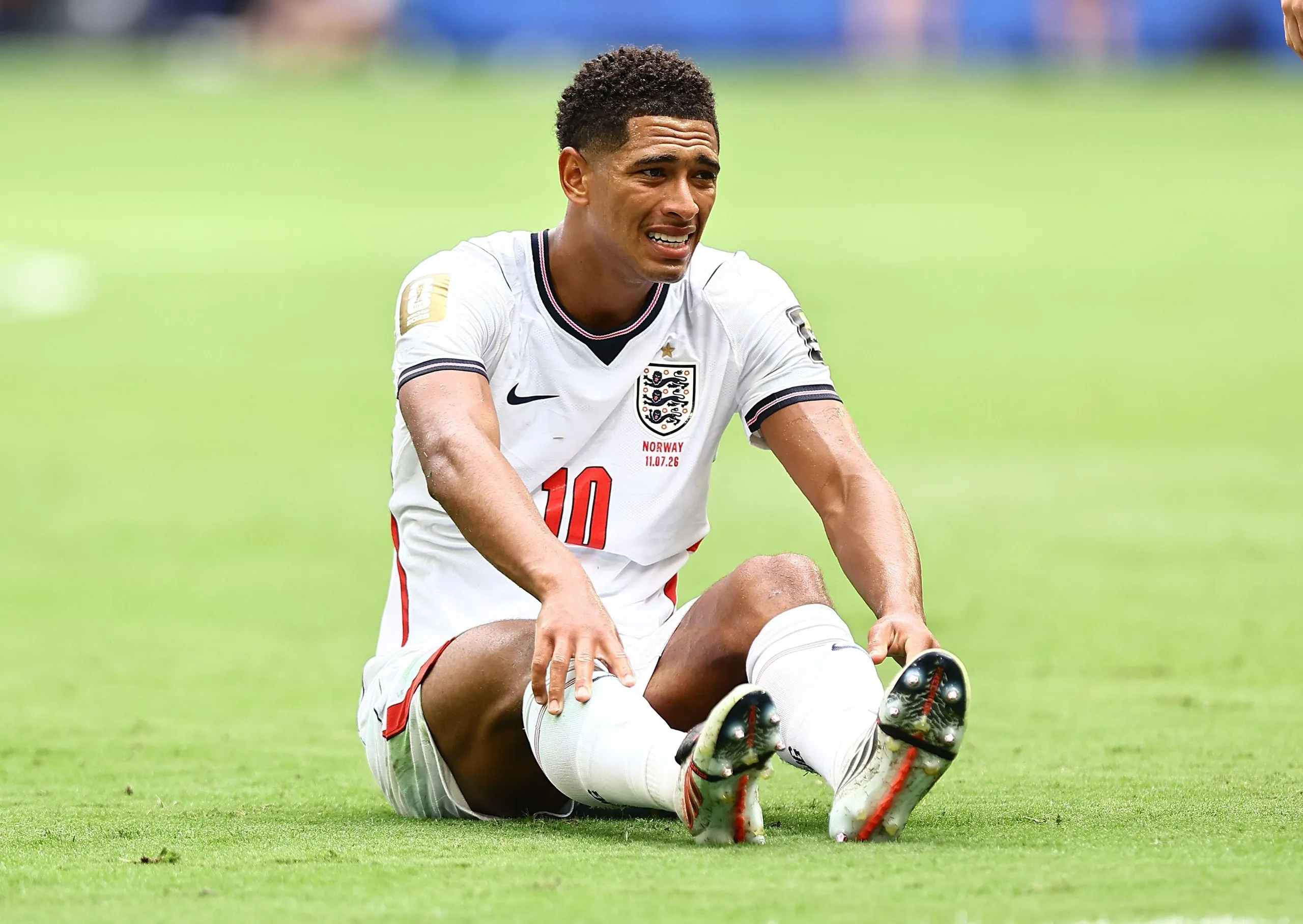
Thomas Tuchel stirred controversy with his remarks, prompting Jude Bellingham to respond sharply. This exchange unfolded in the humid atmosphere of Miami, where maintaining composure proved challenging, and it requires attention before England aims for a historic men’s World Cup final held abroad.
Cool heads are essential at this juncture. Tuchel offered a scathing critique of England’s quarter-final victory over Norway, sharing with ITV’s Gabriel Clarke that the performance lacked urgency and was riddled with errors. While he acknowledged the team’s mentality, the focus shifted to his criticism, which Bellingham addressed with notable assertiveness, risking the stability of England’s campaign due to this public clash with the head coach.
Bellingham’s reactions included a terse remark, where he shrugged and stated, “Yeah, well, whatever … it’s difficult out there,” He elaborated further, saying, “Maybe he doesn’t know what it’s like to play in those kind of conditions against Erling Haaland, [Martin] Ødegaard, [Antonio] Nusa, [Alexander] Sørloth,” This comment was viewed by some as a pointed jab at Tuchel’s modest playing career.
This response from Bellingham seemed unwarranted, especially as it diverted attention from England’s impending semi-final clash with Argentina in Atlanta on Wednesday. Concerns linger that this incident reflects unresolved tensions between him and Tuchel.
Has Tuchel’s earlier remark branding Bellingham’s behavior as “repulsive” truly been laid to rest? Signs indicate that Bellingham has not entirely moved on. It would be understandable if past grievances have resurfaced. Last autumn, Tuchel made a decisive move by excluding Bellingham from the squad, emphasizing team dynamics and hierarchy. Bellingham accepted the challenge, ultimately reclaiming his position in the lineup and emerging as a pivotal force for England in this tournament.
However, this latest episode between Tuchel and Bellingham need not escalate into a spectacle. Initially, Tuchel’s comments were not out of the ordinary; he is known for his straightforwardness with the media. Observers might interpret his critique of England’s performance as a classic managerial strategy aimed at motivating his players.
Tuchel aspires to add another star to the team’s crest. For him, reaching the semi-finals is insufficient. He is intent on raising standards, and his remarks can be seen as a form of tough love. The reality is that England was fortunate to secure a win against Norway, who played better for much of the match, and Tuchel’s comments echoed the confrontational leadership style famously employed by José Mourinho.
This might seem unconventional in an age where many managers opt for a more sensitive approach with players. Nonetheless, Tuchel belongs to the elite class of managers. His frustration came with a knowing smirk, indicating his awareness of the impact of his words. This tactic is common among many successful coaches, as seen with Pep Guardiola, who often challenges reporters when he believes they are overly flattering Manchester City, and Sir Alex Ferguson, who was known for his sharp critiques even after victories.
Two significant issues arise from this situation. Firstly, Tuchel’s bluntness clashes with traditional English reserve, which some find jarring. In contrast, Gareth Southgate would likely have focused on breaking barriers and making history, employing a softer, more sensitive tone. Tuchel, however, embraces a frank style and is unafraid of causing offense.
Then there’s Bellingham, who at just 23 has already scored twice in consecutive knockout matches. It’s no surprise that he is disinclined toward negativity; that’s not his character. His willingness to challenge authority may have been a factor in propelling England forward during tough moments.
Although Bellingham may have crossed a line by seemingly questioning Tuchel’s authority, the head coach would do well not to take it too seriously. Tuchel should appreciate that he has given Bellingham another reason to prove himself. He must also recognize that fostering a culture of honesty means he cannot be surprised when he receives some in return.
The situation becomes problematic when it unfolds publicly. It’s also important to remember the grueling conditions in Miami; Bellingham was likely both physically and mentally exhausted. Speaking shortly after the match, he may not have been able to filter his thoughts as he normally would.
Ultimately, neither Tuchel nor Bellingham benefits from letting this disagreement linger. Tuchel should downplay the matter in his next media appearance, perhaps even turning it into a lighthearted joke. He could humorously note that Bellingham can discuss tactics only after he has led a team to Champions League victory.
It’s crucial for Tuchel to ensure that England’s “brotherhood” remains intact leading into one of the most intense and emotionally charged matches in recent history. Fortunately, those within the camp believe that the tensions will soon dissipate. England has a chance to make history this week, but they can only achieve this if Bellingham and Tuchel align their perspectives.
- World Cup 2026
- Thomas Tuchel
- Jude Bellingham
- England
- World Cup
- comment