


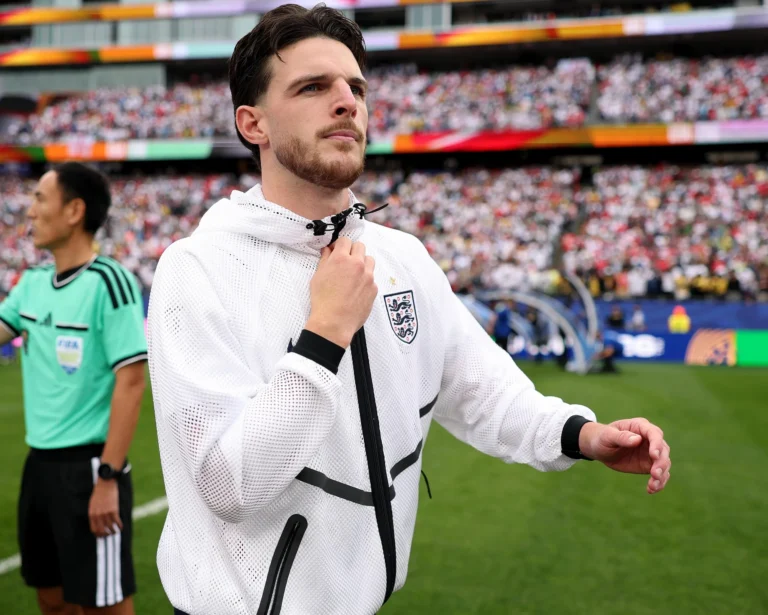
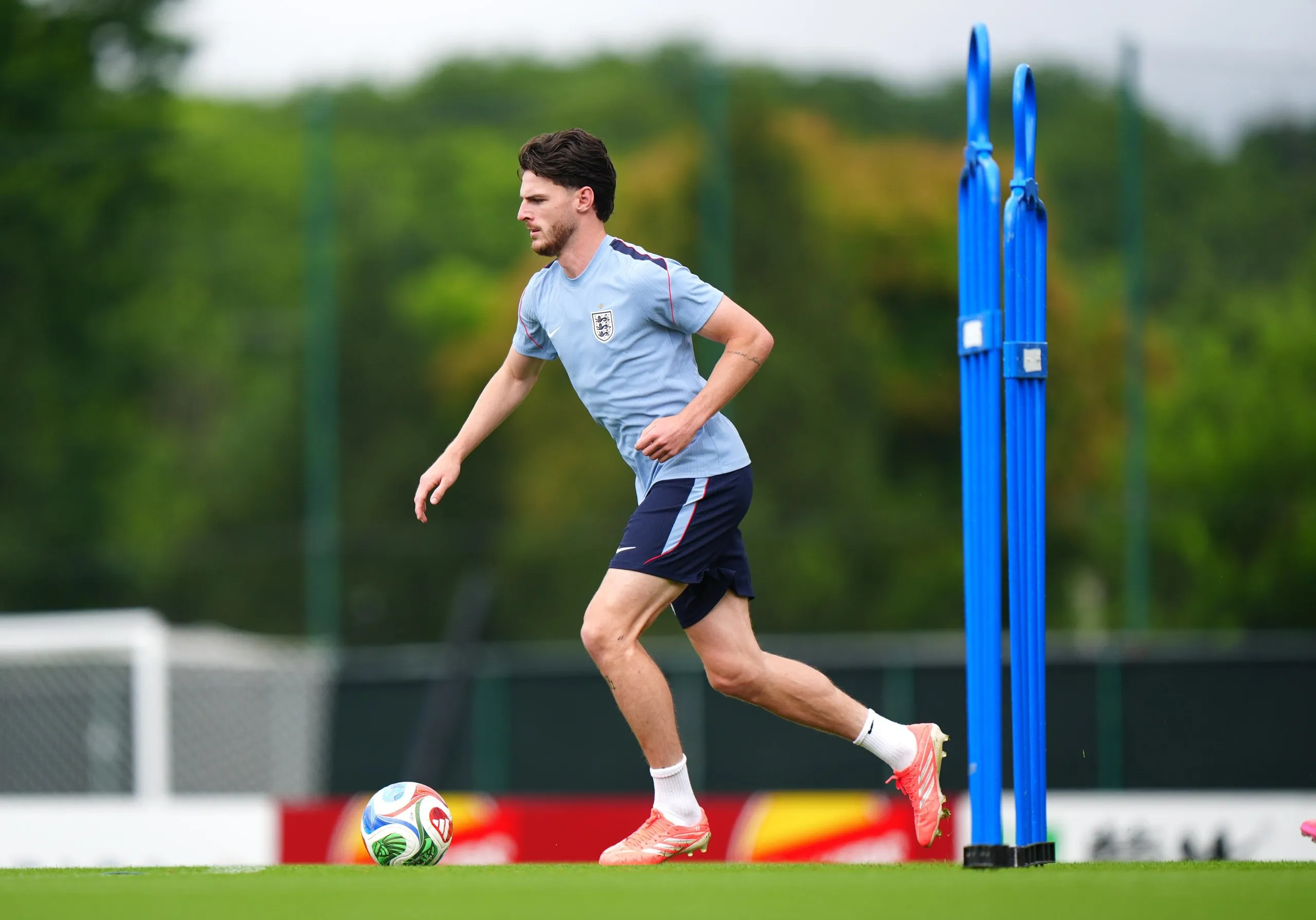
Declan Rice is contemplating a significant turning point in his season, one that many believed could lead to turmoil for both him and Arsenal. Their narrow defeat against Manchester City in mid-April had the two clubs neck-and-neck at the top of the Premier League. With the momentum swinging in City’s favor, questions arose: would Arsenal falter?
Television cameras captured Rice on the pitch at the Etihad Stadium, where his frustration was evident. “It could have gone either way,” the England midfielder stated. Indeed, Arsenal went on to win all their remaining league matches, overcoming immense pressure. City faltered, and Arsenal claimed their first championship since 2004. “That would have lived with me for ever.” Rice reflects with a grin. “I’ve got enough of them. Luckily, it went the way I wanted it to be perceived, even though it was crazy how that all came about.”
This moment resonates with Steven Gerrard’s famous “There’s going to be moments where we have setbacks, where we have to get through,” remark from 2014 as Liverpool approached the title, just before their own slip. Rice acknowledges, “It’s going to be tough and we need to be ready for everything that comes.”
As England gears up to face the Democratic Republic of the Congo in the World Cup Round of 32 in Atlanta on Wednesday, Rice emphasizes the unpredictable nature of pursuing rare successes. The path is fraught with stress, skepticism, and critical moments that test resilience. Finding a way forward, regardless of the obstacles, is essential.
At this stage of the World Cup, it seems England is facing a similar situation. Rice is part of what could be the most valuable midfield trio in international football history, especially with Elliot Anderson’s impending £116 million transfer from Nottingham Forest to Manchester City. Rice’s own move from West Ham to Arsenal in 2023 cost £105 million, while Jude Bellingham’s transfer from Borussia Dortmund to Real Madrid that summer was valued at £88.5 million, potentially reaching £115 million with add-ons. The trio is eager to unleash their potential, but Rice notes that they require opponents willing to press high and engage in man-to-man battles—something that did not happen against Ghana or Panama, and is not anticipated against the DRC either.
Fans of England felt a sense of relief upon learning their team would face the DRC instead of Senegal, who previously defeated England in a friendly last June. Senegal also has a more established reputation. However, the DRC showed their strength during the group stage, managing a 1-1 draw with Portugal and narrowly losing to Colombia before defeating Uzbekistan 3-1.
The DRC boasts players from the Premier League, including Aaron Wan-Bissaka, Axel Tuanzebe, Noah Sadiki, and Yoane Wissa. England’s first knockout match in the tournament promises to be challenging. Rice intends to draw on his experiences with Arsenal, emphasizing the mental fortitude required.
“It’s hard because when you play against low blocks you have a structure the manager wants you to play in,” he warns. “And sometimes you have to do something for the good of the team, even though you feel like you don’t want to do it because you feel a bit stuck. You have to do it because it might help out a teammate. “When you look at the quality that we have across the whole squad, you would say: ‘Right, how are we not scoring four or five?’ But Ghana were incredibly well drilled and so were Panama. The boss [Thomas Tuchel] was saying they’re the same ranking as Wales and Serbia; they’re not terrible opposition. It’s down to us to break down these low blocks and to be patient. “It’s tough but this is the World Cup. I understand the heat [on England], I understand how teams have a way of playing against us and [it is] anything to win, I suppose. We need to find ways to keep counteracting that.”
Rice is certainly familiar with tightly packed defenses, having encountered them frequently with Arsenal, where solutions were not always visually appealing. Both Arsenal and England have faced criticism in this regard. Yet, as Rice discusses the themes of realism and sacrifice, he understands the importance of achieving ultimate success.
“It [the nerve pain] is strange because you can just feel it like sitting there,” he explains. “It’s not a pain that happens [just] during football. You could be sat at home and you’d feel a little pain shoot up your leg. I’ve managed it in a good way, trying to get my rest when I can and prioritising games. When you play that many [club] games, you’re hardly training. It’s just: recovery, games, recovery, games. “I played the Champions League final, had a week completely off‑feet, where I did nothing, and then I got myself back into a rhythm. The body had a little bit of a shock. That’s why I started to feel the pain a little bit [against Croatia] because towards the end [of the season] it was starting to ease off. It’s just something I’ve got to keep managing. Once this season’s done, I’ll get my rest and I’m sure I’ll go into next season fine.”
“We had a great chat the other day at the hotel in Kansas City,”
“We were sat outside on the beanbags. I said to Elliot that he can’t control the price he’s going for. But why he’s going for that price is because he’s been one of the best players in Europe this season. The price tag is just noise. I said: ‘Go to City, do what you’ve been doing and you’ll be fine.’ Elliot wants the ball and if he doesn’t get it he has a little dig at you. He’s one of the best I’ve played with.”
For Rice, this has been a tumultuous period, with the joy of winning the Premier League title overshadowed by the heartbreak of Arsenal’s penalty shootout loss to Paris Saint-Germain in the Champions League final.
He has also battled with neural pain in his hamstring, an issue persisting since Christmas that forced him to exit in the 72nd minute of the World Cup opener against Croatia.
Rice managed to play the full 90 minutes against Ghana but suffered a “I look at this group now and I don’t think there’s a better crop of penalty-takers that England have probably ever had,” at the end, which “I look at Harry [Kane], Ivan [Toney], Marcus [Rashford], Anthony Gordon, [Bukayo] Saka. I can take one. Jude, as well. You hear the stat about how you have to win a penalty shootout to get to a final or win the tournament, so you know that might come along. We’re going to be fully prepared for that.” resulting in his absence against Panama. This marked the first time since Euro 2020 that Rice was not included in an England starting XI for a tournament, breaking a streak of 21 matches.
“It [the nerve pain] is peculiar because you can feel it just sitting there,” Rice describes. “It’s not a pain that occurs only during football. You might feel a slight pain shoot up your leg even while you’re relaxing at home. I’ve managed it well, focusing on rest and prioritizing games. When you play so many club games, training takes a back seat. It’s all about recovery and games.”
“After the Champions League final, I took a week completely off my feet, during which I did nothing, and then I got back into a routine. My body experienced a bit of shock. That’s why I began to feel the pain a bit [against Croatia] because it had started to ease off towards the end of the season. It’s something I need to keep managing. Once this season concludes, I’ll take my rest and I’m confident I’ll be ready for next season.”
Rice assures that his calf injury is not a concern and Tuchel will be pleased to have him back against the DRC, especially since Anderson appeared isolated at times against Panama. Bellingham, who played as a box-to-box midfielder, will switch back to the No 10 role. Rice’s bond with Anderson has quickly strengthened since they began playing together for England last September, and he is positioned to offer guidance regarding record-breaking transfers. He openly admits he faced challenges when he first joined Arsenal.
“We had a great chat the other day at the hotel in Kansas City,” he recalls. “We were sitting outside on beanbags. I told Elliot that he can’t control the price he’s being sold for. But the reason behind that price is because he has been one of the top players in Europe this season. The price tag is merely noise. I said: ‘Go to City, do what you’ve been doing, and you’ll be fine.’ Elliot wants the ball, and if he doesn’t get it, he’s not shy about letting you know. He’s among the best I’ve played with.”
Rice’s confidence is evident, along with a continuous drive toward achieving his ambitions. He recalls feeling apprehensive before taking a penalty during Arsenal’s Carabao Cup quarter-final penalty shootout against Crystal Palace last December, although he successfully converted. In contrast, when he faced PSG, he exuded confidence and delivered a decisive goal. Should England find themselves in a penalty shootout in the coming weeks, Rice believes they would be formidable contenders. To him, it would be a straightforward outcome.
“Looking at this group now, I don’t believe there has ever been a better set of penalty-takers for England,” Rice asserts. “I think of Harry [Kane], Ivan [Toney], Marcus [Rashford], Anthony Gordon, [Bukayo] Saka. I can take one as well. Jude too. You hear the stat about needing to win a penalty shootout to reach a final or win the tournament, so we know that could come into play. We’re going to be fully prepared for that.”
- England
- World Cup 2026
- World Cup
- interviews