


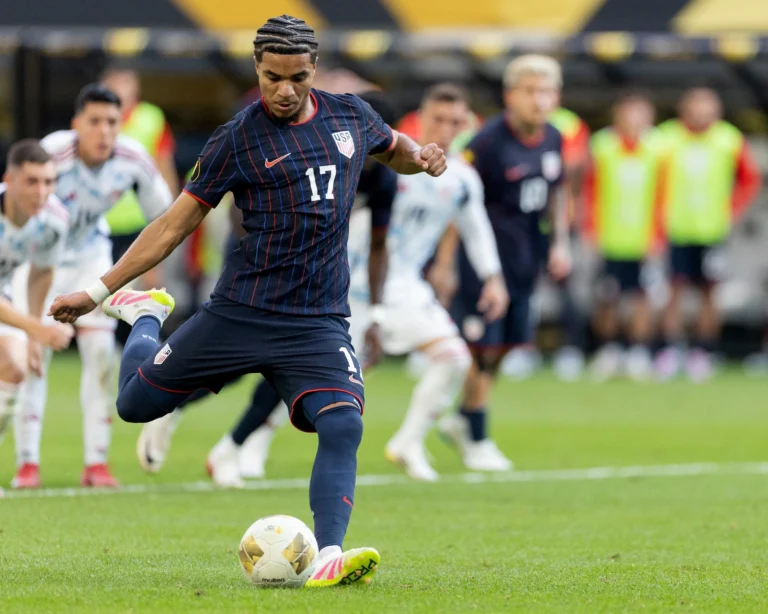
In football, few events stir as much debate as a penalty shootout. The tension and exhilaration it brings were evident during Monday’s knockout phase matches.
Germany fell first to the harsh reality of this process at the World Cup, with players Kai Havertz, Nick Woltemade, and Jonathan Tah all failing to convert their penalties, leading to an unexpected defeat against Paraguay. The Netherlands, familiar with the heartbreak of shootout losses, followed suit, faltering in their attempt against Morocco.
This marked a novel experience for Germany, who had never exited a World Cup via penalties since the introduction of the format in 1982. Following the match, reports emerged detailing that several key players, including midfielder Leon Goretzka and defenders Waldemar Anton, Nathaniel Brown, and Malick Thiaw, had opted out of taking a penalty. Consequently, the task fell to Tah, an individual without prior experience in penalty situations, who ultimately missed the crucial kick, eliminating Germany from the tournament.
This situation has raised questions regarding the preparation strategies employed by German head coach Julian Nagelsmann, with critics highlighting the absence of a pre-established order for penalty takers.
Pochettino’s Strategic Approach
In contrast, US head coach Mauricio Pochettino has adopted a more systematic method. When interviewed, he revealed that his coaching staff had engaged with an external consultancy to analyze penalties and set pieces comprehensively. While he maintains a preferred order for penalty takers, he refrained from disclosing specifics.
“I don’t want to talk too much,” Pochettino commented. “But I think we are working [with outside help] because as a coaching staff we believe we can provide some tools to the players to be better and to improve, [to equip] the players to try and find the best way to face this type of situation, while knowing that it is impossible to replicate the emotional stress and the pressure and expectation that they are going to feel.”
Pochettino emphasized the importance of the coaching staff’s role in determining the order for penalty takers. He stated, “It is going to be [the coaching staff’s] decision, the 1, 2, 3, 4, 5. We try to arrive in this moment and not ask the player if he feels confident or not confident.”
About 18 months ago, the coaching team, along with analysts, formed a group dedicated to enhancing player performance during set pieces. They collaborated with two firms: Neuro11 and Trackman.
Neuro11 employs real-time EEG tracking to study players’ brain activity, previously working with Liverpool FC under Jürgen Klopp on set-piece coaching. Their approach includes use of a specialized helmet during penalty practice, as shown in a video from Liverpool in 2023.
On the other hand, Trackman utilizes radar and sensor data to provide detailed insights into ball movement. US midfielder Sebastian Berhalter acknowledged Trackman’s contribution to improving his set-piece execution, a factor that aided his selection for the World Cup roster.
USMNT’s Preparation for the Knockout Stage
As the USMNT gears up for their last-32 clash against Bosnia and Herzegovina in the Bay Area on Wednesday, penalties have become an integral part of their training regime. Many players observed Monday’s shootouts together, reflecting on the significance of penalty shootouts, something they have yet to experience in World Cup competition. The only exception remains Brad Friedel’s notable penalty save against South Korea in 2002.
“It is an extremely hard thing to do, go up and take penalties,” midfielder Christian Pulisic noted during a press conference at PayPal Park, the team’s current training venue. “For the people that go up and shoot it takes a lot of courage and it is not easy. Goalkeepers get better and better every year … The guys who feel the most confident to shoot will want to go up and shoot. I think that’s normal. There’ll be some players that don’t practice them as much and don’t feel good, I don’t think that’s necessarily a big problem. I feel it’s a pretty brave, courageous team, and I feel guys will give it a go.”
The US boasts a roster filled with skilled penalty takers, with Pulisic leading the charge. The 28-year-old has a perfect record in seven attempts for the senior national team and has similarly excelled at club level with Milan. Forward Ricardo Pepi has also shown proficiency, remaining flawless in penalties since departing MLS in 2022, while Haji Wright has converted 17 out of 19 attempts over the past seven years. Folarin Balogun has also contributed his fair share of attempts.
However, the situation becomes less clear further down the squad. US defender Chris Richards humorously remarked on the prospect of taking a penalty.
“I’m a defender for a reason, man,” Richards said. “We try to not think about the worst-case scenario … In training, though, we prepare for everything, whether it’s penalty kicks or [extra time], we try and not leave any stone unturned. For us it’s just about approaching this game with confidence but also understanding that things don’t always go your way, so be prepared for everything.”
Adapting to Penalty Styles
Furthermore, the style of penalty taking has also come into focus. The recent shootouts displayed a variety of unconventional techniques, including stutter steps and abbreviated run-ups. Several kickers opted to strike across their bodies, leading to a couple of shots hitting the post in the Netherlands-Morocco matchup.
While the US players observed these differing methods, many appeared reluctant to adjust their own techniques. For Pulisic and others, the notion of altering their approach at this stage seemed far-fetched.
“I think everyone has their own style. I don’t think you watch and can take so much away, or try and change your style in one day,” Pulisic stated. “I don’t have too much attacking in me, so I’m just picking my spot and going with it,”
Richards added, laughing, “I don’t have too much attacking in me, so I’m just picking my spot and going with it.”