


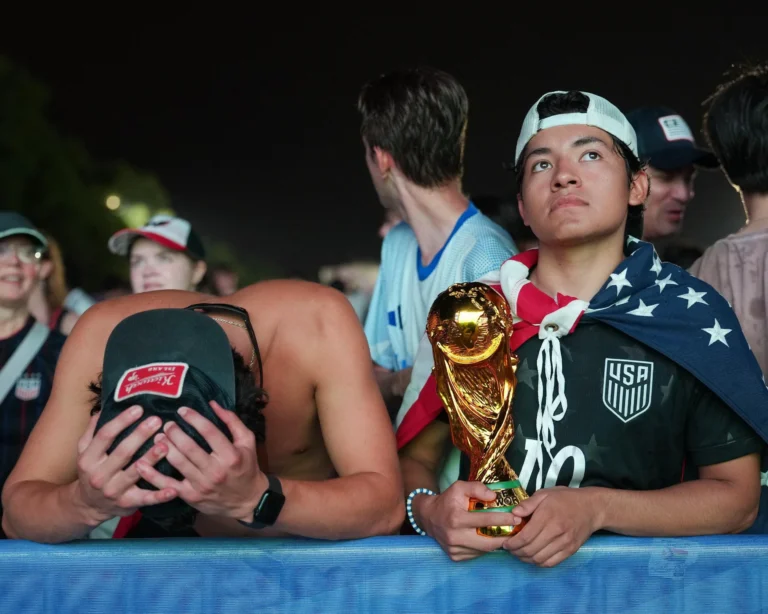
In the waning moments of the United States’ thrilling 3-2 victory over Portugal during the 2002 World Cup, ESPN commentator Jack Edwards reminded the audience of the monumental significance of the match. Broadcasting from Suwon, South Korea, where the campaign would culminate in a quarter-final that remains a pinnacle for the US men’s national team, Edwards delivered a heartfelt monologue about the critical importance of World Cups not just for the team but for soccer’s place in American culture.
“The players on that 1950 team that beat England … this [result] is about the foundation that they laid,” Edwards proclaimed, his voice resonating as the clock approached 7am ET. “This is about the thousands of American families who have helped this sport grow, and the people in those pockets all over the country who have stuck with soccer. And it’s also for those seven- or eight- or nine-year-old kids, who are going to hear about this result when they wake up in the morning and rush outside, and knock a ball against a wall, and dream of something even greater than this.”
This reflection lingered in my mind throughout the United States’ journey in the latest World Cup. It surfaced each time I witnessed the streets alive with red, white, and blue on game days along the West Coast. The sentiment replayed whenever I noticed remarkable TV viewership figures. I thought of it whenever groups of young children—seven, eight, or nine years old—gathered with their families at training grounds, eager for autographs or simply a glimpse of their idols.
In those moments, I pondered: When will that pivotal experience arrive for these young fans? Who will be the one to inspire them? What will that moment entail? However, I hadn’t fully grasped the implications should the opposite scenario unfold.
What must those children have thought about the US team’s performance during their 4-1 loss to Belgium? How were soccer enthusiasts explaining the outcome to their friends who they had finally persuaded to watch this crucial game? For those families that Edwards mentioned, how disillusioned they must have felt. One moment, they felt poised on the brink of something remarkable, believing their dedication to the sport would finally lead to broader acceptance.
What inspiration could be drawn from the team’s erratic attempts to advance, the missed defensive responsibilities, and the lack of composure displayed in critical situations? How could they reconcile the alarming deficiency in technical and tactical skill compared to a solid Belgian team? Observers from other countries reveled in the US team’s downfall, further compounding the disappointment.
Although the viewing figures for Monday’s match have yet to be released, last week’s primetime matchup set a new record for US soccer broadcasts, drawing around 31 million viewers. At the very least, millions—likely tens of millions—were tuning in for their inaugural experience with the US men’s national team, only to witness a performance that fell short of expectations.
These viewers were not the long-standing stalwarts of the sport that Edwards referenced. However, they would have recognized what it looks like for a team to compete against a top-tier opponent. They saw it when Mexico, despite their shortcomings, battled fiercely against England. They witnessed Cape Verde heroically exit against Argentina and recalled the US team’s earlier games in this World Cup, including a euphoric 4-1 victory over Paraguay and a professional 2-0 win against Bosnia and Herzegovina in the round of 32.
The upcoming 2026 World Cup was anticipated as a beacon for the future of the US men’s national team. Yet, the mirage of this tournament may ultimately reveal that, for a brief, frenzied few weeks, we believed that transformation was imminent. Instead, we find ourselves back at square one—performing well against teams we are expected to defeat but still yearning for that elusive breakthrough against stronger opponents.
In the aftermath, there will be ample analysis regarding the reasons for the US’s disappointing exit on Monday night. However, I doubt the significance of that analysis. What remains with me, an unwavering belief that is both disheartening and profound, is that the US has squandered what may be the most significant opportunity for growth in the history of American soccer.
What happens when a new wave of potential fans—representing the living, breathing promise of a once-in-a-lifetime home World Cup—are met with something worse than despair: sheer inadequacy?
We may be on the verge of discovering the answer.