


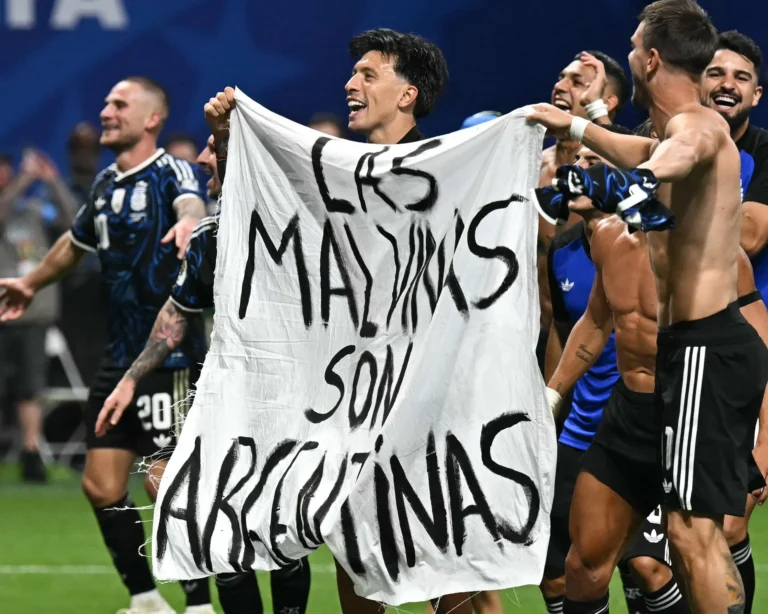
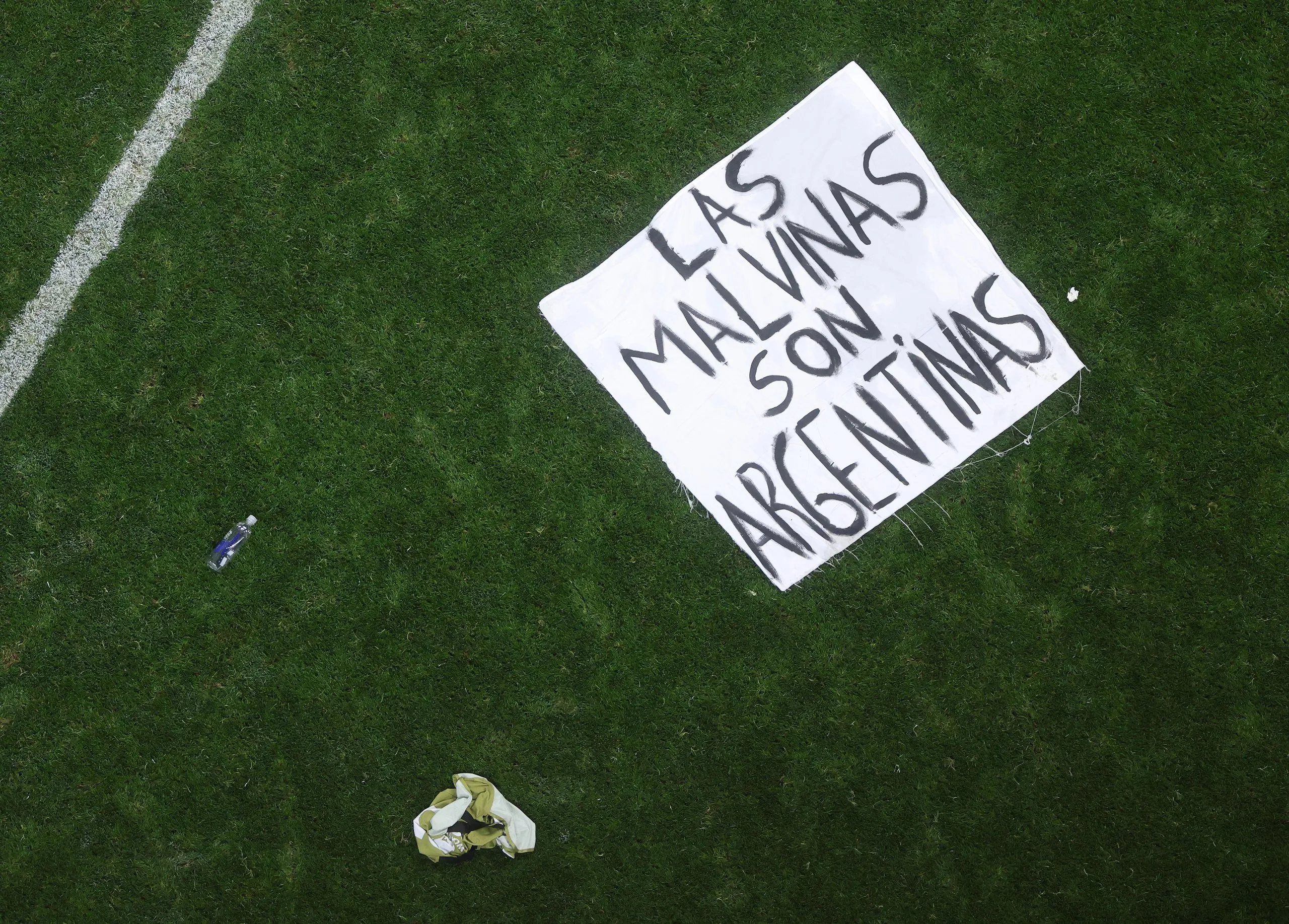
The Argentine football team marked their semi-final victory against England by showcasing a banner that proclaimed, “Las Malvinas son Argentinas” a direct reference to the 1982 conflict over the disputed territory.
In a dramatic turn of events, Argentina, trailing 1-0 with just five minutes remaining, managed to score two goals in quick succession, securing their place in a consecutive World Cup final against Spain, scheduled for Sunday in New Jersey.
This banner highlights the ongoing territorial dispute, known in the UK as the Falkland Islands and in Argentina as the Islas Malvinas, which resulted in a 74-day war over four decades ago, claiming the lives of over 900 individuals, including 649 Argentinians and 255 Britons.
Players Lisandro Martínez and Giovani Lo Celso proudly displayed the banner, smiling and waving to supporters in the stands. The origins of the banner remain unknown.
Political messaging during the World Cup has previously sparked conversations. For instance, during a match last month in Los Angeles, Iranian Americans showcased pre-revolutionary flags as a form of protest against the current Iranian government, an event that unfolded without any disruptions.
Following their quarter-final victory over Switzerland, some Argentine players were heard chanting.
“For the Malvinas, for Diego [Maradona] and for Leo [Messi]’s last one.”
Midfielder Rodrigo De Paul commented on the significance of the game, stating.
“We understand it’s a football game that transcends; it brings back memories of what Diego did. We sing songs about our Malvinas heroes, mainly to remember them, but we have to understand that it’s a football match and that the Malvinas have to be discussed elsewhere. What happened was an atrocity and we always remember the fallen, but what we want is to win this match to get to the final.”
FIFA’s stadium regulations prohibit the display of “banners, flags, flyers, apparel and other paraphernalia that are of a political, offensive, and/or discriminatory nature” within stadiums. A request for comment from FIFA went unanswered.
On Tuesday, Argentina’s security minister, Alejandra Monteoliva, indicated that enhanced security measures had been a topic of discussion during a meeting in the US. “There will be 1,600 officers. We want the celebration to be peaceful,” she told local radio in Argentina. “The entry of elements that have any type of provocative message, whether of political or racial content, is prohibited.”