


As Brazil faced a 1-0 deficit, the atmosphere in the stands shifted dramatically. Initially, a few fans in yellow jerseys began to leave their seats, disillusioned by the prospects of their team clinching a sixth World Cup title. Soon, a steady stream of supporters began making their way out of the arena, resigned to the inevitable.
They sensed the impending conclusion: Brazil was set to exit in the Round of 16, marking their earliest World Cup elimination since 1990. This defeat extends their title drought to six tournaments, the longest in their storied history.
Erling Haaland’s second goal confirmed Brazil’s fate. Neymar’s penalty, taken deep into injury time, proved to be little more than a consolation.
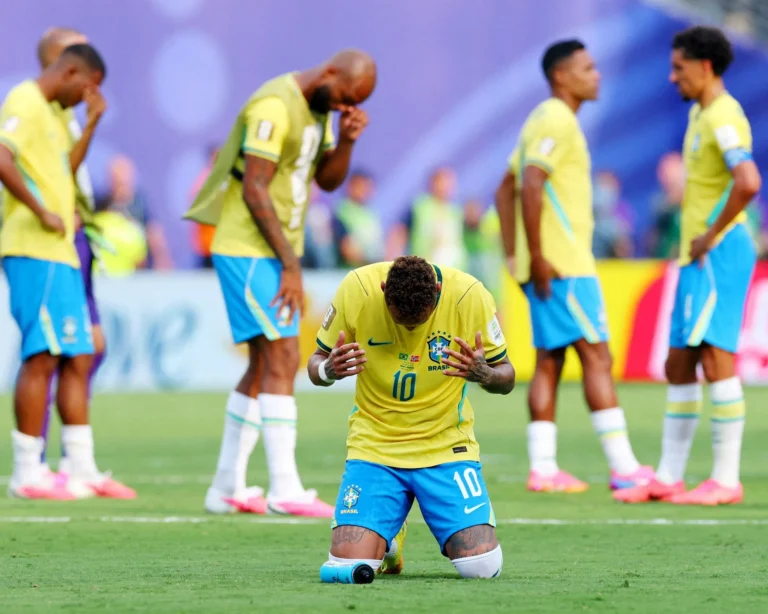
When referee Ismail Elfath signaled the end of the match, the Brazilian players remained on the pitch, seemingly frozen in disbelief. Some sat on the bench, dazed, as though refusing to accept that their World Cup journey had come to an abrupt halt.
The reasons behind this disappointment were clear. Brazil missed a penalty and squandered several promising chances. Ultimately, it was Haaland’s brace that sent them packing, with a final score of 2-1.
What transpired was a collective failure to capitalize on opportunities, particularly from Vinícius Júnior, who finally showcased the form Brazil had been longing for. While he generated most of the attacking threat against Norway, he was not entrusted with the first-half penalty that could have altered the outcome; that responsibility fell to Bruno Guimarães, who faltered with a weak attempt too close to goalkeeper Ørjan Nyland.
Endrick, the 19-year-old prodigy, was unable to change the game upon his introduction in the second half. He received a perfectly threaded pass from Vinícius but misplayed it, resulting in a miss that left Brazil yearning for more.
Neymar’s influence was limited as well. The fans erupted in cheers when he entered the match as a substitute in the second half. He attempted a few flashy moves, which seemed both swift and sluggish, reflecting the later stages of his career. His late penalty brought some excitement but was far from sufficient to turn the tide.
Carlo Ancelotti, the veteran coach, also couldn’t turn Brazil’s fortunes around. He eventually found a way to get Vinícius performing well and secured convincing victories against Haiti and Scotland, following a draw with Morocco. However, his efforts fell short in the end.
Norway had previously never lost to Brazil in four encounters and even defeated them during the group stage of the 1998 World Cup, albeit with Brazil already qualified. Their advancement to the quarter-finals was well-deserved; this was no mere fluke. Ståle Solbakken’s team created their own scoring opportunities and could have taken the lead early on, had Alexander Sørloth not strayed offside before setting up Patrick Berg for a well-placed shot.
This loss raises an unresolved question: is Brazil more of a brand than a cohesive team? They have long been the benchmark of international football, known for their positive energy, global appeal, and rich history. Yet, it has been some time since they met the high expectations set by their own legacy. Their 2019 Copa América victory, their first in twelve years, now feels overshadowed by three consecutive failures to reach the World Cup semi-finals, the last of which was particularly underwhelming.
A lackluster Brazilian squad appeared hesitant throughout the tournament. Their roster felt incomplete in North America. Endrick, despite his talent, was too young for this stage, and Brazil struggled to find a reliable striker. The midfield, composed of aging players, lacked the creativity needed. “It’s very evident that in the midfield, we have to move some players,” Ancelotti stated following the match. “We need some young talent. We need some high-level players to be able to come into Brazil to play for the national team.” This need extends beyond just the midfield.
Ancelotti devised a strategy to exploit Norwegian errors. However, even when such opportunities arose in a sluggish and chaotic match, Brazil failed to convert their chances. A sense of urgency was notably absent, with the players often appearing to stroll about the pitch. Panic set in when Andreas Schjelderup managed to outpace his defender, delivering a cross to Haaland in the 79th minute, resulting in the first goal.
Shortly after, the Norwegian team celebrated with their fans, while the last of the Brazilian players made their way off the field.
“Bottom line, we have to find new ideas. I don’t think it’s the end; it’s the beginning of the new cycle. At this point, we have to deal with our feelings, manage our sadness and start again tomorrow.”
As of Sunday, Brazil has nearly 1,500 tomorrows before they kick off another World Cup.