


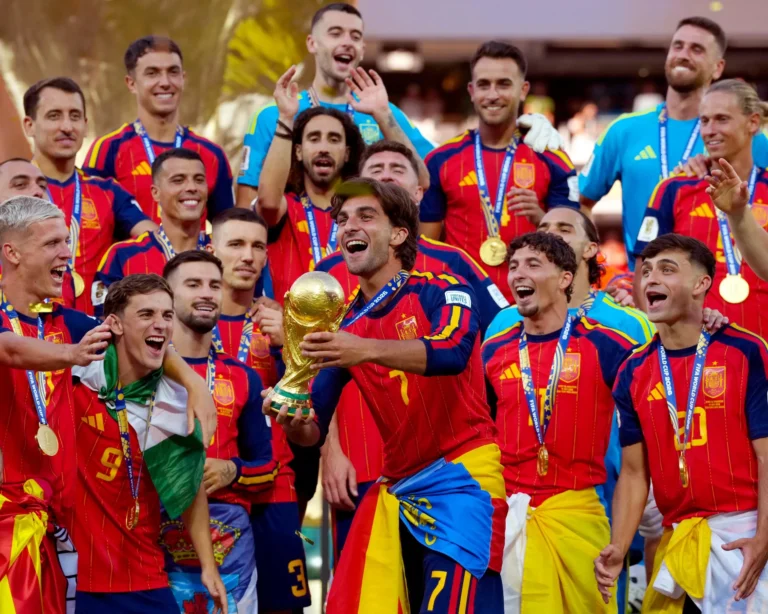
Release the tension, let it flow. Time and again, they had shown up only to be thwarted, yet they refused to back down. Several players attempted to penetrate Emi Martínez’s goal, but he stood resolute as the clock ticked away. Spain, undeterred, pressed on, determined to find a breakthrough.
Then, in what felt like a pivotal moment, Pedro Porro delivered a deep cross that found Nico Williams at the far post. Williams headed the ball back into the Argentina penalty area, where it fell invitingly—waiting for someone to seize the moment.
At precisely 5:42 PM Eastern Daylight Time, 37 seconds into the second period of extra time, Ferran Torres answered the call. With Spain’s 20th shot of the final, he unleashed a powerful strike at 102 km/h that rocketed into the net, clinching the World Cup for his team. He turned and dashed towards the corner flag, celebrating with a volley into the air. His teammates poured in from both the bench and the field, joyfully rushing to him—a moment of complete liberation.
Andrés Iniesta once remarked that when the ball sat perfectly for him in the 116th minute of the 2010 final in South Africa, he could hear the silence. Perhaps Torres experienced a similar sensation; perhaps he felt history beckoning. The crowd at New York New Jersey Stadium erupted in euphoria. Torres stood there, mimicking a gesture of listening for the critics, and received an enormous embrace from Lamine Yamal.
Earlier in Spain’s match against Saudi Arabia, coinciding with Luis de la Fuente’s 65th birthday, Torres had come on as a substitute and seemingly scored the final goal, only to have it disallowed by the video assistant referee. As the replay was reviewed, he stood with his hands clasped in prayer, whispering to himself.
“People have been very unfair with him but he has a spectacular mentality, he keeps going, keeps working, and today life has paid him back,”
This moment encapsulated the immense pressure players endure, and perhaps even a glimpse of desperation. Despite Spain leading 4-0, he still wished for a confirmed goal.
In a previous match against Cape Verde, he struck the crossbar, and he did so again against Uruguay. Critics interpreted these near misses as signs of misfortune, and he often felt that destiny was turning against him. Ultimately, however, fate had reserved something extraordinary for him: the most significant goal of his career, marking a moment of justice not only for the game—where Spain had dominated, while Argentina had yet to register a shot—but also for the team as a whole. As De la Fuente refers to them, they are a family united.
It seemed fitting that Torres would be the one to score, representing the collective spirit of a team that has endured together. He became the seventh different player from Spain to score in the United States. At this World Cup of stars, a team emerged victorious. The European champions stood as the finest team, lifting the trophy after conceding just one goal. This triumph celebrated a system, an ideal, and a dedication to identity. While it may appear inevitable, it was anything but. This victory also served as a testament to the faith their manager has in them, and the belief they share in one another, despite external doubts. Pedro Porro remarked, “This is for all 26 of us.”
As the tournament commenced, captain Rodri was still recovering from injury. Lamine Yamal, the standout player, was also coming back from a setback, and the team initially waited for his return, only to discover they could excel without him. Williams, who provided the assist, had battled injuries throughout the season and feared he would miss out on the World Cup.
Fabián Ruiz had spent a significant portion of the season injured. Aymeric Laporte returned to form, while discussions regarding Unai Simón persisted. Eric García and Martín Zubimendi, who had not played a minute prior, stepped in to contribute to this victory. Who would have predicted Pedro Porro and Marc Cucurella would emerge as the world’s top full-backs before the tournament? Many now hold that belief. Mikel Merino, the ultimate super sub, had seen only 28 minutes of play since March but was instrumental twice in this match.
And when it mattered most, Ferran Torres delivered.
De la Fuente expressed that Spain had been “They are the best players in the world,” by early-game skepticism and a lack of acknowledgment. “They are the best players in the world,” he consistently asserted, and it turned out he was correct. The coach is a man of conviction; he trusts his players, his “family.” Throughout the past month, he exchanged messages with a close friend, Antonio, whom he considers like a son, sharing their mutual belief. “It is written,” the messages stated, and now it has come to fruition.