


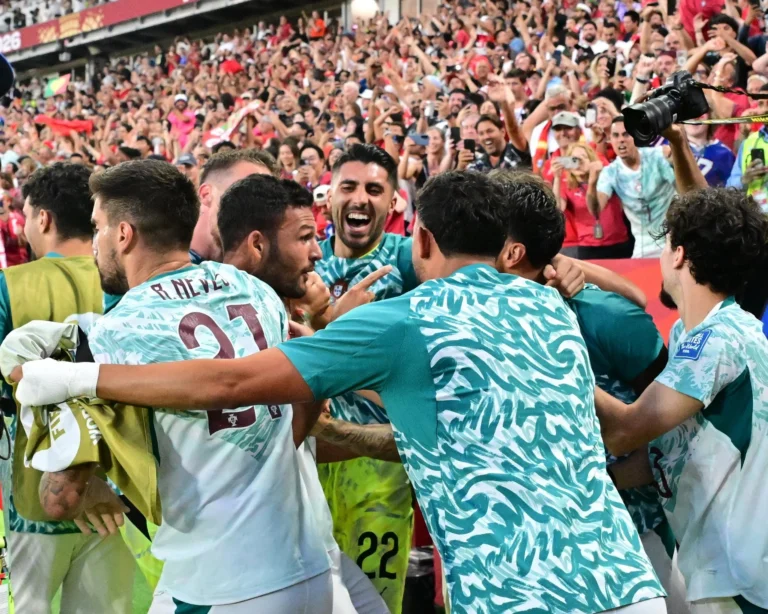
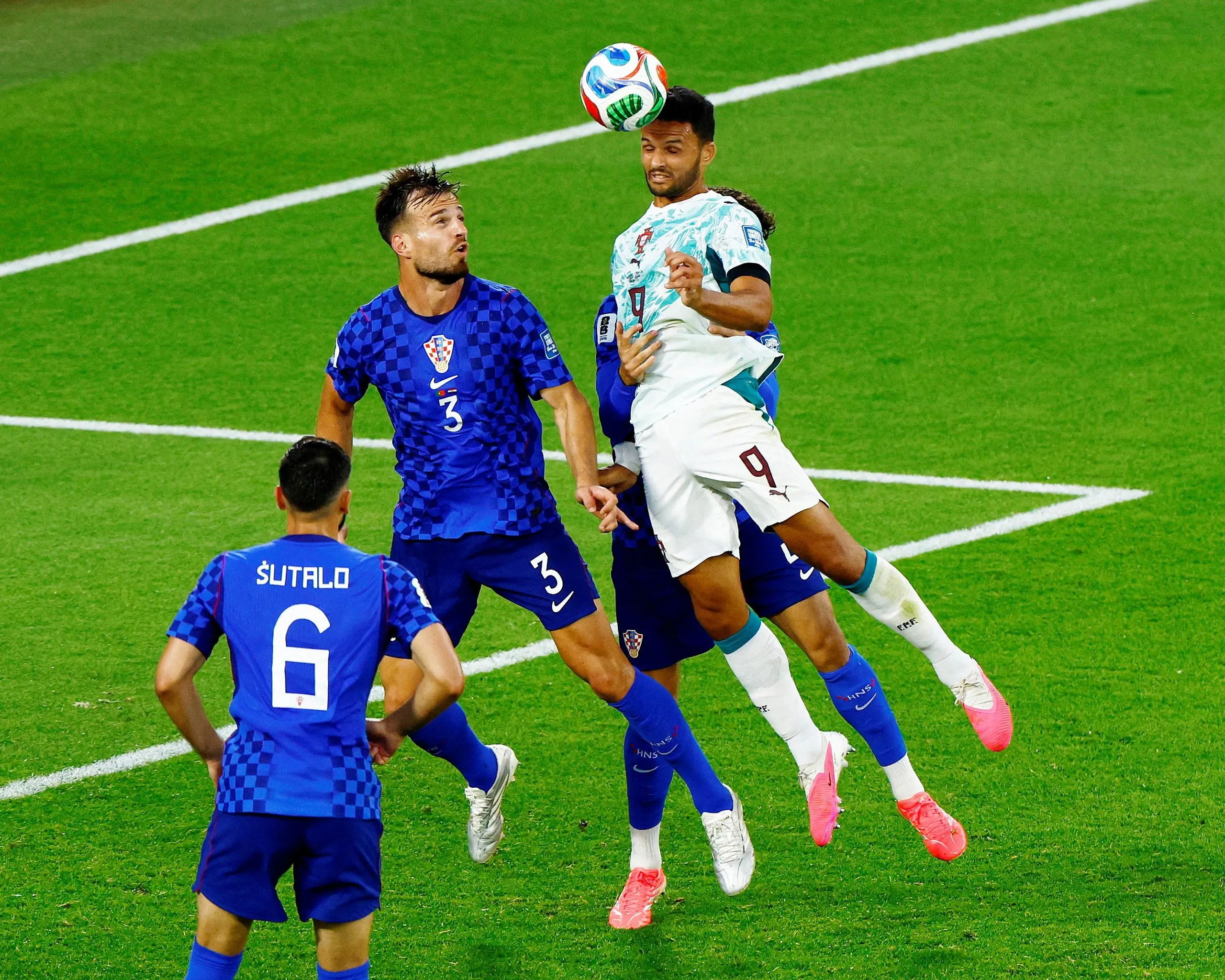
Rafael Leão sank to his knees as his cross was deftly flicked into the net by Gonçalo Ramos, securing Portugal’s progression to the last 16 of the World Cup. However, Leão’s expression was not one of joy, but rather one of relief.
In a match highlighted as a farewell for two football legends, it was Luka Modric, at 40 years old, who departed what is likely his final World Cup. Meanwhile, Cristiano Ronaldo continued his journey, scoring a goal and even being substituted in a game filled with relentless action. Yet, this encounter was not solely about these two stars; they were not the most influential players on the pitch, despite Ronaldo’s bewildering selection as the man of the match. The clash unfolded as a classic World Cup showdown between seasoned teams, with momentum shifting back and forth, accompanied by an extraordinary number of incidents, including four disallowed goals for the first time in World Cup history, one of which denied Croatia a last-second equalizer.
Following a scorching day in Toronto, the evening brought a refreshing coolness, and the atmosphere inside the stadium buzzed with excitement. Portugal largely controlled the first half, where they should have taken the lead before halftime. Their initial opportunity arose just eight minutes in when Leão surged down the left flank and delivered a low cutback to Bruno Fernandes, whose two attempts were thwarted—one saved brilliantly by Dominik Livakovic and the other blocked by an advancing defender.
In that opening period, Pedro Neto emerged as Portugal’s most threatening player. He dominated his duel with Ivan Perisic, who was again positioned as a full-back for Croatia, creating enough space to deliver a series of enticing crosses into the box, all of which, however, went without reward. Livakovic misjudged one of the deliveries and failed to claim it, yet the ball slipped past Ronaldo. Another cross half an hour into the game saw both Ronaldo and Fernandes stretching at the far post, but they were just too late to make contact.
Croatia, despite being on the defensive throughout the first half, managed to remain composed. They withstood Portugal’s incessant attacks, exhibiting resilience in midfield and executing a strategy aimed at isolating Martin Baturina against João Cancelo while aiming to deliver crosses for the formidable Ante Budimir. Although this tactic was not particularly fruitful, it was perhaps hampered by the physical presence of Rúben Dias, who often grappled Budimir to the ground during quieter moments.
At halftime, Zlatko Dalic substituted Budimir for the equally robust Igor Matanovic, which shifted the game’s dynamics immediately. Croatia found themselves on the offensive, while Portugal’s intensity noticeably waned. Just eight minutes into the second half, Croatia took the lead from the same area where Portugal had caused them problems earlier. Josip Stanisic provided the cross from the right, eluding everyone until Perisic emerged at the back post to control the ball and drive it low past Diogo Costa.
Following this, Croatia surged forward momentarily. Petar Sucic located Matanovic in the box, who fired a shot that was perfectly aimed but ruled out for offside. In the 59th minute, Sucic made an attempt himself, cutting into the box from the left and unleashing a powerful shot that Costa saved with his legs.
Amidst these developments, Leão struck a remarkable long-range effort that crashed off the crossbar, while Ronaldo had a goal disallowed for offside, indicating that not all hope was lost for Portugal. Livakovic then made an uncharacteristic error by taking too many touches following a backpass and inadvertently conceding a corner. The corner was delivered and subsequently cleared, but the Portuguese bench erupted in animated calls for a video assistant referee intervention, a plea fervently supported by the crowd.
The VAR review commenced, and the Norwegian referee Espen Eskås was called to the monitor, where he observed Nikola Vlasic wrapping an arm around Veiga during the cross. This was deemed a penalty.
What transpired next was the moment many in the crowd, particularly the Portuguese community in Toronto, had eagerly anticipated. Ronaldo lingered outside the fray until the penalty was confirmed, then made his way to the spot. He prepared himself, went through his familiar rituals, stepped up, sent Livakovic the wrong way, and scored. He raced towards the corner as the stadium erupted, executing his trademark celebration while the crowd echoed his “siuuuuuu!” chant.
With Portugal back in the contest, the overall dynamics had shifted little. Croatia now appeared dominant and had multiple opportunities to score again, especially after the hydration break. Mateo Kovacic had two long-range efforts saved, Matanovic saw a clever near-post attempt thwarted, and Sucic had yet another goal disallowed for offside. Meanwhile, Ronaldo was substituted for Rúben Neves, a decision that may have reflected Roberto Martínez’s assessment of the situation.
This change proved effective. Portugal tightened their defense against counterattacks and began to regain control as the match approached its conclusion. They frequently directed play towards Leão, urging him to deliver a decisive contribution. He ultimately did, and the celebrations following the goal were so prolonged that the referee added three minutes to stoppage time. Croatia managed to score again in the dying moments, but for the fourth time in the match, Josko Gvardiol’s goal was ruled out for offside by VAR. An outpouring of plastic bottles rained down onto the pitch in protest, yet this could not alter the match’s outcome.
- World Cup 2026
- Portugal
- Croatia
- World Cup
- Cristiano Ronaldo
- Video assistant referees (VARs)
- match reports