


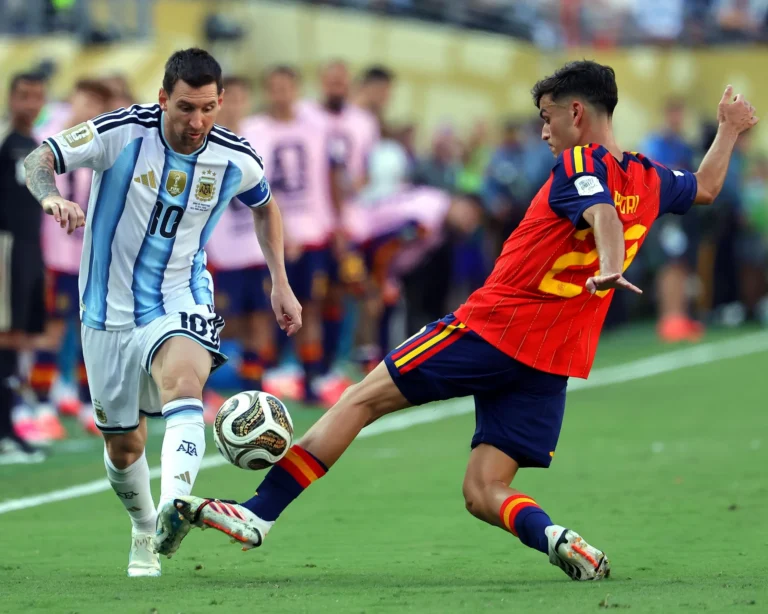
As the lackluster first half came to a close, one couldn’t help but wonder if the half-time entertainment might outshine the match itself. Argentina struggled to keep pace with Spain’s possession-based strategy. However, they had their own methods to level the playing field, employing physicality under Lionel Scaloni’s direction, aiming to disrupt the flow before seizing control in the second half. The Slovenian referee, Slavko Vincic, permitted this approach, allowing Argentina to push the limits. An early foul by Alexis Mac Allister on Dani Olmo could have warranted a booking, but the leniency, paired with a pitch not suited for fluid football, enabled Argentina to interfere with Spain’s passing game, resulting in one of the most tedious World Cup finals.
Spain, however, refused to be baited into a physical contest. The European champions exhibited remarkable composure, capturing their second World Cup title despite Argentina’s incessant attempts to disrupt their rhythm. Argentina struggled to advance, particularly from the back, especially on the left side. Spain’s coordinated pressing stifled their efforts, effectively neutralizing both Enzo Fernández and Mac Allister in midfield. At half-time, Scaloni opted for a change, substituting Nico González, who had struggled on the left wing, for Leandro Paredes to enhance stability. Nonetheless, this adjustment failed to shift the balance of play, as Argentina continued to exhibit cynical tactics. Paredes received a booking for an unnecessary foul on Rodri and was fortunate not to have faced a harsher penalty before the final whistle. The situation worsened for Argentina when Fernández was sent off late in regular time due to two foolish bookings, potentially jeopardizing his prospects for a move to Real Madrid.
Argentina’s aging lineup, having already endured two rounds of extra time, showed signs of fatigue. Their situation was further compounded by injuries to both starting center-backs, Lisandro Martínez and Cristian Romero, who were both crucial in ball distribution. This loss deprived Argentina of vital attacking options, and their overreliance on Lionel Messi became glaringly evident. Spain effectively cut off the supply to the 39-year-old, making it challenging for him to find space or evade more than one defender. Unlike the semi-final against England, where crosses were a significant threat, there was a case to be made that Scaloni should have substituted his captain after Fernández’s red card. Messi stood isolated, unable to hold the ball, while Scaloni removed Julián Álvarez, who might have posed a greater challenge to Spain with his ability to exploit spaces.
The substitution of Álvarez prompted a shift to a back five with the introduction of Marcos Senesi. The statistics underscored Argentina’s struggles; their expected goals (xG) stood at a stark 0.00 until conceding, which led to a desperate late surge. Even then, their threat barely increased to 0.22. It wasn’t until the 117th minute that the defending champions registered their first shot, a long-range effort from Messi that deflected wide. Spain, maintaining their defensive integrity as a unit, remained unfazed. Argentina ended the match with a mere 34.9% possession and only six touches inside the Spanish penalty area. The second half was dominated by Spain, who unleashed 20 shots compared to Argentina’s two. Despite some lackluster finishing and exceptional goalkeeping from Emi Martínez, who made a record 12 saves in a World Cup final—including a remarkable leap to deflect a Lamine Yamal free-kick—Argentina’s efforts ultimately fell short.
From both a tactical and moral standpoint, Spain emerged as deserving victors. They displayed superior footballing skills and demonstrated their big-game mindset by withstanding Argentina’s disruptive strategies. Rodri excelled in his role before being substituted for Martín Zubimendi in extra time, effectively neutralizing Fernández’s influence. Luis de la Fuente’s substitutions proved astute; Pedri injected incisiveness after replacing Fabián Ruiz in midfield. Argentina attempted to stifle Lamine Yamal by deploying Nicolás Tagliafico to contain him on the right, but De la Fuente responded by introducing Nico Williams for Álex Baena on the opposite flank, introducing speed on both wings. This tactical maneuver paid off, leading to a breakthrough. Pedro Porro delivered a deep cross from the right, allowing Williams to outpace Nahuel Molina and set up Ferran Torres, another substitute, to find the net.
- World Cup 2026
- Spain
- Argentina
- World Cup
- features