


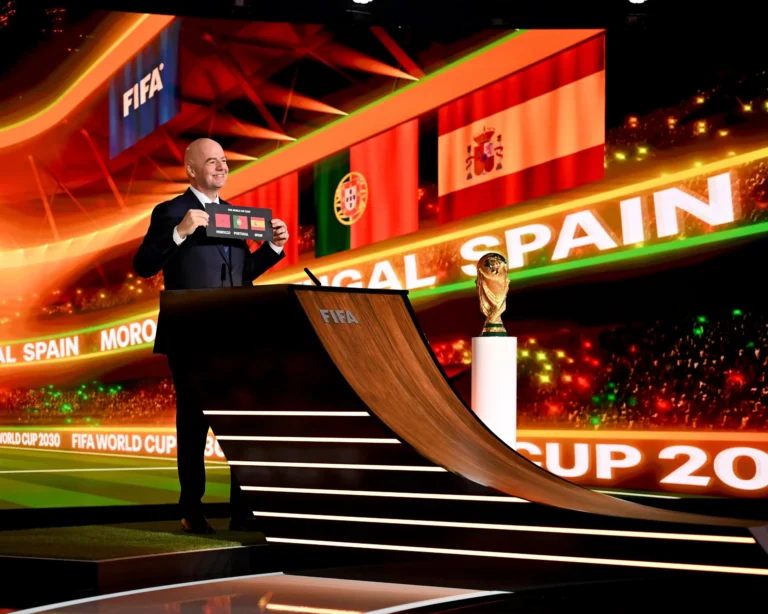
The upcoming 2030 World Cup is poised to set new records, with an expanded format and a remarkable hosting arrangement. Following the monumental 2026 edition, which introduced 48 teams and took place across three nations, the 2030 tournament will further broaden its reach.
Hosting Nations for 2030
The tournament will be shared among three countries: Morocco, Portugal, and Spain. This decision marks a historic moment as it will be the first World Cup held across two confederations, and it will also be the first time the event occurs in North Africa.
In a celebration of the World Cup’s 100-year anniversary, a special match will take place at Estadio Centenario in Montevideo, Uruguay, the venue for the inaugural final in 1930. Additionally, matches are scheduled in Argentina and Paraguay.
Selection Process for Host Countries
The bidding for the 2030 World Cup commenced earnestly in 2022, with the official host selection set for the 2024 FIFA Congress. Due to FIFA’s rotation policy, federations from Asia and North America were disqualified from hosting this edition after Qatar 2022 and North America 2026, respectively.
Spain and Portugal, which previously bid for the 2018 and 2022 tournaments without success, joined forces with Morocco in 2023. Concurrently, Conmebol countries Uruguay, Argentina, Paraguay, and Chile proposed a joint bid, branding it the “in the most appropriate way”.
In October 2023, FIFA’s council unanimously chose the Morocco-Portugal-Spain bid over the South American proposal.
South America’s Involvement in Matches
FIFA President Gianni Infantino announced that Uruguay, Argentina, and Paraguay will each host one match as a tribute to the World Cup’s centenary. Infantino stated this is the “a unique centenary celebration ceremony” to acknowledge the tournament’s roots in Uruguay, which hosted and won the first edition against Argentina.
A unique centenary celebration ceremony is slated for Montevideo the week preceding the tournament, which begins on June 13, 2030.
Potential Team Expansion
Initially, the plan was to maintain the tournament format with 48 teams; however, during the recent World Cup, Infantino hinted at the possibility of expanding to include an additional 16 teams.
“That’s definitely an issue that will be examined and discussed in the relevant committees after this World Cup,” Infantino remarked. He emphasized the importance of organizing the World Cup for all nations globally, not just Europe and South America.
In 2025, Conmebol President Alejandro Domínguez proposed increasing the number of participating teams to 64 to honor the centennial. He noted, “When organising a World Cup, it’s important to organise it for the whole world – not just Europe and South America – but effectively the entire world. An expansion had already been suggested in 2025 when the Conmebol president, Alejandro Domínguez, put forth an official proposal to expand the number of participating teams to 64 in honour of the tournament’s centennial. “[It] will be unique because 100 years are celebrated only once,”
Overview of the Event
Spain last hosted the World Cup in 1982, when Italy triumphed over West Germany in the final held at the Bernabéu. Co-hosts Portugal and Morocco have previously organized significant sporting events, including the 2004 UEFA European Championship and the 2025 Africa Cup of Nations.
The 2030 World Cup will unfold across 17 host cities, exceeding the 2026 edition’s total. Of the 20 proposed stadiums, 11 are located in Spain, with cities like Marrakech and Tangier in Morocco, Porto and Lisbon in Portugal, and Barcelona, Madrid, and San Sebastián in Spain all included.
Key Discussions Surrounding the Tournament
A major point of interest has been the decision to include matches in South America despite the rejection of their host bid. By allowing Uruguay, Argentina, and Paraguay to each host a match, FIFA effectively rendered Conmebol ineligible to bid for the 2034 World Cup, which has been awarded to Saudi Arabia amid significant criticism from human rights advocates.
Looking Ahead
With the tournament just a few years away, the landscape continues to evolve. Speculation abounds regarding potential surprises, including unexpected interventions from figures like Spanish King Felipe VI amidst the ongoing excitement of global football. With so many variables in play, the journey to the 2030 World Cup promises to be anything but predictable.