


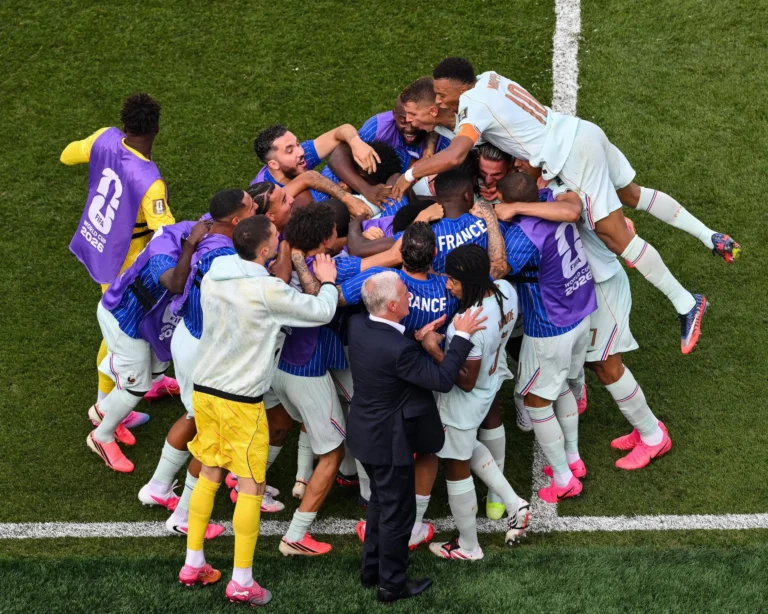
The scorelines may have been identical, but the difference in style between France’s two World Cup knockout matches against Morocco was striking.
Over the course of a single tournament cycle, Didier Deschamps has adopted a markedly different approach, embracing a more fluid attacking strategy. The synergy between Kylian Mbappé and Ousmane Dembélé propelled the team into this year’s semi-finals, once again proving the efficacy of the 57-year-old coach’s tactical evolution.
In 2022, Deschamps employed a pragmatic setup that effectively neutralized Morocco’s attacks during a tightly contested semi-final in Qatar. France secured victory by converting two of their three shots on target, while successfully stifling that year’s surprise team.
Fast forward three and a half years to the semi-final in Boston, and France had already recorded four times as many shots on goal by half-time compared to their entire match against Morocco in 2022. This time, it was France experiencing the frustration.
France’s high pressing strategy, a significant stylistic departure from previous teams, kept Morocco largely on the defensive throughout the first half. With Ismael Saibari absent, Morocco struggled to mount any significant offensive response, offering little respite from the French onslaught.
Concerns arose that France’s commanding win over Paraguay just five days earlier might have disrupted their offensive rhythm, as the team had been averaging over three goals per game until that point. A robust Paraguay defense had stifled their creativity, leaving a lingering sense that the aggressive South American side, supported by questionable officiating, had set a precedent for frustrating Les Bleus.
The memories of that match were still fresh, particularly in light of the racial abuse and verbal attacks directed at Mbappé by Paraguayan senator Celeste Amarilla.
As the match approached, Deschamps asserted, “Morocco will be our opponent, not the referee,” While Les Bleus benefited from fairer officiating and faced a less confrontational opponent this time, Morocco’s defense proved to be a formidable challenge.
As the first half progressed, a familiar sense of exasperation settled in, with Morocco’s goalkeeper Yassine Bounou thwarting attempts from Désiré Doué and other forwards who struggled to find their rhythm. A three-minute delay before Mbappé’s ill-fated penalty only heightened the frustration for France.
Unlike Paraguay’s defense, which allowed minimal space, Morocco adopted a more aggressive stance. Mbappé capitalized on a gap behind his former teammate Achraf Hakimi, leading to the penalty, before scoring the opening goal on the hour mark after creating space for himself on the edge of the box.
Similar to their match against Sweden, Mbappé’s sudden strike broke the deadlock after a relatively inefficient performance in front of goal. Dembélé’s subsequent goal seemed to signal a potential flood of scoring, yet an ankle injury forced Mbappé to leave the match early and disrupted France’s offensive flow.
Despite having less possession than their opponents by the end of the match, as in their last encounter, the momentum appeared firmly in France’s favor. Manu Koné’s dynamic midfield display likely secured him one of the few remaining starting spots up for debate, alleviating concerns about Aurélien Tchouaméni’s fitness issues.
France’s defense had rarely faced serious challenges in the previous three hours of play. This situation benefits Les Bleus, particularly given William Saliba’s ongoing back issues; however, it places them in unfamiliar territory as they advance to the semi-finals. Either Spain or Belgium’s attack promises to be more potent and unforgiving than any they have faced thus far.
Throughout the match, Morocco found themselves consistently pressured as France dominated the best team they had encountered in the tournament. Despite their struggles to score, Les Bleus rarely felt threatened. “We felt that they weren’t dangerous in the moments when we left them the ball,” Adrien Rabiot shared with French broadcaster M6. “We felt as though we didn’t have to fear them.”
Not for the first time in this World Cup, France’s attack took numerous chances before finally finding the net. Despite the impressive interplay among Mbappé, Dembélé, and Michael Olise, there remains a sense that their abundance of opportunities has obscured their inconsistent finishing.
In the pre-match press conference, Deschamps acknowledged the need for improvement in their finishing. “The better the quality of the opponent, the more clinical you have to be,” he emphasized. As Les Bleus prepare to depart the East Coast for their semi-final in Dallas, they seem poised to step outside the comfort zone they have cultivated on and off the pitch.
For now, they are ready to confront any challenge that comes their way.
- World Cup 2026
- World Cup
- France
- Morocco football team
- analysis