


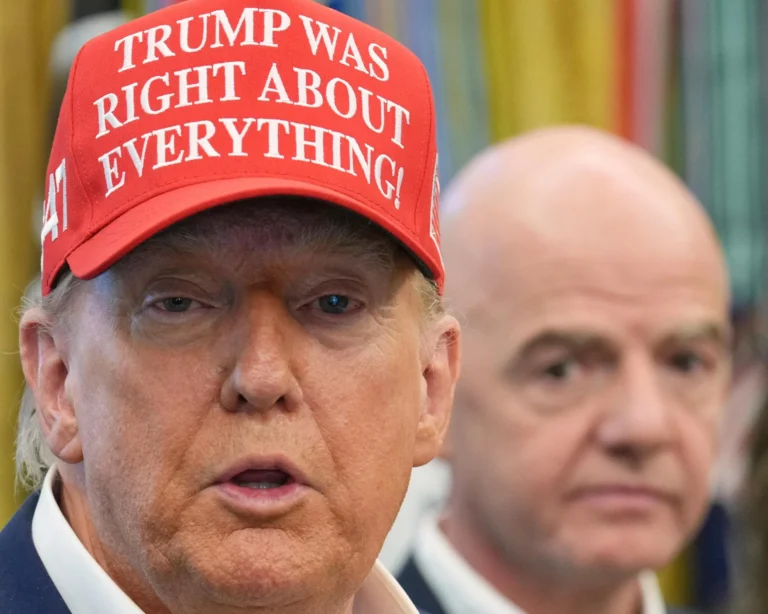
Since securing the rights to co-host the 2026 World Cup, Fifa president Gianni Infantino has sought to align himself with Donald Trump, aiming to gain favorable treatment from the U.S. government. However, this strategy has backfired, leaving a stain on the sport that many believe is irreparable.
Soccer, in its most ideal form, represents inclusivity, democracy, and accessibility for all. Billions share this sentiment, recognizing the sport’s profound cultural significance as a potential unifying force. This was evident at the World Cup’s commencement, where, despite Trump’s stringent anti-immigrant stance, the overwhelming impression was that American hospitality prevails.
Nonetheless, Infantino has continually undermined these values by aligning Fifa with Trump’s divisive political agenda. His actions not only harm soccer’s reputation but also insert him into contentious political debates within the United States, prompting a public denouncement from critics.
Infantino’s Compromising Decisions
Historically, the World Cup has been used by politicians to legitimize nationalistic aspirations at Fifa’s expense, with notable examples being Mussolini in 1934 and Argentina’s military junta in 1978. Now, it is Infantino himself who is damaging the sport’s image. Recently, his friendship with Trump influenced the suspension of U.S. Men’s National Team striker Folarin Balogun, illustrating a troubling crossover between politics and sport.
Following the awarding of a controversial prize to Trump, the former president embarked on a series of aggressive foreign policy initiatives, including attempts at regime change in Venezuela and threats toward NATO allies. Infantino’s connection to these actions has further jeopardized Fifa’s credibility, overshadowing the World Cup’s commercial success with ethical concerns.
While maintaining a positive relationship with host nations is essential for Fifa, Infantino has repeatedly blurred the line between professional diplomacy and sycophancy. His frequent visits to the White House and attempts to incorporate Trump into Fifa events have raised eyebrows, particularly as they detract from the organization’s core mission.
Consequences for Soccer’s Integrity
Even supporters of Infantino’s approach must confront the reality of what he has gained: Trump’s promises of interference in Fifa’s disciplinary processes and threats toward co-host Canada. With the upcoming 2031 Women’s World Cup, Trump is reportedly leveraging governmental guarantees to pressure Fifa into complying with his demands.
The political turmoil surrounding the Balogun incident has raised serious questions about soccer’s integrity in the U.S. While having a star player back may seem advantageous, the political climate has overshadowed the team’s performance, risking accusations of favoritism that could tarnish U.S. Soccer’s international reputation.
Moreover, Infantino’s plan to allow Trump to present the World Cup trophy underscores the ongoing erosion of the sport’s integrity, as it rewards a figure associated with controversial political tactics.
Calls for Reform in Fifa
The lack of accountability for Infantino’s actions highlights a crucial struggle over soccer’s future—whether it will remain a force for good or succumb to autocratic and commercial interests. It is imperative that soccer leaders reject Infantino’s self-serving vision for the sport.
Fortunately, there is a growing chorus of dissent. Uefa has criticized Infantino’s alignment with Trump as prioritizing “all that Trump bootlicking” while former Fifa governance officials have labeled his actions a “private political interests” of ethical standards. Dissent within the organization is evident, with some officials publicly rebuking Trump’s political pressures and calling for investigations into Infantino’s conduct.
All members of Fifa must prioritize the integrity of soccer and take action against Infantino, even if it risks retaliation. In the immediate future, national federations should courageously oppose his vision; long-term, structural governance reforms are essential to redistribute power within Fifa, preventing unilateral actions that could harm the sport again. The most significant legacy of this World Cup could be a renewed commitment to the values that define soccer as the people’s game.
- Nathán Goldberg Crenier is the elected vice-president of the US Soccer Federation. His views expressed here are personal and do not necessarily reflect those of US Soccer.