


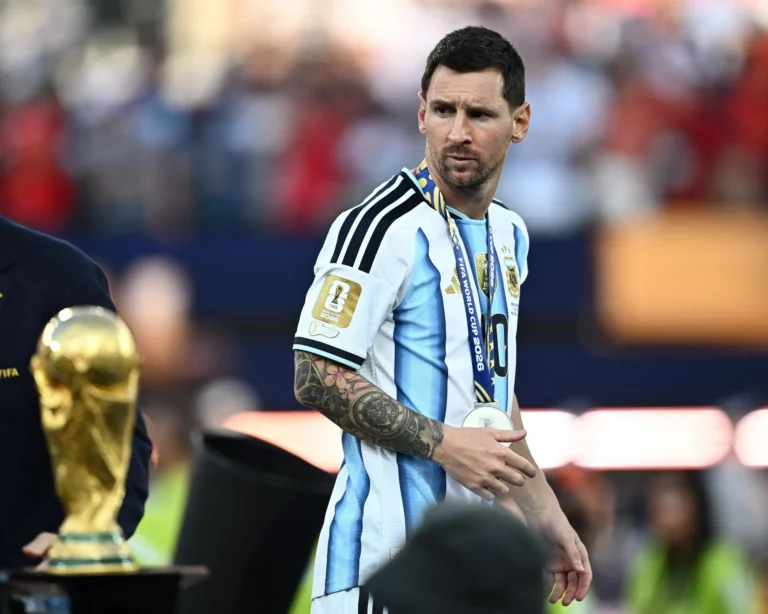
As Lionel Messi took the field for what could be his final World Cup match, many anticipated a spectacular display to cap off his illustrious career. However, as the sun set behind the stands at New York New Jersey Stadium on Sunday, it became increasingly evident that Argentina had lost the spark that had defined their tournament run. Spain seized control, leading to a 1-0 defeat that marked the end of Messi’s World Cup aspirations.
This match starkly contrasted with Argentina’s previous performances throughout the tournament. La Albiceleste had been captivating, not just in the way they scored but in the dramatic timing of their goals. They had faced elimination against weaker teams, which only seemed to strengthen their resolve.
World Cup finals often lack excitement, but this particular match was especially lackluster. Spain, initially defensive, gradually found their rhythm in the second half and eventually scored in extra time. Argentina, on the other hand, made history by being the first team in nearly a century of World Cup finals to not register a single shot during regular time. Even after an additional thirty minutes, they never posed a serious threat.
Before this final, Messi had offered fans a rare chance to witness his brilliance with little pressure. At 39, his legacy is already secure, adorned with numerous titles at both the club and international levels. This loss does not tarnish his reputation; rather, a victory would have further solidified his claim as the greatest player ever. For some Argentinians, the triumph over England in the semi-finals might hold almost as much significance as winning the final.
However, it must be noted that Messi was largely absent during this match, a stark difference from his previous performances. Much of this can be attributed to Spain’s exemplary defensive strategy, which effectively neutralized his influence. Spain outperformed Argentina across the board, and by the end of the match, the Argentinians had devolved into the unruly and desperate team that critics had previously labeled them.
Time usually bends to Messi’s will, allowing him to evade defenders with ease. His performance at this age often evokes memories of his prime, as if he has managed to halt time itself. Yet, the undeniable truth remains: Messi’s World Cup journey has reached its conclusion. This sentiment echoes back to 2022 when he led Argentina to their first World Cup in nearly forty years, as well as to 2016, when he briefly retired from international play following a Copa América defeat. Discussions back then suggested he could never replicate his Barcelona form with the national team, a notion that seems laughable a decade later.
It remains to be seen how Argentina’s disappointing performance will be judged back home, where expectations were sky-high. Both head coach Lionel Scaloni and Messi had expressed their pride in their achievements prior to the final, suggesting that this outcome would not diminish their overall success.
Before taking the field, they had a chance to solidify their legacies. Scaloni, already regarded as one of Argentina’s greatest coaches after securing a World Cup and two Copa América titles, faced a missed opportunity with this performance. The duality of his legacy is clear: he is undeniably remarkable, yet this match stands as one of his poorest outcomes.
Ultimately, the overwhelming feeling is one of disappointment following a lackluster final that robbed Argentina and Messi of a chance to conclude their story on a high note. Instead, they transformed from heroes into villains, unnecessarily so.
- World Cup 2026
- Argentina
- Spain
- World Cup
- Lionel Messi
- analysis