


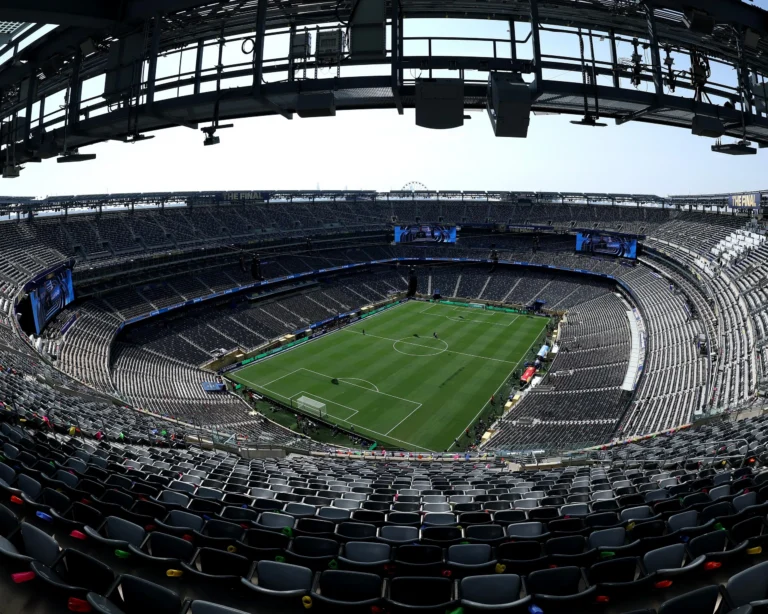
The recent heavy smoke blanketing New York and much of the eastern seaboard has sparked a mix of amusement and schadenfreude in Dallas and Los Angeles. Locals from these cities will tune in with a sense of irony as the World Cup final unfolds at the New York-New Jersey Stadium, commonly known as MetLife Stadium, this Sunday.
Having been overlooked when FIFA designated the final in February 2024, the stadiums in Dallas and Los Angeles are superior venues that lack the climatic vulnerabilities of New York, selected for its international allure and convenient time zone for European viewers.
World Cup Journey of the Finalists
- Group J: Algeria 3-0, Austria 2-0, Jordan 3-1
- Last 32: Cape Verde 3-2 (AET)
- Last 16: Egypt 3-2
- Quarter-final: Switzerland 3-1 (AET)
- Semi-final: England 2-1
- Group H: Cape Verde 0-0, Saudi Arabia 4-0, Uruguay 1-0
- Last 32: Austria 3-0
- Last 16: Portugal 1-0
- Quarter-final: Belgium 2-1
- Semi-final: France 2-0
Follow our news blog for updates and images showcasing the vibrant atmosphere in New York City.
David Wall raises a pertinent question for UK viewers: “One of the big questions for those of us in the UK is how to watch the final,” He critiques ITV’s coverage, noting that despite its New York studio and notable pundits, it has not exceeded expectations. “For all that has been made about ITV’s coverage with their New York studio and one of two excellent pundits, I think their coverage has been less than the sum of its parts, as usual. They’ve not had people other than the commentators in the stadiums so all that studio showed was that it was quite windy in New York sometimes. “We’ve not even seen them out and about seeing what the fan culture was like on the ground in the city. And the pundits have been hampered by adverts and over-use of VTs as always. What is the point of hiring Emma Hayes and Gary Neville if you barely give them any time to discuss tactics? “One of the most interesting bits of coverage I saw through the whole tournament was at half-time in the Netherlands v Sweden game when Thomas Frank, Ellen White and Micah Richards spent the full break dissecting and discussing the fluctuating 45 minutes that we’d all watched. It didn’t matter that they were in a studio in Salford. “Plus, the BBC have Joe Hart who is turning out to be an increasingly interesting pundit (albeit I wouldn’t want to watch a match with him, from the clips they’ve shown of him pacing around and shouting he must be the most irritating of watchers). So I’ll be tuned to the Beeb tonight (as well as following the MBM of course).” he remarked.
He expressed disappointment that ITV has not highlighted the local fan culture, stating, “Do you remember Roger Milla/Saeed Al-Owairan/Keisuke Honda/Paul the Octopus?”
Wall cited a memorable moment during the tournament.
“They grew up in environments where they were afraid of nothing, in which they’ve always been the best at what they do,”
He also praised the BBC’s coverage, particularly Joe Hart’s evolving role as a pundit, despite noting, “As small children they competed and everyone expected so much of them; responsibility doesn’t weigh them down.” He concluded, “I’ll be tuning into the Beeb tonight, along with following the MBM, of course.”
Significance of the Final
As the tournament nears its conclusion, viewers can anticipate no more hydration breaks or obligatory shots of Hollywood celebrities. The FIFA World Cup 2026 is drawing to a close, culminating in a month filled with dramatic and significant moments both on and off the field.
Before the match kicks off between Spain and Argentina this Sunday evening, it is clear that the competition is more than just a game; it stands as a geopolitically significant economic phenomenon.
After a month of matches, billions of dollars have been poured into this extravaganza of consumerism, propelled by advertising, ticket sales, merchandise, and hospitality. FIFA projects that the tournament will contribute approximately $40.9 billion (£30.4 billion) to global GDP, with the U.S. leading the charge ahead of Canada and Mexico.
Spain and Argentina are both generating significant momentum in the world of football. Spain embodies a dominant football culture that extends its influence worldwide, while Argentina brings a unique identity that resonates throughout South America. This World Cup final represents an ideal clash between the two footballing giants.
Johan Cruyff laid the groundwork for Spain’s vision, introducing the 4-3-3 formation and a distinctive ideology to Barcelona. Tactical minds like Pep Guardiola and Unai Emery have refined this approach into a philosophy that has shaped the playing style across the league, youth squads, and the national team for nearly two decades.
The tenets of this style encompass ball-oriented defending, clearly defined roles, high organization, and technical, combination-oriented football. The players function as a cohesive unit, moving fluidly as one.
Cult Heroes of the Tournament
Every World Cup births cult heroes—icons that evoke nostalgic memories. The Geopolitics World Cup has not disappointed, showcasing ten cult heroes that have emerged from this tournament.
Following his crucial goal that secured Argentina’s place in the final, Lautaro Martínez was visibly emotional during a touchline interview. He shared memories of the first pair of shoes his father bought him and how his mother continued to make his bed every day when he moved to a boarding house as a teenager. “That mattered more to me than any goal or any cup,” Martínez expressed.
Argentina’s coach, Lionel Scaloni, reflected on the match against England, stating he felt a bit anxious after England took the lead but never lost faith in his players. “They have grown up in environments where they fear nothing, where they’ve always excelled. As children, they competed under immense expectations; this responsibility does not weigh them down,” he noted.
During the 37 minutes after England took the lead against Argentina, the team only had 12% possession. In the upcoming final, Spain will likely present a different challenge. Unlike England, they do not panic when leading. The finalists have averaged 64% possession throughout the tournament, showcasing their methodical style.
Spain has a distinct style, established since Vicente del Bosque took over as manager in 2008. This offers a glimmer of hope for England, as Spain once struggled in major tournaments until Luis Aragonés ignited a transformation, leading to three European Championships and a World Cup in the last two decades, with another title potentially on the line this Sunday.
While Spain’s emphasis on ball retention can sometimes seem predictable, no system is flawless. Luis de la Fuente has revitalized the juego de posición model. Observing a contrasting style, as seen in Atlanta on Wednesday with a team incapable of maintaining possession, underscores the value of ball retention.
Final Preparations and Expectations
Team news indicates little change for Spain following their convincing semi-final victory over France. Lamine Yamal and Pedro Porro missed training as a precaution but are expected to be fit for the final.
Argentina displayed a stronger performance against England after Rodrigo De Paul and Nicolas Gonzalez entered the match. It would not be surprising if De Paul starts in place of Giuliano Simeone.
The anticipation surrounding a World Cup meeting between Spain and Argentina has been building for sixty years, making this encounter even more thrilling.
It is surprising that it took this long for the champions of Europe and South America to meet in a World Cup final, as well as for tactics expert Donald Trump to attend a match at the 2026 World Cup, all occurring for the first time today.
This is the inaugural World Cup final featuring the champions of Europe and South America. The fact that Argentina holds the title adds to the excitement, especially as they appear determined to maintain their championship, akin to Tony Montana’s relentless pursuit of life. They are on the verge of becoming the first team to retain the men’s World Cup since Brazil in 1962.
Four years ago, Lionel Messi was 35 and had never scored in a World Cup knockout game. Any doubts about his status as a football legend have evaporated. Messi’s remarkable performance against England on Wednesday was just the latest in a series of extraordinary displays.
Interestingly, Messi faces an old acquaintance today. The image of him holding a six-month-old Lamine Yamal is iconic, and it’s remarkable that they will now compete in a World Cup final. While Yamal hasn’t dominated the tournament like Messi, it reflects the differing identities of their respective teams.
Spain exemplifies teamwork in the era of individual stars, much like the European club champions Paris Saint-Germain emphasized. In contrast, Argentina operates as a hybrid model, where the ten players support an ageless genius who has redefined the notion of walking football. The success of both styles illustrates that there is more than one path to create a golden era.
Many observers were surprised by Spain’s resurgence. They left little impact on major tournaments from 2014 to 2022, and even at Euro 2020, they only won two out of six matches despite being one of the best teams. However, Luis de la Fuente has assembled an exhilarating team that offers a refreshing antidote to many of football’s challenges.
Their triumph at Euro 2024, where they defeated the holders Italy, hosts Germany, and pre-tournament favorites France and England, stands out as one of the most remarkable European Championship victories. Although they hadn’t quite reached those heights in America until their semi-final lesson against France.
Spain has faced tougher opponents leading to the final, while Argentina has navigated close calls. Both teams have earned the right to feel invincible—Spain remains unbeaten in 37 matches, while Argentina has secured 14 consecutive wins and triumphed in 31 of their last 37 outings.
The anguish of losing a World Cup final brings a complex emotional struggle for the defeated team.
Kickoff is set for 3 PM EST / 8 PM BST / 5 AM AEST.
* For clarification, Uruguay, not Brazil, was the South American champion in 1970. Brazil withdrew from the 1967 South American Championship, but that’s a different story altogether.