



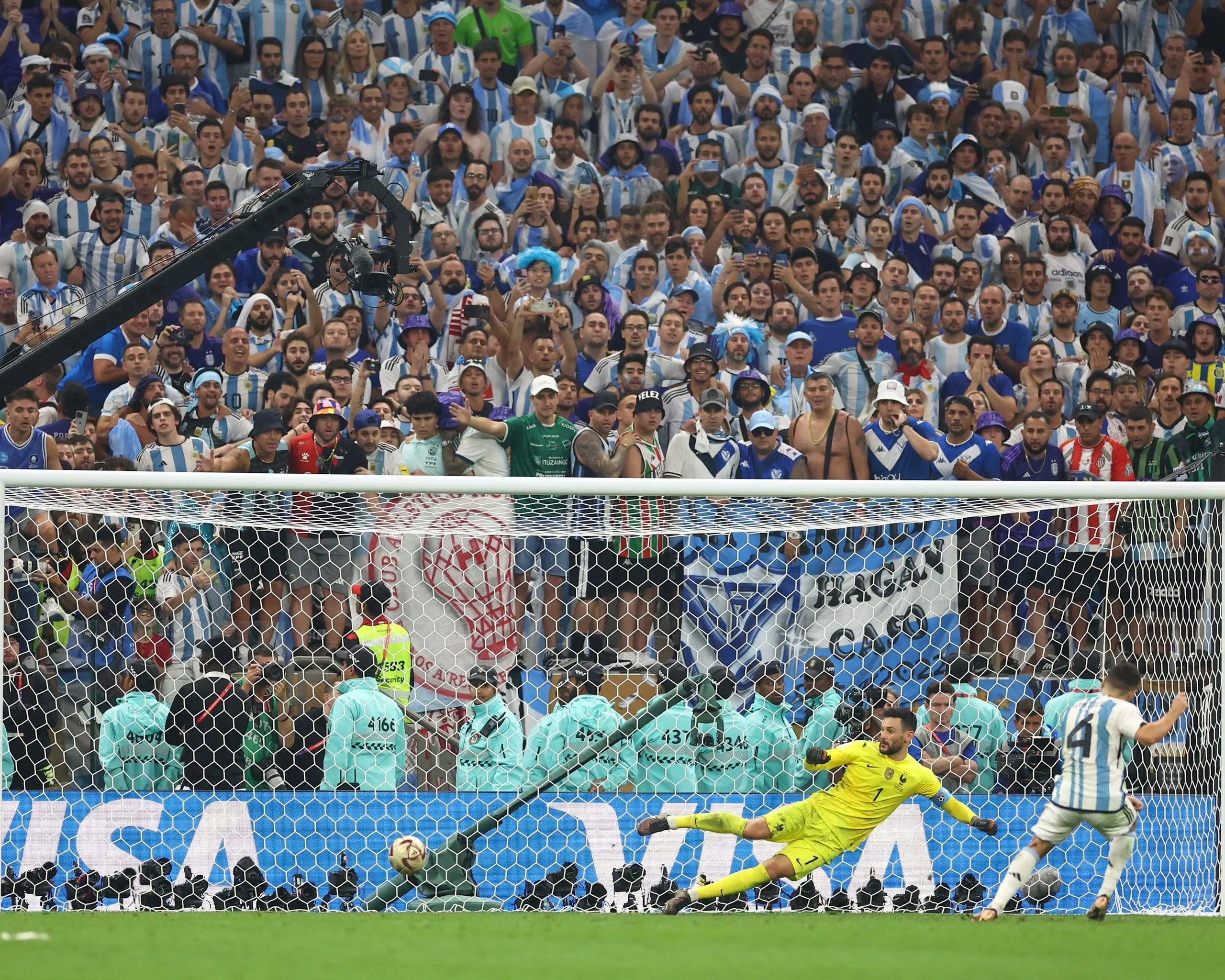
The thrilling climax of the 2022 World Cup final resulted in a nail-biting penalty shootout, with Argentina and France finishing regulation time tied at three goals apiece. Argentina emerged victorious in the shootout, securing the championship with a decisive 4-2 win.
In the context of the World Cup, a single penalty can significantly influence the outcome of a match, highlighting the importance of a well-planned penalty strategy. What can we learn from statistical analyses regarding the most effective methods for executing penalty kicks?
Winning the Toss: A Crucial Edge
Securing the coin toss prior to a shootout can provide a team with a significant advantage. Research examining shootouts from major tournaments, including the World Cup and the European Championship, indicates that teams taking the first penalty enjoy a success rate of 60.5%. More recent studies, analyzing matches following the 2003 rule change that allowed the toss winner to dictate their kicking order, suggest that merely winning the toss can be more beneficial than kicking first. Approximately 60% of teams that won the toss ultimately triumphed in the shootout, contrasting with a 51% win rate for those who shot first.
The Impact of a Proper Run-Up
A comprehensive study analyzing over 1,700 penalties from four seasons (2015-16 to 2018-19) was published in 2020 in the International Journal of Performance Analysis in Sport. Lead author Mikael Jamil and his team investigated various techniques and factors affecting penalty success across elite leagues in England, Spain, Germany, and Italy.
One notable discovery was that successful penalty techniques vary by country. For example, shots aimed straight down the middle were statistically more successful in the Premier League, while La Liga players found the lower left and right corners to be more effective targets.
Across all four leagues, a longer run-up (more than six steps) was linked to higher success rates for penalties. A medium run-up (two to five steps) also showed effectiveness in all leagues except Italy, whereas shorter run-ups did not confer any significant advantage.
Power vs. Placement
Research conducted in 2002, despite its limited sample size, indicated that penalties struck with less power are more likely to be saved, while overly powerful shots often miss the target. The ideal power level appears to be around 75% of maximum for optimal success rates.
In Jamil’s 2020 analysis, penalties were classified based on technique—those struck with the inside of the foot were considered placed, while instep shots were categorized as powerful. Both techniques correlated with successful penalties in Spain, Italy, and Germany, but in England, only placement had a significant link to success.
Moreover, different leagues display distinct tendencies, with placement being favored in the Premier League and Serie A, while La Liga and the Bundesliga show a preference for powerful shots. Panenka-style attempts were not particularly effective across any of the leagues.
Effective Shot Positioning
Multiple studies have explored the target area chosen by penalty takers to identify effective strategies. Researchers devised a grid of the goal to determine where shots were aimed and whether they resulted in saves, misses, or goals.
Findings from a 2016 study by Carlos Almeida and colleagues affirmed a common understanding among players and fans: there is a trade-off between risk and reward associated with shot placement.
In general, shots directed at the upper part of the goal are significantly more challenging to save but carry a greater risk of missing the target. Although higher shots pose a greater challenge for goalkeepers, players tend to prefer lower shots. This trend was evident in the shootouts at the 2022 World Cup, where few attempts targeted the upper regions of the goal.
While Almeida’s research did not specifically address this, other studies suggest that shooting down the center can be a viable strategy, although results may differ by league. A 2009 study of 311 penalties from various men’s professional leagues worldwide found that shots aimed straight down the middle were less likely to be saved compared to those directed at the corners. Premier League statistics from Opta reveal that low left shots have a success rate of 77.2%, while low right shots achieve an 80% success rate. Conversely, high shots aimed down the center boast an impressive 97.8% success rate, with low center shots at 80.2%.
Jamil’s 2020 research further examined shot placement, noting that successful penalties in the Premier League were often associated with shots directed towards the middle of the goal, with bottom corner targets also proving effective in other leagues.
Understanding Goalkeeper Reactions
Several studies have delved into goalkeeper movements during penalty kicks. Given the rapid nature of penalty shots, goalkeepers often lack the time to react appropriately to the shot’s direction. Instead, they tend to rely on guessing where to dive based on the kicker’s body language and previous penalty history.
Interestingly, data reveals that goalkeepers predominantly dive left or right, despite 20% to 30% of shots targeting the center. Many researchers posit that goalkeepers exhibit a bias towards action, preferring to dive rather than remain stationary as a ball potentially rolls into the corner of the net. However, exceptions exist, such as Andrew “The Grey Wiggle” Redmayne, who successfully anticipated a Panenka shot from Brendon Santalab in the 2019 A-League Men final, and Édouard Mendy, who predicted a similar move from Brahim Díaz in January’s Africa Cup of Nations final.
The Value of Unpredictability
Despite evidence indicating that goalkeepers rarely remain centered, a strategic layer to penalties exists that incorporates game theory. Goalkeepers often analyze the shooting tendencies of their opponents. If players consistently direct their shots toward the center, goalkeepers will adapt accordingly. This leads researchers to argue that maintaining unpredictability is a vital strategy for penalty takers, encouraging them to diversify their approaches to spot kicks consistently.
- This article has been updated from its original version published in 2023.
- World Cup
- The Crunch
- World Cup 2022
- World Cup 2026
- Football tactics
- features