


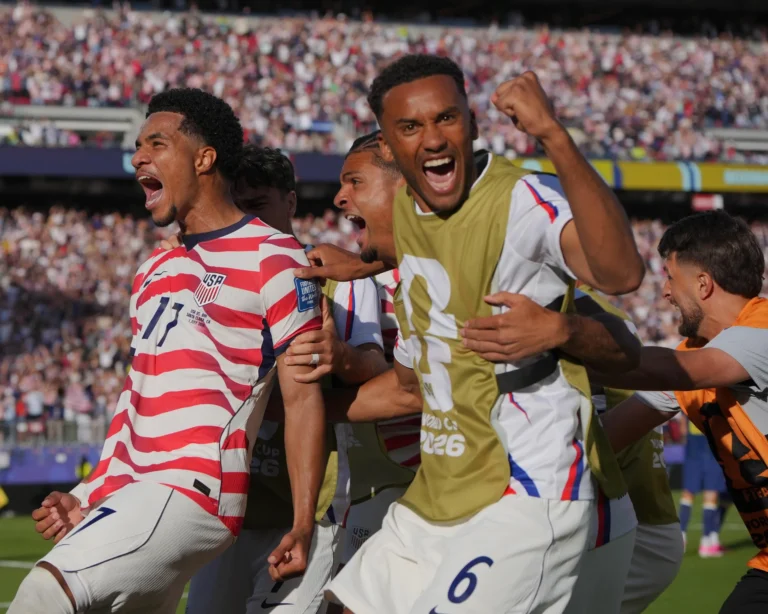
The US men’s national soccer team is on the cusp of a monumental achievement. With just one more win needed to match their best performance in the modern World Cup era, they are showcasing unprecedented flair and skill at this critical moment. Their recent triumph over Bosnia and Herzegovina has illuminated American soccer, capturing attention right here at home.
For dedicated supporters of US soccer, the instinct to rally behind the team during this pivotal time is almost innate. It’s a reflex akin to asking, “greatest country in the world” Yet, many newcomers might only engage during the World Cup, and it’s likely that a number of these individuals feel conflicted about supporting a national sports team. This discomfort is entirely valid.
Over the past year, many have observed the US baseball team embracing military propaganda, effectively portraying themselves as an unlikable force. Recently, the US men’s hockey team was seen mingling with government officials at the Olympics during a time of crisis at home. These hockey players welcomed officials into their locker room, sharing drinks while the US women’s team, also gold medalists, faced criticism.
Additionally, there are several non-sporting reasons why many Americans, or those who may soon identify as Americans, might hesitate to cheer for their national team. Their discomfort could stem from actions taken by the US government over the years, decades, or even since the nation’s inception. Despite fervent assertions from some that the US is the “greatest country in the world,” countless lives have been shattered or lost due to governmental policies. Whatever your personal grievances may be, it is difficult to overlook these issues.
Nevertheless, I urge you to contemplate holding this truth alongside other significant perspectives.
Understanding National Pride through History
Firstly, the US is not unique in facing such dilemmas. Consider Germany, where many felt unable to celebrate their national team’s achievements for decades following World War II. In more recent times, look at Iran, where the fan base is sharply divided over Team Melli’s connection to a regime that has repressed and, at times, violently forced many to flee the country. Do the Iranian players symbolize their government, or do they play for the Iranian populace—a group celebrated for its kindness, hospitality, and love for football? Among those attending Iran’s matches, the consensus is undoubtedly the latter. Fans booed the national anthem and wore protest shirts while passionately celebrating their team’s goals.
This leads us to ponder what drives us to cheer for the US team when our government is perceived unfavorably both at home and abroad. How can we temporarily set aside the ICE raids, military actions, and the mistreatment of numerous fellow Americans to embrace a sense of nationalism for the duration of a match—90 minutes, plus extra time, and, if necessary, penalties?
I could present numerous compelling reasons to support this particular team. They embody the diversity that characterizes our nation, and their American identity has been carefully cultivated by a coach who proudly identifies as “200% Argentinian.” Moreover, similar to Olympic athletes, these players have refined their skills through years of training and numerous sacrifices to reach this peak in their sport. They either live in the US, were raised here, or chose to represent the country rather than other options. Some may even compete in your local league and share your food preferences (just wait until you hear about Weston McKennie and his fondness for ranch dressing). Unlike many in the soccer realm, elements of their lives resonate with Americans, and that bond exists independently of any governmental actions.
Celebrating Collective Joy
Ultimately, my strongest argument for supporting this team hinges on the notion that you are not merely backing a group of players. The athletes, coaches, and staff, along with their varied political beliefs, are transient figures. They will come and go; some will shine while others may stumble, and you may find yourself at odds with the views of one player while connecting with another. Eventually, they will make way for a new generation. It is ironic how much attention fans and journalists dedicate to these individuals when the true appeal lies in something much more profound.
In international soccer, this allure is rooted, more than in any other sport, in the community surrounding you—those whose names you might recognize and whose happiness you genuinely care about. It thrives in the experience of being part of a large crowd, all riding a wave of emotion together, eagerly anticipating the chance to erupt in joy, reminiscent of the scenes in Washington DC, a place of patriotism not far from a monument that often feels hollow.
Sixteen years ago, US men’s soccer experienced its first viral moment when Landon Donovan scored a last-minute goal against Algeria during the 2010 World Cup. Many remember Donovan’s name because of that iconic goal, and they may recall that Tim Howard threw him the ball. However, I would argue that the most vivid memories for those who witnessed that match are not the specific details of the play. Instead, they likely remember where they were, who they were with, and how they reacted in that euphoric, transcendent moment.
Finding Shared Values
If you are searching for a reason to support the US men’s national team, I encourage you, especially on this Fourth of July, to take a moment to look around. Should the team achieve a moment of glory on Monday against Belgium, countless individuals nearby will likely share in that joy—a joy that only sports can consistently provide. These individuals are your neighbors, friends, co-workers, the grocery store clerk, the kitchen staff at your favorite restaurant. They have been part of your life long before this World Cup run, and they will remain after it concludes. You may not have much in common with many of them, but these moments are special because they can bring you closer together, fostering a shared sense of ideals that may not have existed previously.
As the US men’s team advances through this World Cup, they have showcased their interpretation of those very ideals. This is a free country; you are entitled to reject them.
But when joy is at stake, how could you possibly choose to do so?