


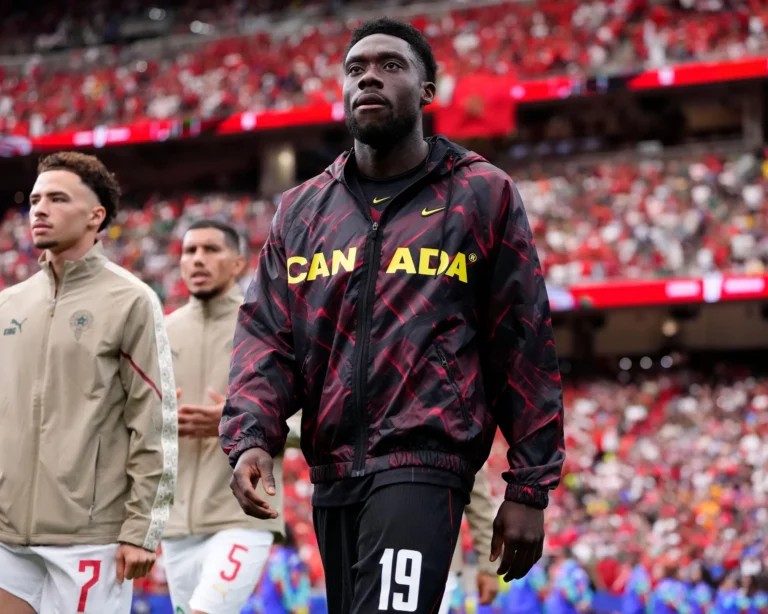
As Canada faced elimination from the World Cup, much of the spotlight fell on Alphonso Davies, the team’s standout player. The national team’s aspirations have often been tied to his performance, especially since his international debut in 2017, and his absence during key moments raised significant concerns.
Throughout the past nine years, Davies has played a pivotal role in reshaping Canada’s soccer narrative. After struggling in the early Gold Cups of the 2010s, the team has made impressive strides, reaching the quarter-finals or beyond in five consecutive tournaments. His contributions were vital during their qualification for the 2022 World Cup, marking a historic return to the tournament since 1986. Notably, a fit Davies also helped secure a fourth-place finish at the 2024 Copa América.
However, the challenges of relying on a singular star became evident during the recent World Cup. After suffering an injury in May, Davies missed all three group stage matches. His return came in the last-32 where he played a brief 15 minutes, helping Canada triumph over South Africa. Hopes were high that he would repeat this performance in subsequent matches.
Davies’ Absence Felt Against Morocco
During Canada’s match against Morocco, fans anxiously awaited Davies’ substitution to reinvigorate the team’s efforts. Despite the mounting pressure, coach Jesse Marsch opted not to deploy him, and Canada ultimately succumbed to a 3-0 defeat, extinguishing their World Cup ambitions.
Davies’ injury issues have persisted over the last 15 months, limiting him to just 13 Bundesliga appearances this season. This situation has strained relationships among the player, his club, and the national team, raising questions about the management of his fitness.
The saga began in March 2025 during the Concacaf Nations League semi-final against Mexico, where Davies played the full match only for Canada to lose 2-0. This led to a third-place match against the United States, an opportunity for Canada to rest key players. Instead, they chose to field Davies, who suffered a torn ACL just 12 minutes into the game.
Bayern Munich expressed their dissatisfaction, with a board member stating, “there is unfortunately always a danger that players come back injured, and this time it has hit us especially hard.”
Davies’ agent, Nedal Huoseh, also voiced his concerns, highlighting that “Alphonso was not 100% after the Mexico game and it was planned that he was not going to start against the USA,”
Looking Ahead to Future Competitions
Despite the disappointment of their World Cup exit, Canada achieved a historic last-16 finish and secured their first men’s World Cup knockout win. Yet, many will now reflect on what might have been if Davies’ fitness had been more effectively managed.
With the World Cup on home soil approaching, the challenge of balancing preparation with player health will be crucial. Most matches leading up to the tournament will be less competitive, as friendlies replace high-stakes qualifiers. Coaches must find new ways to foster team cohesion and assess player readiness for critical moments.
In hindsight, the decision to play Davies against the U.S. could be seen as a risky move given the stakes involved. The focus should have been on preserving their star player’s fitness, especially considering his history with injuries.
After the defeat to Morocco, Davies acknowledged the situation: “As captain, I feel he was pressured to start the game by the coach. Alphonso is not the kind of guy to say no in those moments. Canada Soccer needs to do a better job managing these players, in my opinion.” he said. “To be honest, obviously, we want players on the pitch that are 100% to play the game and 100% to give everything,”
This left a somber note for a team that had much to celebrate during the tournament but ultimately fell short when they needed their key player the most.