

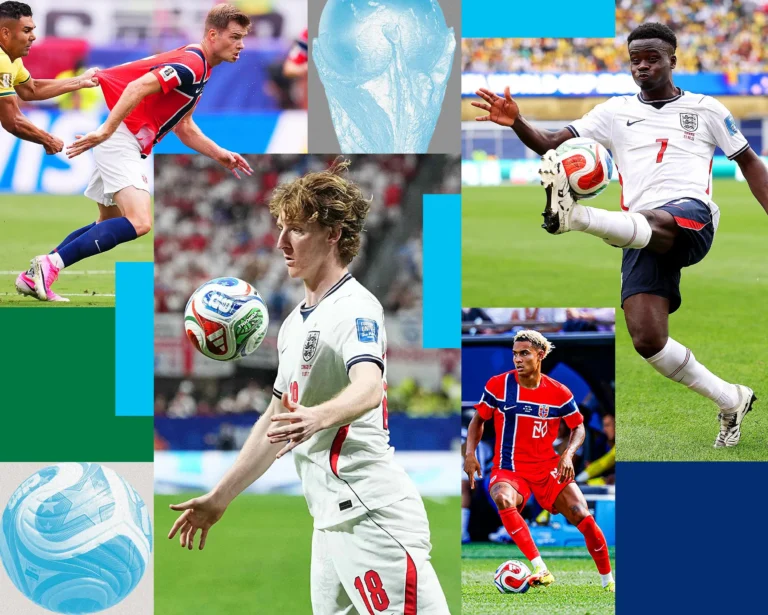
As England prepares to face Norway, all eyes are on Harry Kane and Erling Haaland, who are expected to make their mark on the game. However, the more intriguing question revolves around the choices made by Thomas Tuchel and Ståle Solbakken regarding their wingers. Neither side has fielded the same wide forwards throughout the summer.
For England, the left flank has been manned by Anthony Gordon and Marcus Rashford, while the Arsenal duo of Noni Madueke and Bukayo Saka have taken charge on the right.
Tuchel commented, “All four of the wingers are competing against each other at the highest level,” following England’s initial match against Croatia. The competition is intense, as none of these players have logged more than 57% of the available minutes at the World Cup or started more than three out of five matches.
The England manager appears uncertain about his preferred pair, having experimented with five out of the possible six combinations. Gordon and Rashford, both naturally left-sided players, have not been paired together. Tuchel’s in-game tactics seem influenced by the match score, prompting him to adjust his wide forwards earlier in each game.
A red card issued to Jarell Quansah during the game against Mexico significantly impacted tactical decisions. Following Quansah’s dismissal in the 54th minute, Saka was substituted, forcing England into a wing-less formation.
A noticeable trend has emerged: in England’s last three matches, the starting wingers were the same as those who concluded the prior game. This selection may have been dictated by the specific tactical approach required for each opponent.
Gordon currently leads the squad in average ball carry length at the World Cup, measuring 14.9 meters, while Madueke tops the chart for total distance carried per 90 minutes, with an impressive 255.8 meters. Rashford has been the most effective England winger for successful carries of at least five meters that concluded with a shot, netting a goal against Croatia. Additionally, only two players in the tournament have generated more goals after carries than Saka, one of whom is Norway’s Andreas Schjelderup.
Schjelderup’s only start came when Solbakken made ten changes for the final group stage match against France. Having assisted Haaland for both goals in the game against Brazil, the 22-year-old could feature prominently against England.
In contrast, Solbakken has been more methodical in deploying his wingers. The pairing of Antonio Nusa and Alexander Sørloth started three out of four ‘first-team’ matches, with Schjelderup and Oscar Bobb concluding each of those games.
All four assists from these players originated from the left side, making it crucial for England’s right-back to disrupt the supply chain to Haaland.
For Norway’s defensive line, the challenge of countering threats from wide positions is multifaceted. While the objective remains to neutralize one of the top strikers globally, the success of their wingers could ultimately determine the match’s outcome.
- World Cup 2026
- Norway
- England
- World Cup
- features