


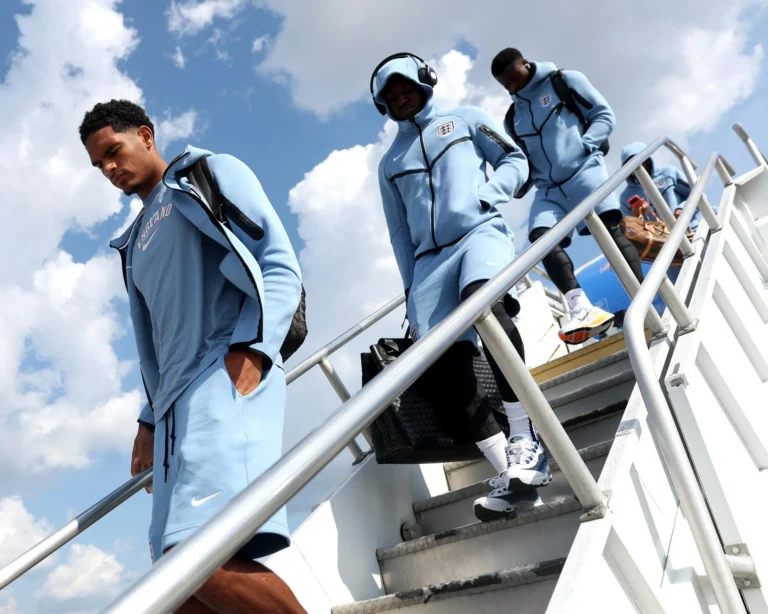
Much emphasis has been placed on England’s challenge of playing against Mexico at high altitude in the Estadio Azteca. However, a significant concern may be the extensive total distance the team has traveled during the World Cup, which far surpasses that of their competitors.
The Football Association made the decision to station England in Kansas City, despite the fact that the team has no scheduled matches there. Their rationale was that a central location would minimize the length of flights required for each game. Nevertheless, this has resulted in round trips of at least 670 miles for every match, based on direct measurements between their base camp and the venues.
With journeys to Foxborough, East Rutherford, and Mexico City exceeding 1,100 miles each way, England’s players have covered an average of approximately 1,842 miles over their first five matches. This distance is comparable to a round trip from London to Lisbon, a manageable journey for a footballer accustomed to European club competitions. However, England’s average round trip distance is greater than the total distance traveled by France, and they have also surpassed their next opponent, Norway, by more than 3,000 miles.
The shortest return trip made by England’s squad was still longer than any journey undertaken by the French team. Additionally, England has played all five matches in different locations, with Miami Gardens set to host their sixth match against Norway this Saturday. In contrast, Norway has opted for a more traditional approach by basing themselves in one location (Greensboro, North Carolina) during the group stage and then moving to various cities for their knockout matches.
Some teams have benefited from their strategic decisions regarding their bases. Belgium has chosen to camp in Renton, Washington, which is only about 10 miles from Seattle Stadium, where they played their initial two knockout games. Argentina has also based themselves in Kansas City, where they will play both their opening match and quarter-final. England, anticipating topping their group, could have planned their logistics differently. For instance, choosing a base near Atlanta would have positioned them advantageously for their last-32 match while reducing overall travel during the group stage.
This example illustrates that numerous factors influence the decision of where to establish a base camp beyond mere proximity to matches. The extent to which traveling longer distances than other teams impacts performance is challenging to measure. However, with England having three round trips longer than France’s total travel, this could play a significant role if they advance far enough to meet in the final.
- England
- World Cup 2026
- World Cup
- features