


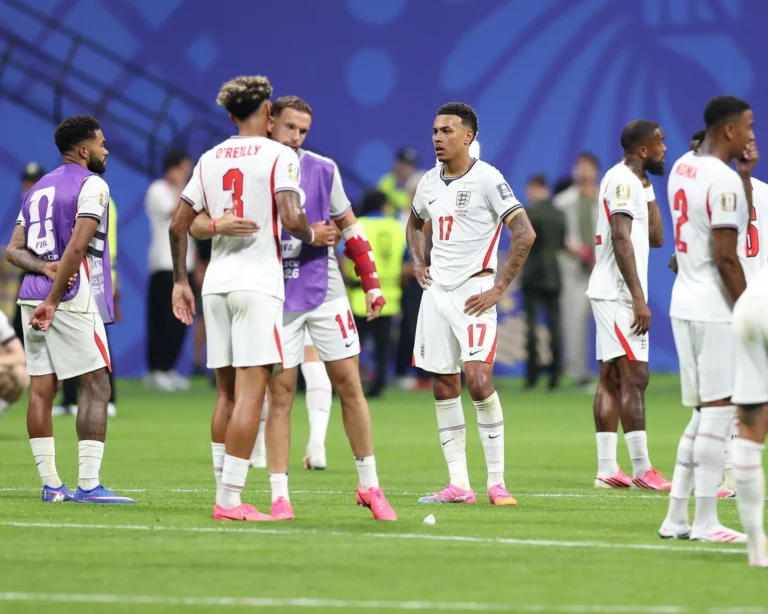
Future coaching seminars might reference England’s encounter with Argentina as a case study of how not to maintain a one-goal lead. Such a conclusion, though harsh, finds support in the match’s statistics.
Upon analyzing the game, several troubling figures emerged. Perhaps the most striking was noted by OptaJoe, which revealed that England held just 12% possession during the 30 minutes that followed Anthony Gordon’s goal until Argentina equalized. They remarked, “That is the lowest by a team to be winning for at least 10 minutes in a World Cup match in the last 60 years,”
The situation worsens when examining this segment more closely. Before the hydration break, Thomas Tuchel’s squad performed relatively well, with a well-placed pass from Harry Kane leading to a shot in the 66th minute. Kane then had a chance himself when England regained possession in the attacking third, indicating that Argentina could be kept under pressure.
However, the threat diminished when Ezri Konsa came on for Gordon, as England shifted to a 5-4-1 formation. This tactical adjustment stripped the team of any real pace on the counterattack. Although substituting Kane would have been a significant decision, his contribution was minimal as the team attempted to defend the lead with a compact formation.
England’s Goal Difference Analysis
As Tuchel prepares for the third-place playoff instead of the final this weekend, he might find it worth noting England’s goal difference throughout the tournament, which stood at +6 over 6.3 matches, averaging +0.82 per 90 minutes. This statistic varied with different players on the field, highlighting the importance of personnel. When Bukayo Saka played, the goal difference was +2.01 per 90 minutes, while Reece James and Gordon contributed +1.16 and +1.14, respectively.
The need for speed in their attack was evident, yet Saka remained on the bench. Having a fast player in the forward position could have provided an outlet to relieve pressure.
Between Konsa’s introduction and Argentina’s winning goal, a mere 19 minutes elapsed during which England managed only 11 passes.
Remarkably, only four of those passes were successful: two came from the restart after the hydration break when Jordan Pickford passed to John Stones and received the ball back immediately. Another successful pass occurred in stoppage time when Kane found Jude Bellingham, who subsequently lost possession. The final successful pass was Bellingham’s kick-off following Enzo Fernández’s equalizer.
Inadequate Game Management
This sequence encapsulated England’s unraveling. Bellingham returned the ball to Pickford, who attempted a long pass toward Kane that proved fruitless. Notably, the goalkeeper was responsible for five of England’s seven unsuccessful passes from Konsa’s entry until the moment they fell behind, with three of those passes going out of play.
Another significant issue was the failure to effectively manage the game. Argentina often disrupted play with fouls, some of which went unpunished, until they fell behind. In that timeframe, England conceded just one free-kick and executed their last successful tackle in the 63rd minute.
Adding to the frustration, England conceded the decisive goal to a header from the 174cm tall Lautaro Martínez, despite bringing in the 201cm Dan Burn to counter Argentina’s aerial threats. Burn’s involvement was limited to touches in the final third after England had already conceded—rendering him more of an oversized decorative piece than a defensive asset.
No matter how one analyzes the statistics following England’s lead, the outcomes tell a disheartening story.