


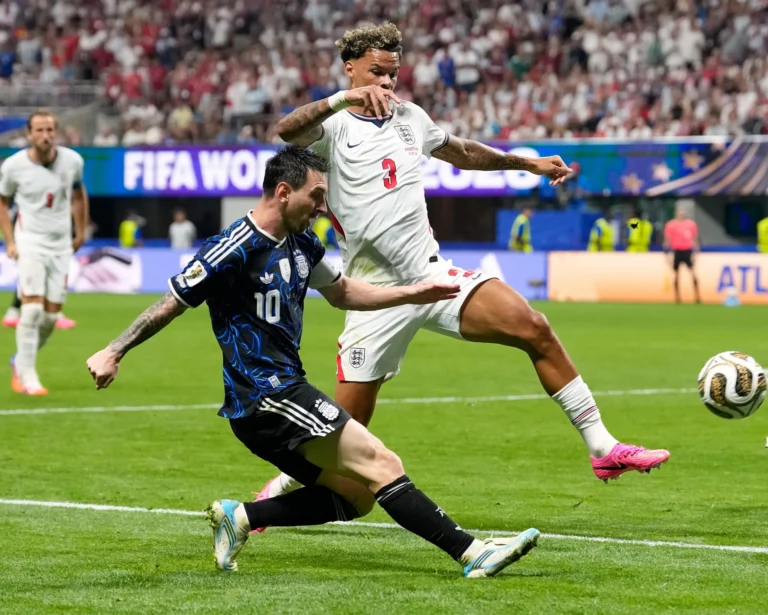
Prior to England’s clash with Argentina, Thomas Tuchel meticulously prepared for every possible scenario. He focused on ways to bolster his team’s attack while ensuring a robust defense. Anticipating various outcomes, including the possibility of scoring first or falling behind, Tuchel considered how best to neutralize the threat posed by Lionel Messi.
For the opening hour, Messi was mostly uninvolved, with statistics indicating that England successfully curtailed his impact in critical areas. The only time Messi touched the ball in the center of the penalty area was thwarted by a timely tackle from Elliot Anderson, shortly after Anthony Gordon netted for England. His sprinting metrics, defined by Fifa as running at least 20km/h, were merely 4.3%, lower than his previous outings against Switzerland (4.6%) and Egypt (5.4%).
Tuchel likely felt reassured by Messi’s limited attempts on goal. The Argentine’s lone effort was from a distance and promptly blocked before it could reach the England area. Remarkably, this was only the second time in 19 World Cup matches where Messi, playing a full 90 minutes, registered so few shots in normal time. His only other low came during a 120-minute match against the Netherlands in 2014.
Messi’s heat map revealed a familiar pattern, indicating his activity in the right half-space near the opponent’s penalty box. While it could not be claimed that England completely neutralized him, they at least managed to keep him operating in expected areas, which is something they could plan for.
However, a complete match heat map can obscure subtle tactical adjustments. For instance, Messi’s only touch on the flank between the penalty box and the touchline in the first half occurred near the center circle when he passed to an offside Giuliano Simeone.
Yet, it was from this very flank that Messi made a decisive impact in the second half. He attempted six open-play crosses, an unusually high figure for a player who has averaged 2.3 crosses (including set plays) per 90 minutes in league football since 2015. Only in two World Cup matches has he attempted more, both in the previous rounds.
One of Messi’s wide crosses led to a header from Nico González, which Jordan Pickford managed to save just before the second hydration break. This moment likely influenced Tuchel to introduce Ezri Konsa immediately afterward, later supplementing him with Dan Burn as he transitioned to a back five. The strategy had previously worked against Mexico, prompting Tuchel to try it again.
However, Messi’s crossing ability far surpasses that of Roberto Alvarado and Jesús Gallardo, who combined for 25 open-play crosses in their match against Mexico, yielding just one chance with a meager 0.05xG. In contrast, Messi’s cross that led to Lautaro Martínez’s winning goal generated an impressive 0.53xG, exceeding England’s total chances for the night. This was only his second World Cup assist with his right foot and was considerably more challenging than the cutback he provided to Julián Álvarez during the semi-finals in Qatar.
The match was statistically peculiar for Messi, filled with anomalies. Nevertheless, it underscored a significant truth: regardless of the space available, the greatest of all time will invariably find a way to dismantle even the most carefully crafted plans.