


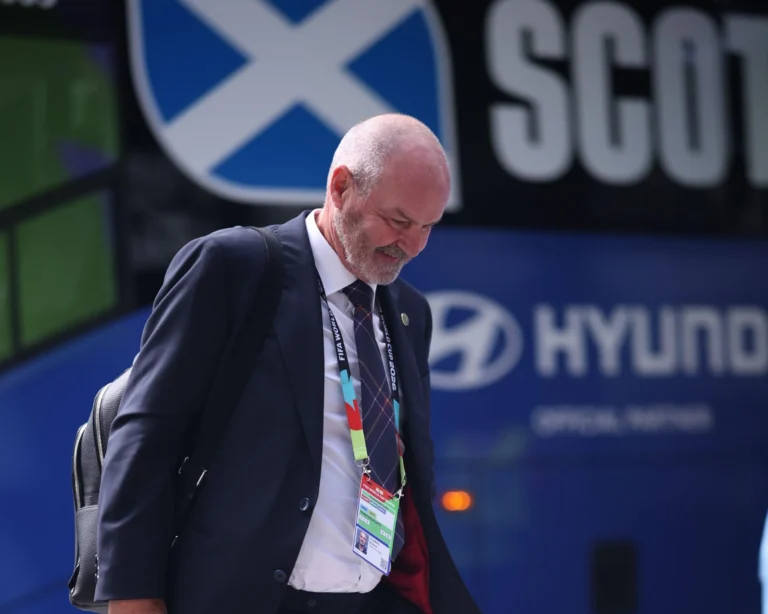
Steve Clarke has officially resigned as head coach of the Scotland national team, a decision made public shortly after the team’s elimination from the World Cup. Clarke, who had been at the helm since 2019, had recently extended his contract for four more years before the tournament commenced. The circumstances surrounding Scotland’s early exit prompted a significant reevaluation from the 62-year-old coach.
Clarke’s tenure as Scotland manager will likely be viewed positively in the long run. After a lengthy absence from major international tournaments since 1998, Scotland qualified for the European Championships in both 2021 and 2024 under his leadership. The recent World Cup marked Scotland’s first appearance in the tournament in 28 years.
Despite this achievement, the team failed to meet their goal of advancing to the knockout stage, finishing Group C with only three points. Clarke appeared dejected as Scotland wrapped up the group stage with a 3-0 defeat to Brazil, following a narrow win against Haiti and a subsequent loss to Morocco.
The coach faced criticism for adopting a perceived overly cautious strategy, and his terse demeanor during media interviews at the World Cup attracted negative attention.
In an extensive open letter to fans, Clarke refrained from directly addressing the team’s World Cup shortcomings. Instead, he expressed gratitude towards his staff and players, stating, “The most emotional part of this goodbye is for my players, without whom we wouldn’t have had any of the memories that we’ve accumulated from 2019 until now,”
Ian Maxwell, chief executive of the Scottish Football Association, remarked, “They deserve all the praise and adulation that they receive and it was truly an honour to be called their gaffer. Thanks for having me and good luck to my successor.” However, Maxwell and his colleagues may face scrutiny for granting Clarke a new deal prior to the World Cup.
Clarke began his letter by noting that many had advised him against taking the Scotland job, viewing it as a “We thank Steve for his record-breaking contribution and know that when the disappointment of World Cup elimination subsides, the Scotland supporters will be thankful for the memories of marching with pride at major tournaments once again.” His successful return to Scottish football, starting as manager at Kilmarnock, set the stage for his national team role. Reflecting on his seven years in the position, Clarke shared, “As I reflect on my seven years in the job, my overwhelming emotion is pride, closely followed by satisfaction.”
Scotland’s departure from the World Cup was sealed by Croatia’s victory over Ghana, a result that felt inevitable. Ghana would have needed to win by three goals to maintain any slim hopes for Scotland.
The Scottish FA now faces a challenging task in finding Clarke’s successor. While Derek McInnes, previously seen as a future candidate, has recently joined Rangers, David Moyes remains tied to his role at Everton. With limited domestic options available, there is likely to be pressure on the governing body to consider international candidates.
The new head coach will have the prospect of preparing for a home Euros in 2028, with two spots reserved for host nations—Scotland, England, Wales, and the Republic of Ireland—if they do not qualify through the regular process.