


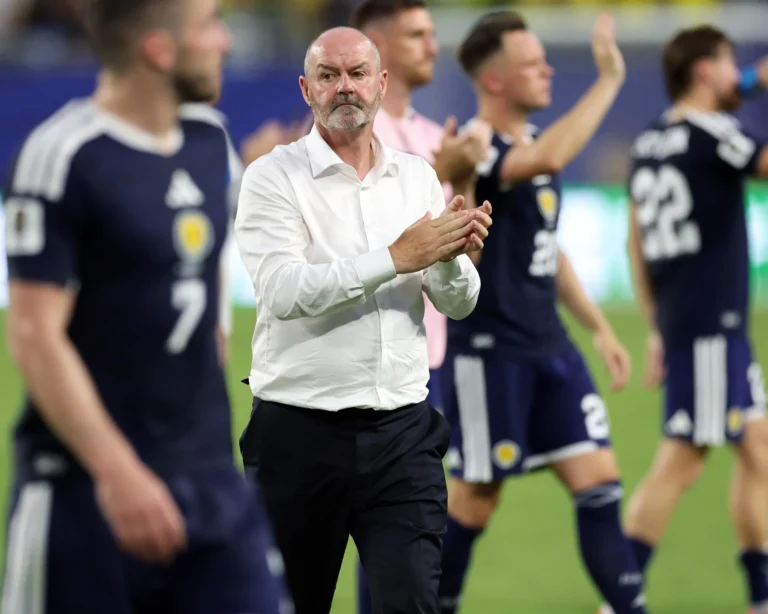
The Scottish Football Association (SFA) made a perplexing choice in granting Steve Clarke a four-year contract just weeks before the World Cup, yet one aspect of this decision stands out. In evaluating potential replacements for Clarke, it becomes evident that the scarcity of talent within the nation’s players is mirrored in the coaching ranks. Clarke’s unexpected resignation has put the SFA in a challenging position that they sought to avoid, demanding a level of innovative thinking they typically lack.
Clarke’s legacy should be viewed positively; he broke Scotland’s lengthy absence from major tournaments on three occasions despite significant limitations in player resources. His critics, however, seem oblivious to these constraints. It is unfortunate that his term concluded amidst controversy following another disappointing finals appearance, a situation that partially reflects coaching shortcomings.
If Clarke had adhered to his initial belief that this World Cup would mark the end of his tenure, the sentiment surrounding his departure might have been more accepting. Instead, there is confusion over why the SFA overlooked the implications of events in the U.S. while considering a potential long-term commitment to Clarke. Their handling of the situation has been characteristically tone-deaf and presumptuous.
Clarke has no need for the stress associated with managing a demanding football nation with a dwindling player pool. Financially secure, he has previously expressed that he shifted from being an assistant to a head coach only when he felt capable of handling failure. Ultimately, he proved himself successful. While Clarke may feel the sting of Scotland’s lackluster World Cup exit, his demeanor during post-match media duties in Miami suggested he could lead a more tranquil life.
Clarke is a principled individual who has made a commendable choice by stepping away from guaranteed income. Personal criticisms directed at him have often been excessive. Notably, in a detailed open letter to supporters and staff, he refrained from elaborating on his reasons for resigning or addressing why Scotland fell short in the U.S. As the 11th-ranked team among the third-placed squads, Scotland was significantly removed from their goal of reaching the last 32.
The SFA now faces the challenge of demonstrating that their decision-making can be anything but lazy. Those in administrative positions, who have enjoyed the spotlight on their own terms, must elevate their standards. The recent appointment of Craig Mulholland as chief football officer has done little to dispel the perception of a culture that feels too comfortable and narrow-minded.
Need for External Perspectives
The role left vacant by Clarke is no longer just a Scottish position; it presents an opportunity to invite insights from beyond Glasgow to reform a failing national football model. Scotland should consider coaches who have excelled in similarly sized nations. Seeking managers from abroad is not a matter of being bold or different; it is a necessary step at this juncture.
Currently, only two Scottish managers, David Moyes and Alex Neil, are involved in the top two tiers of English football. Derek McInnes has often been seen as a future Scotland manager, as has Moyes. However, club commitments make both unattainable. Beyond McInnes, only five Scottish managers are active in the Scottish Premiership, with John McGlynn, who has achieved remarkable results at Falkirk, being the only credible candidate among them. Concerns linger over whether McGlynn’s abilities could resonate with prominent players like Scott McTominay or John McGinn. Yet, given their disappointing performances in consecutive tournaments, this concern seems almost moot.
Exploring Broader Options
Steven Naismith, who served as Clarke’s assistant, is likely to be mentioned as a potential candidate. However, at just 39 years old, he shares responsibility for Scotland’s dismal World Cup performance. It would be surprising if he were the best option available to the SFA. Paul Lambert’s name has also surfaced, yet he has not managed since leaving Ipswich Town in 2021.
Within Scottish football, there is a sense of dread at the mention of Berti Vogts, whose tenure is often viewed as chaotic and disastrous. While some criticisms are warranted, it must be acknowledged that he inherited a struggling and aging squad. Ange Postecoglou seemingly meets all the criteria for the Scotland role, though it appears unrealistic to expect mutual interest.
Scotland’s domestic league has never been as diverse. For instance, when Hearts sought a replacement for McInnes, they looked to Belgium. Jens Berthel Askou, who excelled at Motherwell last season, was brought in from the coaching ranks in Copenhagen. It is presumptuous to think that Scotland’s football system cannot learn from others. England has a German manager, and Brazil has no qualms about employing an Italian like Carlo Ancelotti. Fresh perspectives are vital for the overall development of Scottish football. A parochial mentality has hindered the progress of the national sport for decades.
Looking Ahead
The new manager must be appointed before Scotland’s next Nations League campaign begins in September. Following that, the relatively straightforward task of qualifying for Euro 2028 awaits. As a host nation, Scotland’s path will be more accessible. A significant achievement of Clarke’s was the elevation of expectations. The SFA now has the opportunity to quell the noise surrounding them by broadening their horizons.