


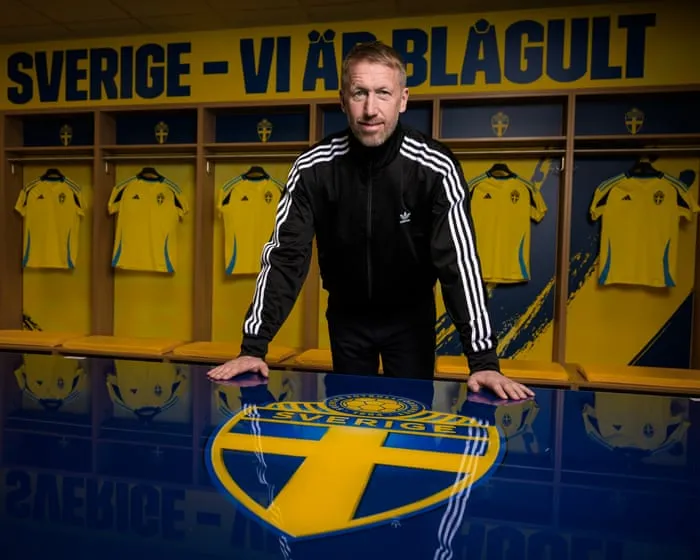
Graham Potter has learned through his management career that avoiding failure is futile. The 51-year-old emphasizes the importance of confronting challenges head-on, recalling how he navigated tough periods at Chelsea and West Ham. He believes that facing difficulties increases the likelihood of experiencing rewarding moments.
In a candid discussion, Potter reflects on his tumultuous recent years and the harsh realities of managing a football team. While acknowledging the setbacks, he also celebrates his achievements, notably guiding Sweden to the World Cup after reviving their fortunes. His tenure at Chelsea lasted just seven months following his departure from Brighton in September 2022, and he found himself at West Ham, where things did not go as planned.
During his time at West Ham, Potter struggled amid the club’s internal issues, winning only six out of 25 matches. After a disappointing start to his first full season, he was dismissed last September, leaving him to ponder the future of a career that once held great promise.
“I have sufficient life experience to put everything into perspective,” Potter states. “I appreciate all my life experiences, both positive and negative. Ultimately, life is about confronting what it presents to you. After my stint at West Ham, I faced a choice: I could either retreat to the media or pursue coaching again.”
Shortly after, an opportunity arose from Sweden, who were struggling in their World Cup qualifying group. They sought a replacement for Danish coach Jon Dahl Tomasson. Before accepting the role, Potter needed to reflect and discuss how to move beyond his time at West Ham.
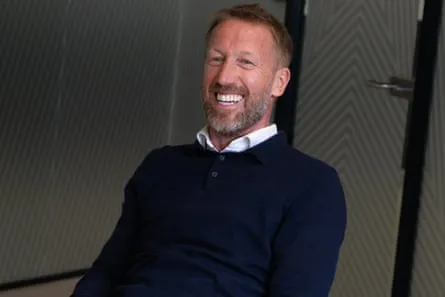
“You have to confront your failures,” he explains. “But these experiences can make you a better individual. In football, sometimes you can’t rationalize events. You might think, ‘Maybe it just wasn’t meant to happen,’ and then you have to move on.”
Potter remains focused and dismisses external opinions. “If I concern myself with others’ perceptions, it leads to a miserable existence,” he notes. He understood the high stakes involved when he took on the role of Sweden’s manager on a temporary contract in October. Although he could not initially guide them out of their qualifying group, Sweden’s strong Nations League performances secured them a playoff spot, making further failure detrimental to his reputation.
When Sweden regrouped in March, the team’s dynamics shifted dramatically. They displayed composure during the playoffs, with Viktor Gyökeres netting a hat-trick in a 3-1 semi-final triumph over Ukraine, followed by a decisive 3-2 win against Poland in the final round in Stockholm.
“Watching the Swedish commentary of the game on YouTube, I felt an emotional connection,” Potter recalls. “When Viktor scored, it felt surreal. Our substitutes rushed onto the field, and I was concerned about yellow cards and potential issues. But in a World Cup context, those worries seem trivial.”
Potter has since extended his contract until 2030, deepening his bond with Sweden. He was not an outsider when he assumed the role, having previously earned recognition during his seven years at Östersund, where he led the club from the fourth tier to the Europa League.
“I feel quite Swedish when I’m coaching,” he asserts. “I even resemble a Swede to some extent. Two of my children were born here.” Potter perceives international football as having a profound significance. “With the national team, you’re part of something larger than yourself. It’s a collective effort, which adds to the experience’s intensity and beauty.”
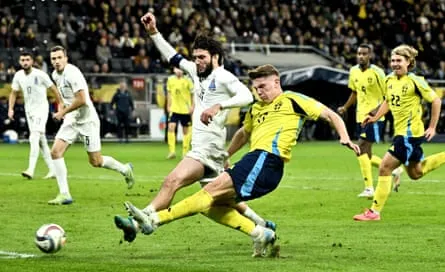
Adjusting to international management poses its challenges, particularly for a coach known for his methodical approach. “Time is limited for developing ideas,” Potter admits. “The danger lies in overcomplicating strategies based on a training camp in November for a match in March, when in reality, you have only two days to prepare. Simplicity is key.”
Following the playoffs, Potter faced difficult discussions with players who did not make the final squad for the World Cup. Fostering unity within the team remains crucial. “Even in an 11-a-side training match, several players will be left out, which can create tension. It’s essential that everyone is aligned,” he points out.
Sweden is currently preparing for their training camp in Stockholm before heading to Texas for the World Cup. Potter recognizes the high expectations, especially considering Sweden’s impressive third-place finish in the 1994 World Cup. However, with Japan, the Netherlands, and Tunisia in Group F, advancing to the knockout stage will be a formidable challenge.
As Sweden gears up for their opening match against Tunisia in Monterrey on June 14, managing the climate will be critical. Potter anticipates slower-paced games and emphasizes the importance of set pieces.
“Observing the evolution of the game, one can see that tournament football heightens the stakes,” he explains. “Matches tighten up, making it harder to play expansively. Set pieces become a vital avenue for creating scoring opportunities.”
Despite missing the injured Dejan Kulusevski, Sweden boasts other attacking threats. The duo of Alexander Isak and Gyökeres could prove to be a potent combination. Although Gyökeres faced criticism during his initial season at Arsenal, Potter remains optimistic. “His contribution to our World Cup qualification is remarkable. From Arsenal’s perspective, he’s fulfilled his role, scored goals, and helped the team secure the Premier League title and reach the Champions League final. His work rate has been exceptional this season,” Potter notes.
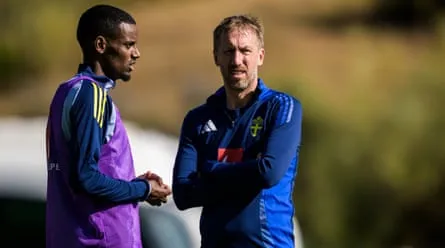
Isak’s transition from Newcastle to Liverpool has not been as smooth. He struggled with fitness and form after recovering from a broken leg, following a disrupted pre-season.
“His first season at Anfield hasn’t unfolded as he had hoped,” Potter reflects. “We often assume that signing a player guarantees improvement, but that’s not always true. While Alex thrived at Newcastle, adapting to Liverpool’s style is another challenge. His inherent quality remains intact; it’s about how he meshes with the team, which can take time. He’s a fantastic person.”
Potter recalls Isak’s debut for AIK against Östersund. “Before the match, we felt confident as the center-forward was absent, so we faced a 16-year-old instead. Then he scored, and we lost 2-0; I learned my lesson that day,” he chuckles.
Encouragement came for Potter when Isak scored a remarkable goal in Sweden’s recent 3-1 loss to Norway. He is eager to have Gyökeres and Isak on the field together. “Their contrasting styles could benefit us. We haven’t paired them yet, which is an exciting prospect for development,” he expresses.
As the anticipation builds, Potter has been in contact with former Sweden striker Zlatan Ibrahimovic. He reflects on the trend of club managers transitioning to international roles. “Conversations with those who have made the switch reveal that tournaments evoke some of the most profound feelings in football,” Potter says. “Being part of a national team adds a soulful dimension to the experience.”
Potter is flourishing in his role. Although West Ham parted ways with him, the club still faced relegation. In contrast, Potter is heading to the World Cup. “My earliest football memories revolve around ’86, watching Diego Maradona mesmerize everyone. As a child, that sparked my passion for the sport. To have the opportunity to work in that environment is a dream come true.”