


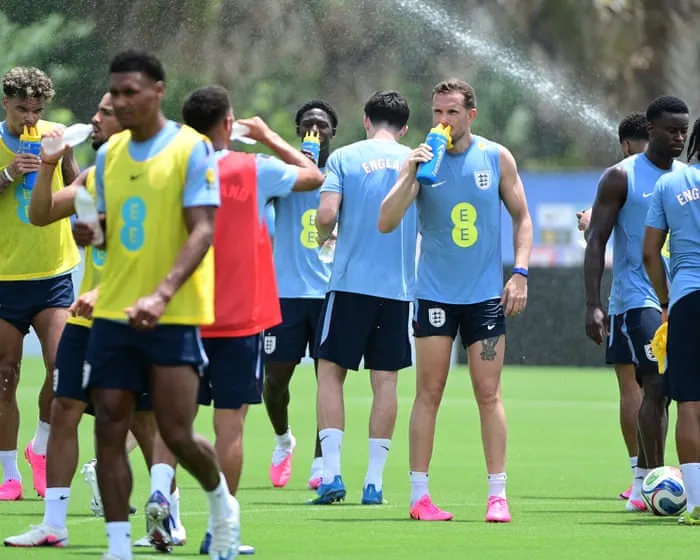
As temperatures soar, England’s national football team is ramping up preparations for the upcoming World Cup. Alexi Lalas, the former USA defender and current Fox Sports analyst, recalled the intense heat during the 1994 tournament, asserting, “It was hot then, and it will be just as scorching this year.” His remarks, made during the tournament draw in Washington D.C. last December, underscored the challenges ahead for the English squad.
While Lalas expressed concern over England’s ambitions, his vocal presence left an impression. He emphasized that England’s goal is to seize the trophy and return it home, a sentiment he clearly opposes. Nevertheless, his underlying message about the oppressive heat seemed directed at European teams, including England, urging them to adapt to the conditions.
In response to the heat, England’s players are proactively confronting the challenge. Thomas Tuchel, the team’s manager, has prioritized acclimatization, opting for the sweltering environment of West Palm Beach for their initial training session. This choice, taking place just two weeks before their opening match against Croatia in Dallas, signals their commitment to overcoming the climate hurdles.
On Tuesday, the temperature reached 32°C with a staggering 79% humidity in West Palm Beach. The Miami stadium, which will host key matches, ranks as the most heat-challenged venue, followed closely by Kansas City, where England will be based. Should they advance from their group, Miami will host their quarter-final, while a potentially altitude-affected last-16 match awaits in Mexico City.

England’s first warm-up match against New Zealand is scheduled for Saturday at 4 PM local time in Tampa, approximately four hours from their training camp. The expected kickoff temperature is also 32°C, albeit with slightly lower humidity, aligning with the Football Association’s mantra to make players “comfortable being uncomfortable.”
It’s well-known that extreme heat can hinder athletic performance. Data from last summer’s Club World Cup highlighted how elevated temperatures reduce player activity levels. Tuchel’s assistant, Anthony Barry, has noted that North America’s conditions may not support top-tier football, suggesting that the winning team will rely on key moments rather than consistent play.
Concerns about the challenging conditions loom large, particularly for players recovering from a demanding Premier League season, with some nursing minor injuries. The FA has acknowledged that this World Cup will be the most arduous yet, featuring the hottest conditions since 1994, the largest number of participating nations at 48, and logistical complexities spanning the U.S., Mexico, and Canada across multiple time zones.
The team that adapts best to these variables will likely emerge victorious. From England’s perspective, strategies focusing on heat resilience—covering player selection, rotations, and recovery—are critical.

The FA has invested considerable effort into ensuring players are in peak physical condition for the tournament. Much of this acclimatization occurs in Florida, where a second friendly against Costa Rica is planned in Orlando. The groundwork for these preparations started last June when Tuchel led the squad on a week-long warm-weather training retreat in Girona.
These training sessions have been rigorous, requiring players to cycle for 45 minutes in a heated tent maintained at 35°C. Sports science plays a crucial role in these preparations, with players ingesting biometric tablets to monitor their core temperatures during physical exertion. Additionally, some players have invested in recovery technologies like hyperbaric oxygen chambers and ice baths at home.
Data collection and analysis have become a focal point, tracking both external metrics—such as distance covered and high-intensity runs—and internal metrics like heart-rate variability using wearable technology during training. This week, players have utilized health bands to optimize their performance.
Collaboration with players’ clubs has proven beneficial, with shared data enhancing training insights. Tuchel’s decision to include John Stones, who had limited playing time in the latter half of the season, was influenced by positive data from his club training sessions. This meticulous approach allows Tuchel and his staff to tailor training and match loads to each player’s condition.
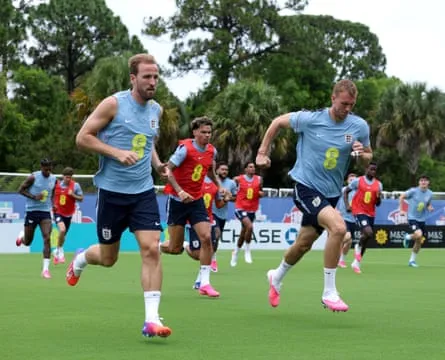
The focus on recovery extends to post-match nutrition and sleep. The FA has aimed to acclimatize players to North America’s Bermuda grass, which differs slightly from English surfaces, ensuring training pitches are of high quality.
The Kansas City base camp offers a strategic location in the heart of the U.S., minimizing travel time for matches—no flight exceeding three-and-a-half hours. This contrasts with teams that may face longer journeys in the knockout stages. The FA believes that having a stable base with familiar comforts will benefit the players; they are satisfied with their accommodation at the four-star Inn at Meadowbrook, which they will occupy starting Saturday.
As England prepares for their first match against New Zealand at Raymond James Stadium—home of the NFL’s Tampa Bay Buccaneers—the venue’s atmosphere adds to the excitement. Originally, warm-up matches were intended for Miami, closer to West Palm Beach, but logistical issues prompted the change.
England will take the field as the home team against New Zealand, with FA branding prominently displayed throughout the stadium. High above the stands, fans can see the Buccaneers’ ring of honor, featuring their all-time greats, including the late Malcolm Glazer.
Known for its iconic pirate ship, which fires cannons and produces smoke during Buccaneers’ touchdowns, the stadium promises a unique backdrop for England’s summer kickoff. Whether the cannons will fire for England remains to be seen, but as they step onto the pitch, the countdown to their World Cup journey officially begins.