


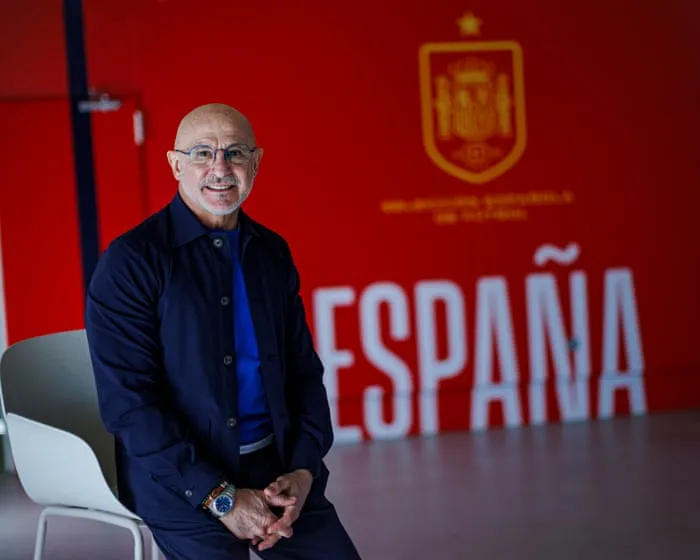
At the Spanish football federation’s headquarters in Las Rozas, two classrooms are adorned with photographs of every player who has represented la selección. Over 800 former players grace the walls, yet the coach who is currently guiding them towards World Cup glory is noticeably absent. Luis de la Fuente, whose international career peaked at the under-21 level, lacks a photograph among this illustrious assembly. He playfully remarks, “I used to have hair like this,” while gesturing to his own head, but he is no stranger to this environment. This is a place of learning for him, having both taught and absorbed knowledge here, witnessing many of his students ascend to great heights.
The coach, who led Spain to victory in the 2024 European Championship, comfortably settles onto a sofa in a nearby room. With his squad finalized, he prepares for their upcoming journey to Chattanooga. These moments are filled with anticipation as he assesses player readiness: 20 players reported on the first day, followed by Pedro Porro and Yéremy Pino on subsequent days, concluding with Mikel Merino and those who participated in the Champions League final. He reflects on this experience, stating, “I’m so happy to be going to a World Cup,” taking pride in his team’s achievements.
Among the Spanish contingent in Budapest were not only Fabián Ruiz, David Raya, and Martín Zubimendi but also notable managers: Luis Enrique, De la Fuente’s predecessor, and Mikel Arteta. Just three days prior, Iñigo Pérez had led Rayo Vallecano to the Conference League final. The week preceding that, Unai Emery celebrated a Europa League victory, while Pep Guardiola stepped away, leaving a significant mark as one of the Premier League’s most influential figures. Additionally, Xabi Alonso has taken charge at Chelsea, and Andoni Iraola at Liverpool, which De la Fuente asserts is no coincidence.
“This is a long-term evolution; finally, it feels like the appreciation is coming,” he comments. “Such recognition should have emerged much sooner. While trophies highlight our success, the groundwork laid by coaching schools within regional and national federations has consistently set an exemplary standard.”
He acknowledges the legacy created and inherited, drawing satisfaction from deeper connections beyond mere accolades. Although not all his former pupils originated from this institution, Spain’s unique football environment has undeniably influenced them, a principle that the national team coach wholeheartedly embraces. Both Iraola and Alonso began their journeys among these celebrated images, as did Lionel Scaloni, the coach of this summer’s defending champions, Argentina, and many others. De la Fuente’s role as an educator has shaped him too; a guiding influence that has persisted through his time with Spain’s under-19s and under-21s.
For three years, he stood at the helm of the classroom starting in 2017, facing familiar faces, perhaps more recognizable than they were back then. During his tenure coaching Spain’s youth teams, he instructed on two subjects in the federation’s UEFA pro license course: the evolution of football and team dynamics. Among the attendees, Montse Tomé, who served as assistant coach during Spain’s 2023 Women’s World Cup triumph, sat in the front row alongside Scaloni, while Joan Capdevila filled the role of the class jester in the back.
“It felt like school: the eager students at the front and the jokers at the back,” De la Fuente reminisces. He fondly recalls Capdevila’s humor and the spirited debates with Scaloni. “It’s easy to say Scaloni stood out, but several had that unique spark. Their eagerness to challenge you was invigorating: ‘I don’t see it that way.’ Scaloni was particularly vocal, always ready to engage. Our paths have run parallel. He began with the under-20s, transitioned to the senior squad, and achieved monumental success. Our mutual drive for victory was palpable; we both understood the stakes. Scaloni faced immense challenges with Argentina, and I see similarities in our experiences, especially in our calm, collected approach to pressure.”
In just six years, both teacher and pupil would emerge as champions in their respective tournaments. A planned reunion at the Finalissima in Qatar in March was thwarted by the war, with attempts at finding alternatives failing to materialize. “If one side doesn’t want to play, the match won’t happen,” De la Fuente laments. “It was disappointing. I believe politics won’t interfere this summer; football has the potential to unite people across all divides. I look forward to seeing Leo at the World Cup and sharing a moment with him.”
As defending champions face off against the favorites, De la Fuente reflects on their beginnings. “Who would have imagined this?” he wonders. His initial major senior role arrived after the age of 60, after dedicating a decade to Spain’s youth structure. Scaloni, thrust into the senior team at just 40, lacked club experience. “Life offers incredible opportunities. Nothing was handed to us; our success is a product of relentless effort.”
De la Fuente feels that without his students, he might not be where he is today. “They rejuvenated my perspective and energy. For me, teaching is a continuous journey. I’ve engaged in courses in Bilbao and Seville, and being at the federation has been fulfilling. Engaging in football discussions with talents like Xabi, Xavi, Raúl, and Scaloni has been enlightening. The dynamic of 30 people exchanging insights in a single room brought invaluable lessons. The expectations they set for me as a teacher ensured I approached each class with enthusiasm and left more knowledgeable. It extends beyond football; it’s a life lesson: learning never stops.”
“Ultimately, sporting success is fleeting. Yet, the influence of my mentors remains vivid in my memory. So, when the opportunity arose to contribute to the RFEF, I embraced the chance to shape future talents.”
De la Fuente gestures for his glasses resting on the table. “Could you pass my glasses please? … Thank you,” he requests. “Players notice when their manager shows courtesy. It’s about instilling values and principles; we can’t accept anything less. I’ve forged connections with many of our players from their early days: Álvaro [Morata], Dani [Carvajal], Unai Simón, Fabián, Rodrigo, [Marc] Cucurella, Mikel Merino, and [Mikel] Oyarzabal. In that regard, I see myself as more than just a coach.”
“A team must embody selflessness; that human connection is vital. We often refer to the team as a ‘family,’ and it’s heartening to see players adopt that sentiment organically. I perceive a similarity between the current squad and the 2010 World Cup-winning team, which poses the challenge ahead of us. Conversations with Vicente del Bosque, who led that team, reveal echoes of our current dynamic.”
Perhaps no role has been more crucial than that of Lamine Yamal, who was called to la selección at just 16 while managing school exams. Now, at 18, he arrives at the World Cup as a standout player, burdened with the accompanying pressure. This is particularly challenging since he has been sidelined since April due to a hamstring injury; he expressed concerns about missing out, admitting he “prayed” for a favorable diagnosis.
“He’s recovering swiftly, meeting targets ahead of schedule,” De la Fuente notes. “I believe he’ll be fit for the first match, but we’ll assess whether he should play immediately or wait for the second game.” He acknowledges the vital role of Javier López Vallejo, the national team’s psychologist, seated nearby. “This gentleman is crucial,” he states.
Equally important is the environment surrounding him, which De la Fuente emphasizes starts with mutual respect. “We want individuals who prioritize teamwork over ego. If faced with a choice between a talented but difficult player and a good-natured one, my choice is clear. The younger players learn from the wisdom of the veterans, while the older players draw energy from youth. The seasoned players must uphold the standard of conduct: ‘This is how we operate.’ If there’s trust, such guidance is embraced; if not, the response could be dismissive.”
“Lamine is destined for greatness. His bold personality sets him apart. While such pressure might overwhelm many, he possesses extraordinary resilience. Frequently, we ponder why some talented players falter: it requires more than just skill. At 16 during the Euros, and now at 18, Lamine manages intense media scrutiny with remarkable composure. A single error could shift focus unfairly onto him; it’s unjust. Behind the scenes, there’s a dedicated team of physios, nutritionists, psychologists, and coaches working tirelessly to support him.
“Footballers are immensely capable individuals, possessing sharp intellect. They are gifted, and only a select few are touched by greatness, such as Lamine and Messi.”
Whether Lamine Yamal is Messi’s heir is a hefty claim. “Messi: those are lofty expectations. Messi has been, is, and will always be … he represents football.”
When asked about the best player he has witnessed, he reflects, “I have always admired Johan Cruyff. Experiencing Diego Maradona on the pitch was surreal. Those were different times, and the intensity is unimaginable. People can’t grasp the ferocity of that era. However, I recognize that Messi, like Cristiano Ronaldo, is extraordinary. While the game has evolved, with better pitches and equipment, Cruyff would still shine today. Would we thrive in this era? Absolutely. But could today’s stars have excelled back then? Likely not; we trained on steep hills, running up and down for hours.”
De la Fuente chuckles while discussing the evolution of football. “Fridays were about hearty meals like beans or T-bone steaks. After training, the entire Athletic Bilbao squad would gather at the bar near Lezama for beers, wine, tortilla, and peppers, followed by a siesta before the next day’s game. There’s a wealth of literature on modern football, but forgive me if I’m not inclined towards that. I approach coaching with a classic football philosophy. Yet, evolution is essential, and I have adapted over time. With experience, my clarity has sharpened. Learning is a lifelong endeavor; failing to recognize that is a mistake.”