



In the context of the World Cup, the advantages of hosting are often significant. Historical examples abound, from Uruguay in 1930 to England in 1966, where home teams thrived on support from their passionate fans. Yet, this time was markedly different for Brazil as they faced an unexpected calamity.
“The expressions on the Brazilian players’ faces as they entered the pitch resembled those of contestants in the Hunger Games,” remarked Zico, a legendary midfielder from the 1970s and 80s. “They were not relishing the occasion, which only amplified their struggles. When they encountered a similarly skilled opponent, they fell short.”
Brazil and Spain stand out as the only World Cup champions who have yet to claim victory on their home soil, a curious fact given Brazil’s storied history and prior hosting duties. In 1950, they suffered a shocking defeat to Uruguay in the Maracanã final, a loss that left an indelible mark, famously known as the Maracanazo. Fast-forward to 2014, and another dark chapter unfolded, the Mineirazo, yet this loss was far more profound—an utter humiliation.
In a breathtaking display of football, Germany unleashed a ferocity rarely seen in such high-stakes matches. Within a mere seven minutes of the first half, Germany showcased a ruthless brand of football. From the eighth second of the 23rd minute to the 49th second of the 29th minute, Germany, already ahead, unleashed four more goals, shredding Brazil’s defense and leaving spectators in a state of shock. This moment felt like a nation’s aspirations being washed away in a torrent of tears. “I just wanted to bring some joy to my people, who endure so much,” David Luiz shared after the match. “I wished to see them smile.”
In the 23rd minute, Miroslav Klose etched his name in history by becoming the first player to score 16 World Cup goals, doubling Germany’s lead. Television cameras captured a distraught Brazilian fan, her face painted in the national colors, as a single tear streamed down her cheek. Moments later, Toni Kroos delivered a thunderous left-footed shot from the edge of the box, causing another fan to gaze in disbelief at her companion. Tite, Brazil’s current coach, recounted, “While watching at home with my wife, she began to cry after the third goal, and that set me off. The 7-1 scoreline is like a ghost that lingers—it’s a topic still discussed, yet the more we talk about it, the less likely it seems to fade away.”
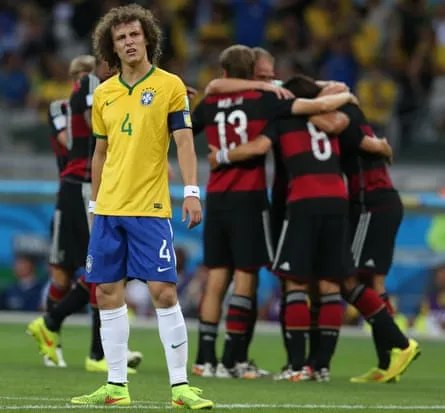
The onslaught continued. Following the ensuing kickoff, Kroos seized the ball from Fernandinho, executed a quick exchange with Sami Khedira, and slotted in a third goal. Just three minutes later, Khedira added a fifth, prompting the broadcast to shift away from the distraught fans.
On Germany’s bench, coach Joachim Löw turned to his assistant, Hansi Flick, and asked, “Hansi, is this really happening?” Löw later described his emotions at that moment as a blend of pure elation and disbelief. “To be 5-0 up in a semi-final against the host nation was simply unbelievable,” he reflected.
Shortly thereafter, Löw delivered a halftime address unlike any other, urging his players to temper their performance. “I didn’t want anyone to humiliate the Brazilians in front of millions,” he stated. “The respect that Brazilians had shown us across the nation was immense. It seemed unthinkable to me to demean them or display arrogance.”
Eight years prior, Löw was an assistant manager when Germany faced Italy in the semi-finals on home turf and suffered a painful defeat in Dortmund. “In 2006, we understood firsthand the agony of missing a World Cup final before our own fans,” he recounted. In 2014, they blended ruthlessness with a sense of empathy.
The second half saw two additional goals from substitute Andre Schürrle, although more could have followed. Oscar managed a late consolation for Brazil just moments after Mesut Özil squandered a one-on-one opportunity against Júlio César.
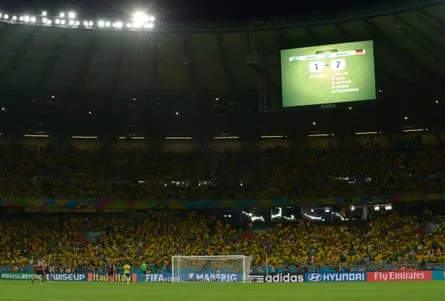
This match marked Brazil’s first semi-final defeat in 76 years and their first loss on home soil in any competitive fixture in 39 years. It also represented their most significant defeat in nearly a century, since Uruguay triumphed 6-0 in 1920. Historically, only Zaire in 1974 against Yugoslavia and Haiti against Poland that same year have ever found themselves five goals down at halftime—a position Brazil is unaccustomed to.
Two players from the squad, Luiz Gustavo and Dante, had to return to Germany to continue their club careers. Months later, Dante expressed, “If I had been in another country, it might have been easier. People tend to forget respect. They overlook everything you’ve accomplished, and you feel isolated. It’s painful and challenging, but I’ve learned a lot. In football, once it’s done, it’s done. Today, I’m happy. In life, it’s essential to move forward.”
Meanwhile, Neymar, Brazil’s star forward, was sidelined due to injury sustained in the quarter-finals against Colombia and watched the semi-final from home. Midway through the second half, with his mother Dona Nadine in tears, Neymar turned off his television, realizing his dream of leading his team to victory was dashed.
However, hope was not lost. Two years later, Rio de Janeiro hosted the Olympics, where a younger Brazilian squad, with Neymar at the forefront, aimed for redemption. They struggled initially, drawing their first two matches against South Africa and Iraq without scoring, prompting boos from their disappointed home crowd. But then they found their rhythm, demolishing Denmark, Colombia, and Honduras with a staggering aggregate score of 12-0, propelling them to a final showdown against… Germany.
Ultimately, the match was decided by penalties; all five Brazilian players converted, with Neymar scoring last, while Nils Petersen had his attempt saved. This victory marked a moment of emotional release, and as the players celebrated in a packed Maracanã, the fans began to sing a particular anthem, also heard when Brazil returned to Estadio Mineirão for a World Cup qualifier three months later, after their semi-final heartbreak, triumphing over Argentina 3-0: O Campeao Voltou. The champions have returned.