


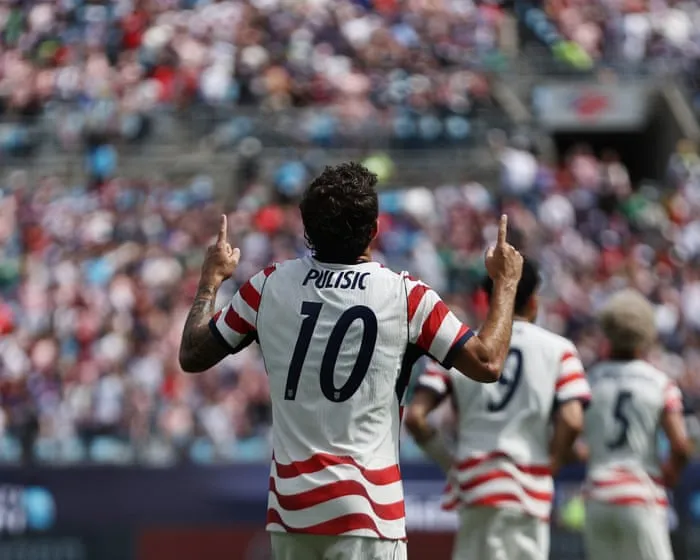
The latest episode of the lengthy Pulisic documentary series features Christian Pulisic seated at a table adorned with vibrant pink orchids behind him.
A friend, camera in hand, queries him, “What time is it?”
To which Pulisic responds, “Bible time,” while flipping through the pages of his Bible, a pencil held between his fingers and a notepad ready beside him. A cross hangs prominently from his necklace.
Pulisic’s spirituality is well-documented; he has shared images of highlighted verses from his Bible on social media.
Similarly, Weston McKennie, another star of the U.S. Men’s National Team, has a succinct Instagram bio: “All glory to God.” In his profile picture, he raises both index fingers skyward, showcasing diamond earrings shaped like crosses.
Defender Chris Richards is also vocal about his religious beliefs. He revealed that he and approximately ten teammates from Crystal Palace join in prayer before matches and participate in Bible study sessions.
Upon joining the USMNT, goalkeeper Matt Freese, a committed Catholic, casually mentioned that he had previously met Pulisic during a Bible study gathering.
The team’s head coach, Mauricio Pochettino, identifies as Catholic and is often seen wearing a bracelet featuring a patron saint. During his initial managerial role with Espanyol in 2009, he undertook a 7.5-mile pilgrimage to the Montserrat religious site near Barcelona to pray for the team’s salvation from relegation, a plea that proved effective.
During the previous World Cup, the USMNT roster showcased players like Walker Zimmerman, the pastor’s son who openly expressed his faith; Yunus Musah, a Muslim who observed Ramadan fasting even on game days; and DeAndre Yedlin, a Buddhist who led his teammates in meditation on the pitch following every match in Qatar.
This shift signifies a significant transformation in the team’s public approach to religion and personal beliefs.
While demographics imply that some past national team players may have been religious, few openly shared their beliefs. Clint Dempsey gave a single interview about his faith to a religious outlet around the 2014 World Cup. Tim Howard was affiliated with the Fellowship of Christian Athletes but seldom discussed his faith publicly. Jozy Altidore noted towards the end of his career that he had been “raised as a Jehovah’s Witness,” without further explanation. Landon Donovan has been identified as an atheist.
Aside from these instances, only a handful of prominent national team figures have broached the topic. To this day, the faith of players like Cobi Jones, Tab Ramos, Alexi Lalas, and Marcelo Balboa remains largely unknown, as does that of Michael Bradley and DaMarcus Beasley. Yet, it was never a necessity for them to disclose their beliefs.
The contrast today is striking.
It’s essential to recognize that, although these developments are separate, the USMNT’s openness about faith occurs amid a political landscape that sometimes embraces overt religiosity. The Trump administration has emboldened Christian nationalists, aiming to reshape the nation’s constitutionally guaranteed religious freedom into a predominantly Christian framework.
The leading players’ declarations of faith appear genuine, reflecting their commitment to expressing their beliefs sincerely. This trend aligns with a generation of American athletes who are increasingly comfortable articulating their views compared to their predecessors.
While it’s not a novel concept for professional athletes to incorporate religion into their public image, it represents a notable change within a national team context, where public engagement rules differ. US Soccer previously prohibited kneeling during the national anthem, only to lift that ban three years later when societal attitudes shifted, arguing that such actions in national colors differ from protests associated with individual franchises. Similarly, utilizing World Cup visibility for evangelism complicates the team’s stance on sporting neutrality.
Instances of missteps, such as Team USA’s unexpected embrace of militarism during the World Baseball Classic, have sometimes alienated fans, rendering them the least enjoyable team in the event.
However, one could argue that the confidence displayed by the team’s stars to authentically express themselves during significant events is a positive development. This current generation of U.S. players has often been reticent in media interactions that could reveal the depth and eloquence of several key members. In light of limited visibility, some have even labeled this team as unlikable.
Regardless of the outcome, as the nation becomes acquainted with its men’s national team in the coming weeks, it will be exposed to a deeper understanding of their values and beliefs than ever before.
- Leander Schaerlaeckens authored “The Long Game: U.S. Men’s Soccer and Its Savage, Four-Decade Journey to the Top, or Thereabouts,” currently available. He is also an educator at Marist University.
Leander Schaerlaeckens authored “The Long Game: U.S. Men’s Soccer and Its Savage, Four-Decade Journey to the Top, or Thereabouts,” currently available. He is also an educator at Marist University.