


The upcoming 2026 World Cup is poised to introduce groundbreaking semi-automated offside technology, harnessing a network of twelve cameras that capture player movements at an impressive rate of 50 images per second. This innovative system promises to enhance the officiating process by minimizing delays and providing better assistance to referees.
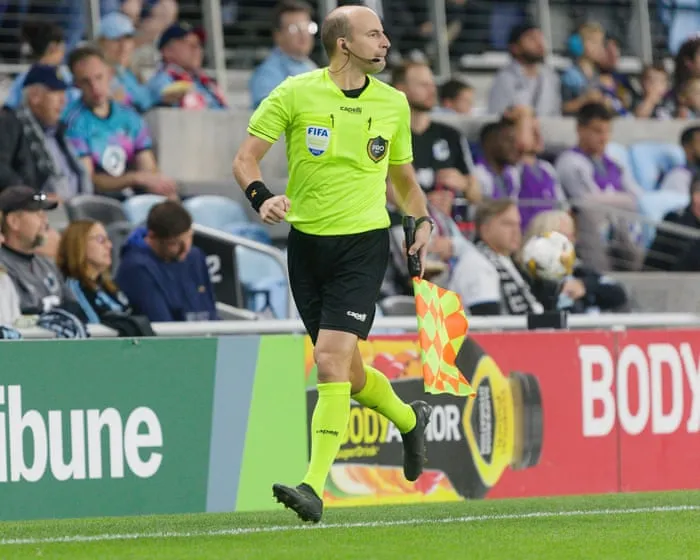
Among the officials is Micheal Barwegan, a member of the first all-Canadian refereeing squad in the history of the men’s World Cup. Over the past two years, he has collaborated closely with referee Drew Fischer and assistant referee Lyes Arfa, including their joint efforts at the 2024 Olympics and last summer’s Club World Cup, alongside their regular roles in club competitions.
Barwegan’s experience with this technology isn’t new; he previously utilized it during Botafogo’s notable victory against Paris Saint-Germain in the Club World Cup last summer.
While he acknowledges the benefits of the tech, Barwegan emphasizes that it does not replace the critical role of the assistant referee. He stated,
“I’m gonna tell you, the semi-automated system is not perfect. As such, our job stays exactly the same. It is really, really good – I like to say I’m a little bit better – but I think that’s purely just on a technical side with how it’s programmed.”
He further elaborated on the system’s capabilities, noting,
“It’s tracking every player, and it’s got points [on each of those players] that it’s tracking … so I’m going to say it is as perfect as an assistant referee, if not better, on your normal run-of-the-mill offside calls. Its accuracy is amazing at that.”
The technology assesses whether an attacking player is positioned beyond the second-to-last defender when a pass is made. If the system detects a clear offside, it promptly alerts assistant referees with an automated voice stating, “offside, offside, offside.” As of last summer’s Club World Cup, a player is deemed “clearly offside” if the gap between them and the defender exceeds 10 centimeters.
In instances where the players are closer, the system communicates a “delay” message to the assistant referee. If no clear offside is apparent, either due to minimal separation between players or off-ball actions complicating the situation, the system provides no notification. Throughout this process, assistant referees continue their duties, allowing play to proceed unless the situation is definitively clear.
Only assistant referees receive these automated messages, and they maintain continuous communication with the referee for the entire match duration. Barwegan and some of his colleagues have started integrating the system’s feedback into their responsibilities.
“The advantage to us on those plays is that the system doesn’t make a decision until the offside position player touches the ball,” Barwegan explained.
“When the ball gets played and a player’s running, I am quick to say [whether] he’s going to be offside or he’s good, and I will clear it to the referee in his earpiece before another decision has to be made. The computer has to think, and it’s super fast, but [on the field] it feels like forever.”
Barwegan, who also teaches math and enjoys board games, embarked on his officiating journey at the age of 12, initially seeking a way to earn some extra money. Within just five years, he discovered a passion for officiating that surpassed his enjoyment of playing, candidly admitting he “wasn’t that good” at the latter.
“Some people are like, ‘I need to go for a run’,” he remarked. “I clearly still need to do that, because I have to run [as a referee]. I like engaging my brain. I like reading rules, deciphering rules, and seeing how systems work together.”
By 2012, he had transitioned to officiating professional matches. His brother, Brian, also pursued a career in officiating and ended up refereeing high school and college games for 17 years.
As Brian prepared to retire in 2025, he made one special request: that Micheal be his assistant referee. Barwegan recalled,
“I texted my manager with a weird request: can you [assign] me to Toronto?”
His rationale was simple; Toronto was the nearest city to Brian’s home in Alberta, allowing Micheal to officiate a professional game on Saturday and still make it back in time for Brian’s final match.
After officiating Toronto FC’s 4-2 triumph over Orlando City, Micheal caught a flight and arrived at the University of Lethbridge just in time for the Pronghorns’ game against the University of Alberta Golden Bears.
“I came screaming in, threw on a uniform and threw on my badge and went out there,” Barwegan recounted. “They still yelled at me non-stop. I was doing a game in MLS 14 hours ago, guys. I know what offside is, I promise.”