


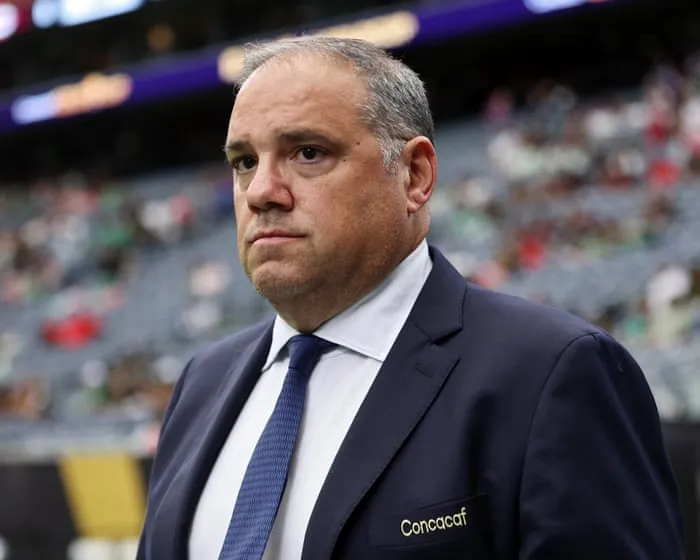
Victor Montagliani foresees that the forthcoming World Cup will spark a “cultural revolution” across North America, potentially propelling Major League Soccer (MLS) to a stature that competes with the Premier League in club football.
In a candid discussion, the president of Concacaf and Fifa vice president shared his insights:
- He defended the tournament’s controversial pricing strategy, asserting that hosting the World Cup in North America epitomizes Fifa’s revenue potential, essential for funding football worldwide.
- He emphasized that Donald Trump will not influence the tournament, highlighting that Fifa transcends any single individual.
- He noted that conversations regarding expanding the World Cup to 64 teams, a proposition from the South American confederation Conmebol, are premature.
- He expressed his endorsement for enlarging the Club World Cup to 48 teams, aiming to elevate standards and increase financial returns.
- He did not dismiss the idea of pursuing the Fifa presidency in 2031, following Gianni Infantino’s expected final term next year.
Montagliani reiterated his support for the pricing approach, arguing that this World Cup presents a unique chance for Fifa to optimize earnings that will ultimately benefit global football.
He remarked that Trump will have “no part to play” in the tournament, stressing that Fifa is not dictated by any single figure.
He acknowledged that it is too early to consider the expansion of the World Cup to 64 teams, despite requests from Conmebol.
Montagliani demonstrated his commitment to expanding the Club World Cup to 48 teams, emphasizing its ability to enhance competition and financial expansion.
Reflecting on his own journey, he recalled advocating for Canada’s World Cup bid in 2012, a vision he has worked towards since taking the helm at Concacaf in 2016. After witnessing the inaugural match of this World Cup in Mexico City featuring the host country against South Africa, the 60-year-old looks forward to attending Canada’s opening match against Bosnia and Herzegovina, an occasion that holds deep personal significance.
“This has been an extraordinary experience, possibly the highlight of my career,” Montagliani stated. “It’s taking place in my home region, my confederation, and one of the hosts is my own country. It holds special meaning for me.”
He reflected on the maturation of soccer in North America, stating, “When we won the bid, the landscape was drastically different. Canada lacked its own professional league eight years ago—now, our teams are transferring players to European Champions League clubs and competing in the Concacaf Champions Cup. Plus, with Lionel Messi now part of MLS, we might even see him buying a franchise.”
Montagliani believes this momentum marks just the beginning, envisioning the World Cup transforming football into a truly North American sport.
“The legacy will be a cultural revolution in our perception of the game, recognizing it as our sport and not merely a European pastime that we consume,” he remarked. “Soccer will become an integral part of our identity in global sports.”
He firmly believes in the vast potential of MLS, asserting, “It could evolve into the second-largest league in the world. Perhaps even the largest. While it might take time, I genuinely believe it can happen.”
“The strength and international diversity of ownership groups in MLS is impressive. Moreover, the American mindset is ambitious. I’ve lived alongside the US my entire life, and I’ve never encountered a mindset that settles for being merely eighth or tenth best. They aspire to be the best, and there’s nothing stopping them from achieving that in the league,” he added.
“The experience at MLS stadiums is exceptional. The training facilities are top-notch, but ultimately, it’s the on-field product that counts. We just need a few more star players and adjustments to the salary cap. While there’s only one Messi, the potential is limitless with a cadre of players of that caliber across 30 teams.”
The issue of steep ticket prices has been a significant concern leading up to the World Cup, with numerous matches still unsold. However, Montagliani remains optimistic about the pricing strategy, asserting that Fifa has a rare opportunity to enhance revenues, which are projected to reach $13 billion for the tournament.
“This could very well be the largest global event ever held regarding its magnitude and scope,” he stated. “Every metric I’ve encountered suggests it’s the most significant sporting event in history, and it could be a long time before that’s surpassed. The scale of this event, the host nations, and the economic realities of this region all contribute to that.”
“In four years, we’ll return to Europe, which will present a different economic landscape. While it will be great, the ticket prices will likely be lower. Fifa operates as a member organization, governed by its members, and the council and executives are duty-bound to maximize revenue, which is entirely reinvested into football.”
“For my members, it would be beneficial to increase the financial resources available, providing them with more opportunities. Realistically, this could be the peak from a World Cup perspective.”
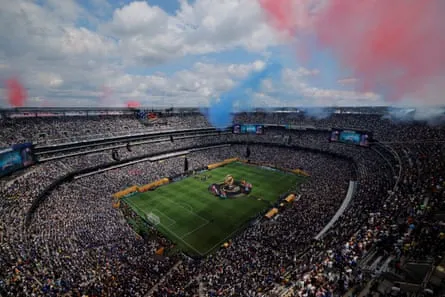
Montagliani also emphasized the need to explore revenue growth in other areas, such as the Women’s World Cup, which has historically operated at a loss but is now nearing profitability.
He noted that the newly launched Club World Cup has substantial growth potential as well, though he believes it will be difficult to surpass the success of the current World Cup.
A significant portion of the World Cup’s expansion has come from increasing the tournament size to 48 teams, raising the number of matches from 64 to 104.
While Montagliani was initially skeptical about this expansion, he is against the idea of increasing the tournament to 64 teams in 2030 as proposed by Conmebol. However, he is more open to the notion of extending the Club World Cup to 48 teams.
“I grew up with a traditional 24 or 32-team World Cup, so I had concerns about expansion. However, the teams that qualified have earned their presence here, which gives me confidence that we can manage with 48 teams,” he remarked.
“We cannot discuss any further expansion until we have experienced a few cycles of this format. We must proceed cautiously. The World Cup has maintained a 32-team format since 1998, so changing it after just one edition would not be wise.”
“The Club World Cup is distinct, having begun with 32 teams, and it would be intriguing to assess the implications of potential expansion. Major clubs in the UK may wonder why they are not participating in this event at home.”
“From a club standpoint, the quality is significantly improved as they can acquire players. In England, there are easily ten teams that could compete at this level.”
“I believe that expanding to 48 teams is feasible eventually. I’m not sure if it will happen in the next iteration, but I would like to see it analyzed. The global quality is certainly present to support it, and economically, that’s where growth could arise. As for our confederation, Asia, and Africa, our national teams will only improve when our players and clubs engage in higher-level competitions.”
“This would also shift the dynamics in Europe. The Champions League is the trophy that every club aspires to win, even more than their domestic leagues. In my confederation, this was once the case. However, now, our top clubs in MLS and the Mexican League prioritize qualifying for the Concacaf Champions Cup and subsequently the Club World Cup. This shift has fostered a more ambitious mentality among clubs, which is encouraging. Positioning the Club World Cup at the pinnacle of this hierarchy serves as a powerful motivator.”
As the tournament draws near, Montagliani remains unperturbed by potential political complications, despite alarming allegations from the US government regarding Iran’s attempts to enter the country illegally with 15 members of its coaching staff being denied visas.
“President Trump will not influence the tournament in any way,” Montagliani asserted. “It’s solely about football. He will certainly attend matches and enjoy the experience. He serves as the head of state, just like my prime minister, Mark Carney, and the Mexican president, Claudia Sheinbaum.”
He added, “Ultimately, all three governments have effectively collaborated to meet Fifa’s needs on various issues. Politicians will be politicians, but the work done by the administrations and their bureaucracies has been remarkable.”
“The cooperation among the three nations regarding security and logistics has been excellent. I commend the Carney administration, the Trump administration, and Sheinbaum’s government for their exceptional efforts in facilitating this event.”
Montagliani has long been viewed as a likely successor to Infantino, who is expected to be reelected unopposed at the upcoming Fifa Congress in Rabat, Morocco.
While Montagliani’s immediate focus will be on securing reelection as Concacaf president, he has not ruled out the possibility of a future candidacy for the Fifa presidency, especially considering his term overlaps with Infantino’s, who is expected to step down in 2031, according to current Fifa regulations.
“That’s a long way off, to begin with,” Montagliani noted. “My priority has consistently been and will remain Concacaf. I have my own reelection to consider next year, and I aim to see that through. There is still much work to be done within Concacaf. The future will unfold as it may.”
“In governance, criticism is part of the role. However, from a reputational perspective, Fifa has undergone significant transformation over the past decade. Fifa represents more than just one individual or the 37 people on the council; it encompasses 211 members, and we serve all of them.”
“One lesson I’ve learned is that the essence of football itself is what ultimately sustains us. When I refer to ‘us’, I mean the entire football community—not just Fifa but everyone involved, including confederations, leagues, and more. The unifying factor that preserves us is football itself. When the game is on, everything else fades away.”