


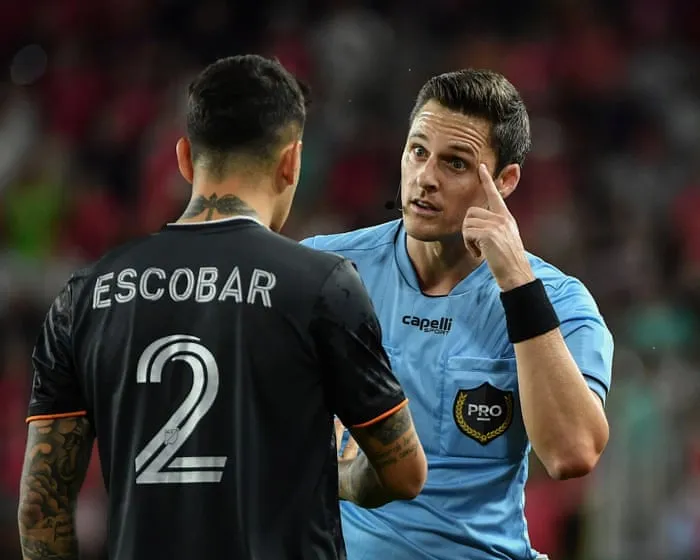
Joe Dickerson never intended to pursue a career in officiating. Initially, he was informed that refereeing would serve as a side gig for extra income, help him grasp responsibility, and, more importantly, enhance his understanding of the sport on a deeper level.
What began as early assignments in the San Jose area has evolved into a distinguished career, culminating in Dickerson being recognized as US Soccer’s male referee of the year in 2025. His meticulous attention to detail has now positioned him as a VAR official in the replay booth for the upcoming World Cup this summer.
“There was a period early in my career—something I still feel today—when I absolutely disliked going to the monitor,” Dickerson shared in an interview. “I hated it because it often indicated that I had likely made an error, and I strive for perfection on the field.”
With time, Dickerson has come to accept, if not embrace, the necessity of using the monitor. This adaptation will serve him well, as he will frequently engage with it while stationed in the VAR booth at various North American stadiums this summer.
Role in the World Cup
As one of the many officials globally monitored by FIFA during the World Cup cycle, Dickerson had the opportunity to be considered for either center officiating or video assistant referee duties for the tournament. He will serve as a crucial voice in the referee’s ear, alerting them to contentious plays that require review. His initial hesitation to rely on the monitor will assist him in striking the right tone when urging a referee to reconsider a decision.
“Most of the errors made during a World Cup by even the top referees are relatively minor,” Dickerson explained. “Well, saying ‘minor’ isn’t quite right; they’re actually quite challenging. They are subtle, specific, or simply difficult to perceive. These instances are seldom criticized by fans.”
In addition to his officiating duties, Dickerson is pursuing a master’s degree at the University of Chicago. His thesis will explore Machiavelli’s political philosophy, with a focus on its relevance to refereeing. While this connection may appear unusual to some, it makes perfect sense from his perspective.
“In short, I believe Machiavelli illustrates the importance of empathy and leadership through some of his otherwise amoral and pragmatic teachings,” Dickerson noted. “I also have a fondness for Nietzsche and Confucius. I often bring this up because I think many lessons learned in officiating are deeply philosophical and applicable to various facets of life.”
Philosophical Implications of VAR
VAR has sparked considerable philosophical discussions within the world of soccer since its inception. Criticism has intensified over the past year, particularly following a series of controversial incidents that have influenced title races and promotion or relegation battles. In February, UEFA’s director of refereeing cautioned that the review process was becoming “too microscopic.” By the end of the European club season, the Premier League opted against expanding VAR’s authority to include potential corner kick decisions, which FIFA now mandates for scrutiny during this World Cup.
Dickerson perceives the distinct nature of international football as a beneficial factor for referees in this World Cup. In a typical league season, the sheer volume of matches over months can cause any outlier decisions to become focal points of contention.
Challenges and Training
As the decade-long era of VAR has progressed, some of the most debated calls—those lacking clear resolution—involve handballs, instances where one player wins the ball before making contact with an opponent, and situations where attackers initiate contact to draw a foul. These scenarios are meticulously reviewed by all World Cup referees during training seminars, the latest of which occurred in Brazil.
“We participate in a 10-day seminar to ensure we maintain consistency in our decision-making,” Dickerson explained. “We recognize that over 90% of the calls we will encounter at the World Cup will be almost unequivocal, even if the public disagrees. We have invested significant time analyzing these clips so we can confidently identify ‘that’s a handball,’ ‘that’s a penalty,’ ‘that’s a red card,’ and ‘that’s a yellow card.’”
Contemporary VAR booth operations involve a trio of officials: the video assistant referee, who communicates with the on-field referee throughout the match; a support VAR, who continues to monitor while the VAR reviews a potential contentious call; and an assistant VAR, who takes notes that the VAR may not be able to jot down while engaged in monitoring. Each member has undergone identical training, enabling them to evaluate a potential review collaboratively, benefiting from multiple perspectives.
While some may not appreciate the video review system, and even center officials may share this sentiment, one thing is clear: VAR will undoubtedly be a significant element of this World Cup.
“You can’t ignore the public’s biases when analyzing VAR,” Dickerson stated. “However, I don’t view that as a negative. I enjoy attending matches in what I would describe as hostile environments because it signifies that the fans are incredibly passionate about the game. That passion is one of the sport’s most beautiful aspects.”
“Another beautiful aspect of the sport is its subjectivity. When you combine this subjectivity with inherent biases and heightened emotions, it leads to a plethora of strong opinions regarding VAR decisions.”