


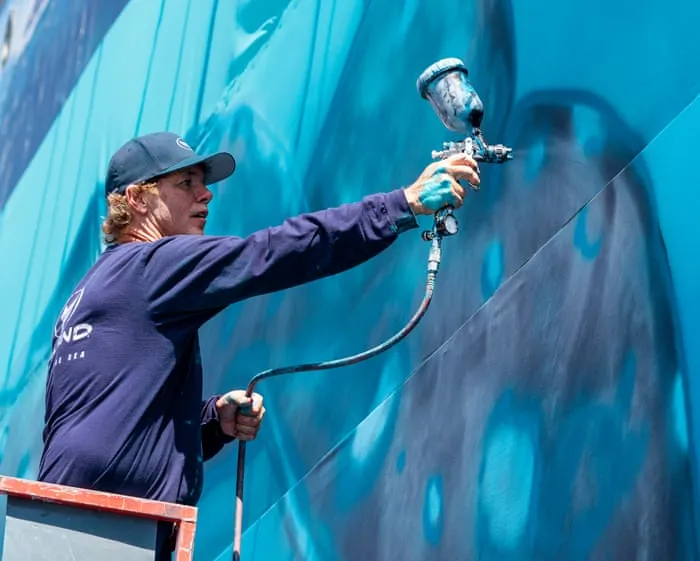
Renowned Florida artist Robert Wyland, commonly known simply as “Wyland,” was immersed in his creative process in the Florida Keys when unexpected news arrived from his assistant. She informed him that a beloved mural he painted had been whitewashed.
At 69 years old, Wyland has garnered global recognition for his “whaling walls”—massive murals depicting marine life that have become landmarks in various cities across the U.S. These serene portrayals of whales serve as a calming presence amid urban hustle and bustle, contributing significantly to community aesthetics.
In the late 1990s, Wyland completed one of his cherished creations, titled Ocean Life, in Dallas, Texas. Standing at 82 feet, it quickly became a cherished feature within the city. Over the decades, the mural had begun to show signs of wear, with fading colors and cracks appearing in the paint, prompting Wyland to consider restoration.
However, that plan changed dramatically when his assistant delivered distressing news about the mural’s fate.
“She told me someone had called and informed her they were either whitewashing or blue-washing the wall,” Wyland recounted. “I was taken aback; it completely blindsided me.”
Photos of the covered mural soon surfaced on social media, leaving Wyland and his foundation puzzled about the sudden disappearance of such a significant piece of public art. Though Wyland has previously experienced the loss of his work due to building demolitions, he and his team were never informed or consulted about this latest alteration.
This incident has escalated into a clash involving FIFA, the local organizing committee, and has ignited a broader discussion on the rights to public art. Eventually, Wyland discovered that his mural had been obscured to make way for a new promotional piece for the upcoming FIFA World Cup. In response, his team promptly filed a cease-and-desist order followed by a $25 million lawsuit against FIFA.
“This feels like a classic David versus Goliath scenario,” declared Wyland. “They represent a multi-billion-dollar organization, while I am just one artist with a small foundation. Yet, they’ve chosen the wrong artist and the wrong artwork to erase. I refuse to let them proceed without accountability.”
Wyland’s passion for marine life ignited at the age of 14 during a family trip to California. Growing up in Detroit, his exposure to the ocean was limited, but witnessing a pod of grey whales during the migration sparked a lifelong fascination. Inspired by the experience, he later idolized oceanographer Jacques Cousteau.
Not long after, Wyland attempted his first mural. An art-loving teacher assigned him to paint a snowy mountain scene on the side of their ice cream shop, paying him $100. This initial experience set him on a path in the arts, despite enduring periods of hardship, where he survived on just one Snickers bar a day.
Throughout his illustrious career, Wyland has focused on ocean conservation, creating his first whaling wall in 1981 near Laguna Beach, the site of his initial inspiration. The mural, featuring a California grey whale and her calf, was met with overwhelming enthusiasm. Motivated by this success, he committed to painting a total of 100 murals, achieving this ambitious goal in just under 27 years. His artwork now spans 17 countries.
The erasure of his Dallas mural has sparked significant backlash. With multiple parties involved—including the North Texas World Cup Organizing Committee, the Dallas government, and FIFA—assigning responsibility has proven challenging. Very few parties have openly commented, with the city of Dallas insisting that Wyland was notified about the mural’s fate, a claim Wyland vehemently denies, labeling it a “blatant lie.”
Wyland believes he knows who is at fault and asserts that his legal action aims to uncover the decision-makers behind this artistic erasure.
“FIFA needs to come clean,” Wyland insisted. “They bear the responsibility. They’re claiming otherwise. Does that seem credible to you? This is their event.”
His lawsuit references the Visual Artists Rights Act (VARA) of 1990, which protects artists of “recognized stature” from the willful or negligent destruction of their artwork. If successful, Wyland’s claim for $25 million would set a new precedent for VARA cases, with the artist promising to donate any winnings to charity.
“Sometimes, financial implications are the only language that resonates,” Wyland explained. “The figure needed to be substantial enough to resonate with those who come into a community and obliterate a piece of art that holds cultural significance. Artist rights extend beyond the individual; they also encompass public art that brings joy to the community.”
Currently, all work on the new mural has halted, with blame being shifted among the involved parties. The building’s owners clarified that they only provided the space for a public art initiative without any financial gain. FIFA, in their response, distanced themselves from the situation, stating they are “not involved at all” and directing inquiries to the local committee.
The local organizing committee has acknowledged their communication lapses while exonerating FIFA. Meanwhile, Downtown Dallas, Inc. (DDI), the local economic development agency, has attempted to dissociate from the controversy, claiming they were only peripherally involved in early discussions.
However, emails obtained by local news outlets reveal a different narrative, with a DDI employee citing Wyland’s mural as a prime candidate for the World Cup mural replacement.
“The existing mural is over 30 years old and has surpassed its useful life,” the email stated.
“Is the Mona Lisa no longer usable?” Wyland retorted. “Would anyone argue that a Van Gogh is past its prime? My murals have stood the test of time. They may show wear, but who decides that one person’s opinion should dictate the fate of art cherished by all of Dallas? They’ll attempt to spin anything.”
Unanswered questions linger, particularly surrounding why FIFA or the organizing committee did not consider a temporary solution for the mural. Precedent exists; Wyland’s mural in Dallas had previously been covered by advertisements for eight years before resurfacing during the pandemic.
Wyland is eager to seek clarity in court, where he hopes his legal team can “follow the money.” Even if given the opportunity, he has expressed hesitance to repaint the wall, as recreating the expansive mural would be a monumental challenge for someone approaching 70.
The local organizing committee has yet to disclose any details regarding the proposed replacement for Wyland’s mural, raising doubts about whether any new artwork will materialize, especially given the public outcry.
Ultimately, the emotional toll of this controversy weighs heavily on Wyland. He reflects on his loss with palpable sentiment.
“These walls are like my children,” Wyland shared. “This situation is profoundly personal.”