


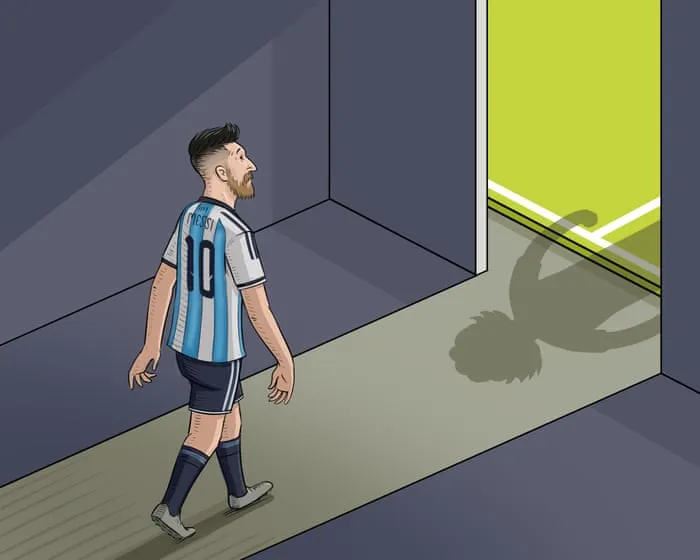
For Lionel Messi, the World Cup in Qatar represented the ideal culmination of his storied career. It was poised to be the grand finale, a moment that would inevitably draw comparisons to Diego Maradona. While Maradona’s life was marked by dramatic highs and lows—including injury, addiction, and controversies—Messi’s narrative has often felt less tumultuous: a young talent who consistently excelled for twenty years, accumulating titles. Although Messi experienced emotional moments, his life has not been characterized by the chaos that defined Maradona’s journey.
However, the Qatar tournament introduced an element of suspense. Messi’s club achievements had seemingly fallen short of fulfilling his ambition. He emerged as a leader, overcoming his natural shyness to guide the team, especially after clinching the Copa América in Brazil the previous year. His spirited outburst during a TV interview following the quarter-final victory over the Netherlands, when he confronted Wout Weghorst with, “Que mira, bobo?”—meaning, “What are you looking at, idiot?”—was celebrated as a sign of his newfound assertiveness.
The backdrop of Qatar also felt significant historically. The nation had been the host of Argentina’s first Under-20 World Cup victory in 1995, under the guidance of José Pékerman and Hugo Tocalli. Lionel Scaloni, the current manager, was part of that squad, along with his assistants Walter Samuel and Pablo Aimar. Messi himself participated in the last of those triumphs in 2007, alongside teammates like Papu Gómez and Ángel Di María. This lineage was a reminder of Argentina’s youth football success, which had not yet translated into senior glory, making the current tournament all the more poignant.
If Messi had been guided solely by narrative, he might have shrugged off the bisht that adorned him during the trophy ceremony and chosen to retire from international football. He could have taken a victory lap, reminiscent of Maradona’s iconic celebration in 1986. It could have been the perfect ending, a fitting conclusion to a remarkable career.
Yet here we are, four years later, with Argentina gearing up for another World Cup featuring Messi. He has strayed from the expected narrative. At nearly 39, he is set to become the oldest Argentinian to compete in the tournament, although he will not be the oldest player overall in the United States, Mexico, and Canada. There looms a threat of him exiting on a disappointing note, evoking memories of past World Cups that fell short for Argentina.
Yet, the possibility of triumph exists. Can he do it again? To an outsider, it may seem that he has nothing left to prove, that his legacy is secure, and it is time for him to either relax or explore a different career path, perhaps in coaching or analysis. However, elite athletes often possess an unwavering, almost irrational self-belief. Perhaps Messi believes he can once again lead Argentina to success.
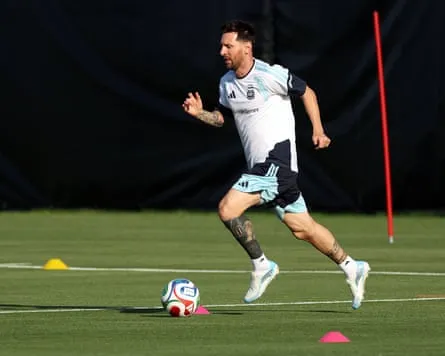
After years of living in the shadow of Maradona and hearing constant reminders that his club success did not include a World Cup victory for his country, could Messi surpass him by winning the tournament twice? Is there a scenario where Argentinians gather around the asado pit, acknowledging that while Diego was extraordinary, he only claimed the World Cup once?
But how realistic is this hope? Messi appeared to show signs of age during the last World Cup. He often lingered at the edges of matches, making fleeting appearances of brilliance before retreating once more. Rodrigo De Paul became crucial in maintaining his effectiveness, to such an extent that Inter Miami felt compelled to recruit De Paul to support Messi in the MLS. Julián Alvarez and Enzo Fernández also contributed significantly to the team’s efforts. However, if it’s accepted that Messi’s physical capabilities have diminished, a gradual decline may not be as impactful. Operating from the shadows, he can still pose a threat without burdening the team’s dynamics.
Prior to the last World Cup, Messi was competing regularly at a high level. In the half-season leading up to the tournament, he played 13 matches in Ligue 1 and five in the Champions League. This year, he has participated in 14 MLS games and two Concacaf Champions League matches, which seem comparable. Nevertheless, while familiarity with the environment may provide an advantage, the competitive standard is nowhere near that of France’s top division. Despite this, Messi has remained effective for Argentina, contributing to their Copa América victory and subsequent qualification matches.
Is he prepared for this upcoming challenge? The uncertainty looms large. There is a worry that Messi may become a mere shadow of his former self, a reminder of past accolades. Many athletes face the fear of clinging to their careers beyond their prime, apprehensive about losing their sense of purpose.
What lies ahead for Messi? His enigmatic nature makes it challenging to predict whether he possesses an interest or talent for coaching or commentary, or if he has aspirations in those arenas. If his post-playing days consist solely of promotional appearances and gaming sessions, it’s easy to understand his reluctance to contemplate the end of his playing career.
However, perhaps it is unjust to project ordinary expectations onto someone who has always defied convention. While Qatar appeared to be the climactic ending, it might just mark the beginning of an even more remarkable chapter. There remains a glimmer of hope that he could indeed achieve a second World Cup victory.