


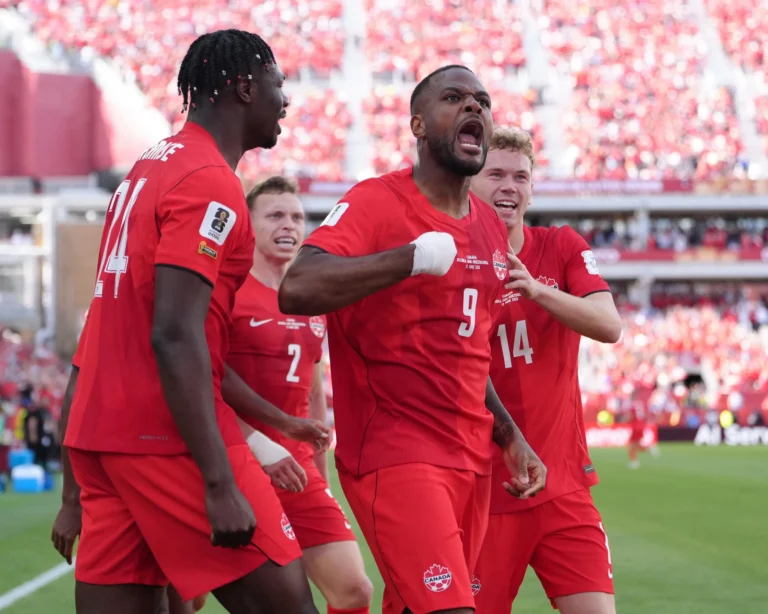
Ismaël Koné was on the verge of fainting, while Cyle Larin found himself almost overwhelmed by the noise. Seventy-eight minutes into a match where the specter of “It doesn’t feel like the same BMO … I guess … you guys didn’t hear that,” threatened to haunt Canada, a moment of clarity arrived, igniting a jubilant eruption of emotion.
Last week, what was known as BMO Field in Toronto now bore witness to a pivotal moment. In his post-match press conference, Jesse Marsch, still reeling from the day’s events, stumbled over the stadium’s name.
“Honestly, I felt like I was going to faint. It was crazy,”
The atmosphere was electric as Larin scored a crucial equalizer, marking Canada’s first-ever men’s World Cup point during their 1-1 draw against Bosnia and Herzegovina. The collective joy and relief surged as fans processed the implications of the match’s outcome.
“I felt like we did everything to give ourselves the chance to score. We were on top of them, we were pushing the game, we had momentum, we hit the bar. We deserved it. It was just a relief.” said Koné, whose dynamic run from the left initiated the scoring opportunity. “That’s for the fans, the reporters, and the journalists who say I shouldn’t have been where I’m supposed to be,”
Having started the match on the bench, Larin took just two minutes to make an impact after his substitution. As the crowd roared, he celebrated by putting his fingers in his ears, a gesture that spoke volumes.
“But I’ve always proved them wrong. And I did it again. Hopefully now they can shut up.” Larin explained post-match. “We’re going to score more goals,”
In light of earlier disappointing performances in warm-up matches against Uzbekistan and Ireland, Marsch had reshuffled his lineup. The combination of Larin and Jonathan David had struggled, leading to a tense build-up to this match. “So I don’t have to put up with any more stupid questions from you guys.” Marsch asserted on Monday, expressing frustration over prior inquiries.
With only 12 minutes remaining before a press conference filled with challenging questions, Larin’s goal alleviated that pressure. However, the question remains: what’s next for the team?
David’s early miss and lackluster performance stood out as the primary negative of an otherwise uplifting afternoon. Tani Oluwaseyi, who started in place of Larin, also squandered a promising chance. After just an hour, Marsch substituted one David for another, bringing on Union-SG’s Promise David in hopes of reigniting the attack. But it was Larin’s entry that turned the tide, aided by a clever flick from Promise David.
Marsch was asked whether he believed Larin’s goal could unlock greater potential for his team. “On one level you can say the subs we made [had] a big impact so they were some good decisions,” he noted. “But I gotta figure a way to get more out of the starters too.”
Next, Canada will travel to Vancouver to face Qatar on Thursday, enjoying an extra day of rest between matches. Marsch acknowledged David’s underwhelming performance but suggested that Larin’s goal might serve as a catalyst for future success.
“A home World Cup is a different occasion. It’s a different feel,” Marsch stated. “I do think we’ll learn from this and if you look at World Cups historically, doesn’t matter if it’s Argentina losing to Saudi Arabia last World Cup or different scenarios where it starts a little bit tense in the beginning stages. Then the games come more to life and you see truer versions of teams.”
During the second half, as Canada began to build momentum, Alphonso Davies observed from the edge of the dugout, resting his chin in his hand. The captain is still recuperating from an injury, as is defender Moïse Bombito.
Ultimately, Larin’s strike provided not only a crucial point for Canada but also a sense of belonging at their own World Cup—a significant achievement.
“I haven’t scored in a while, but I knew it was coming,” Larin reflected. “I’ve always come up [big] when Canada needed me.”