


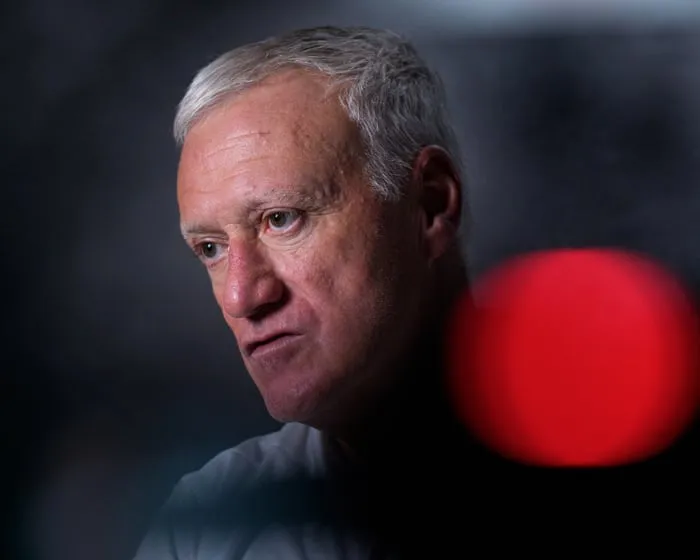
As you stroll along the lush pathway leading to the Château de Clairefontaine, you encounter a three-meter tall replica of the World Cup trophy, proudly displaying two stars that symbolize France’s World Cup victories. Didier Deschamps played a pivotal role in both triumphs, first as captain in 1998 and later as the manager in 2018.
France’s inaugural win in the 1998 World Cup has since evolved into a remarkable journey, with Les Bleus reaching the finals four times in the last seven tournaments—Deschamps has been part of three of those quests. With another chance to reach the pinnacle in North America, the expectations are rooted in past achievements. “We’re among the favourites,” Deschamps confidently states during our conversation. “This label isn’t taboo for me. If we are viewed this way, it’s a logical outcome of our past performances and achievements.”
As the discussion unfolds, Deschamps’ assistant, Guy Stéphan, jokingly pops his head into the room, saying, “You’ve got the best.” With a grin, Deschamps responds, “He’s always very objective.” Given Deschamps’ impressive history as a player and manager, Stéphan’s remark is hard to contest.
However, Deschamps acknowledges a certain subjectivity in perception. “Internationally, there is perhaps more recognition,” he notes. “Traveling abroad, I can sense a different sentiment compared to what’s felt in France.” Domestic concerns often focus on the playing style. With a chuckle, he remarks, “It really depends on what you mean by ‘playing style.’ Internationally, that may differ, but within France, it’s known that even if our team is labeled as defensive, it hasn’t hindered our success.”
Deschamps, however, is unconcerned with his legacy. He emphasizes, “It doesn’t matter to me, nor does it interest me. The priority is the present and the future, and tomorrow is the World Cup. Afterward, everyone will form their own opinions and interpretations.”
While public perception is one aspect, how he is viewed by his fellow coaches presents another dimension. Gareth Southgate previously looked up to him, and Deschamps shares that he has communicated with notable figures like Thomas Tuchel, whom he regards highly, along with Brazil’s Carlo Ancelotti and former Germany head coach Hansi Flick. With three major finals and a Nations League title under his belt, Deschamps has become a central figure in modern international football.
Despite this, he asserts that there is no secret recipe for success. “I have one magic word: adaptation … I remind myself to adjust based on the individual in front of me. This leads to necessary changes … Just because something worked before doesn’t mean we shouldn’t evolve. It’s not about changing for the sake of it,” he explains.
Beyond tactical adjustments, effective man management is equally crucial, requiring ongoing adaptation. “The generation I began with in 2012 is not the same as today … the current players require more communication,” Deschamps observes, having overseen a significant transition within the French national team.
Following the defeat to Argentina in the 2022 World Cup final, several key players, including Hugo Lloris, Olivier Giroud, Raphaël Varane, and Antoine Griezmann, have stepped away from international duty. “The torch has been passed,” Deschamps states, naming Kylian Mbappé as the successor to Lloris, the most-capped player in French history.
“Kylian, our captain today, was attentive before he took on this role; he observed and learned. His leadership style is different from Hugo’s. He commands respect both on and off the pitch, realizing that when he speaks, he’s voicing the sentiments of all the players, not just himself.” Deschamps also defended his strategic use of the Real Madrid star: “It would be foolish to underestimate the numerous capable coaches who have utilized him centrally in their systems … for the past two years at Real and his last year at PSG, he’s consistently played as a central figure.”
However, Mbappé’s performance at Euro 2024 fell short of expectations, especially after suffering a broken nose in the opening match against Austria. Deschamps added that his preparation was “suboptimal,” remarking that, “He arrived after a very challenging final six months with PSG, which limited his playing time.” Heading into the World Cup, Mbappé stands just one goal behind Giroud’s record of 57, a statistic that provides further justification for Deschamps, whose decisions often face scrutiny but tend to yield positive results.
For Mbappé to eclipse Giroud’s record, Deschamps must strike the right “balance,” a term he emphasizes repeatedly throughout our discussion. “At the 2022 World Cup, we started four attackers already,” he points out, countering the notion that shifting from a 4-3-3 to a 4-2-3-1 could jeopardize Les Bleus’ renowned defensive strength.
He highlights Griezmann’s role in the midfield trio as the fourth attacker during the last World Cup. His replacement will be Michael Olise. “He’s more reserved and a bit shy, but when on the pitch, he’s exceptional,” praises Deschamps. “Currently, he’s excelling and one of the standout players at the World Cup.”
Deschamps faces tough choices, particularly regarding his forward lineup. The competition includes Mbappé, Olise, Ousmane Dembélé, Rayan Cherki, Désiré Doué, Bradley Barcola, Marcus Thuram, Jean-Philippe Mateta, and Maghnes Akliouche—all cannot feature in the starting lineup.
“It’s crucial to manage the disappointment of those who won’t be in the lineup,” Deschamps explains. “It’s always a challenge to accept, as every player believes they’re superior to the one filling their position … ask any elite professional footballer, and they will acknowledge that competition exists, yet it becomes more challenging when it affects them personally.”
Consequently, echoing Tuchel’s sentiments, Deschamps emphasizes that assembling the best 26 players for the World Cup isn’t the sole consideration.
As he approaches his 58th birthday in October, Deschamps is acutely aware of these complexities. He asserts that managing a national team is an entirely different experience than club management, and none of his World Cup counterparts possess his extensive knowledge.
“If I remain in this position, it’s because the French team has consistently achieved victories. If not, my time could have concluded earlier, whether by my own choice or otherwise,” he remarks. Ultimately, it was his choice. As he confirmed in January 2025, Deschamps will step down at the end of Les Bleus’ campaign this summer.
This decision doesn’t signify retirement; however, the former manager of Juventus, Monaco, and Marseille is not contemplating his next steps just yet. “I won’t make any decisions until after the World Cup,” he asserts, although he acknowledges receiving offers.
When questioned about a potential break, Deschamps responds that he possesses “the freedom to choose.” Unlike his previous hiatus from the game after leaving Juventus in 2007, when he was on virtually every shortlist, he recalls a piece of advice from his son: “The issue is that you always come up short.” He certainly does not require the World Cup to showcase his capabilities.
Although Deschamps may not be focused on his legacy, as he departed the Château de Clairefontaine for the final time on Sunday, he has undoubtedly secured a place in history.