


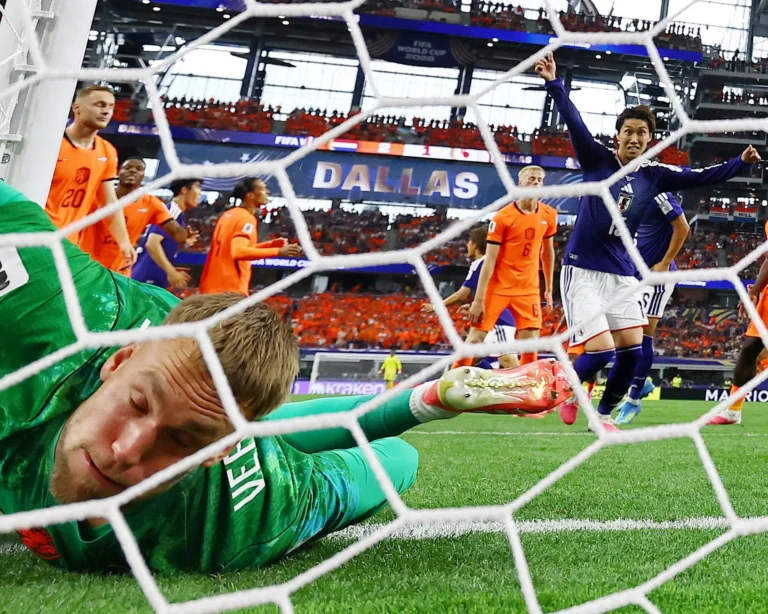
The World Cup delivered yet another unexpected twist in Arlington, Texas, as Japan and the Netherlands engaged in a thrilling clash on a scorching afternoon. Daichi Kamada found the net with an 88th-minute equalizer, leveling the score at 2-2 just as the Dutch seemed poised to dominate one of the tournament’s more challenging groups.
This match exemplified the surprises inherent in sports. When the entire Japanese bench erupted in jubilation following Kamada’s deflected goal from a corner kick, it raised the possibility that a significant upset might be unfolding.
Concerns about player fatigue, tournament format issues, and empty stadiums have circulated, although the venue here was packed. Nonetheless, there seems to be a revitalizing spirit evident in the opening matches, suggesting that perhaps – dare one say – the World Cup is showcasing its charm.
The atmosphere was electric from the start. The Dallas Stadium, resembling a colossal concrete spaceship, welcomed fans with its grand scale. Inside, the ambiance was reminiscent of an oversized Victorian railway station, with a vast glass roof that allowed light to pour in, giving the venue a unique, humid feel.
Visually, the match was captivating, featuring contrasting colors of warm royal blue and vibrant orange. Regardless of their current form, the Netherlands consistently evoke nostalgic memories of past tournaments. Coach Ronald Koeman hinted at Memphis Depay’s potential return, but Donyell Malen led the attack from the outset.
Japan has demonstrated strong performances in recent World Cups. Their manager, Hajime Moriyasu, is serious about their ambitions this year, fielding a squad that included attackers in wing-back roles, reflecting an evolution from their approach in Qatar.
The Netherlands began the match dominantly, nearly scoring within the first three minutes courtesy of a swift run by Malen, whose powerful shot was expertly saved by Zion Suzuki. What followed was a tactical battle with both teams cautiously probing each other’s defenses.
Japan showcased some effective high pressing, while Frenkie de Jong controlled the tempo with his intelligent play, always appearing comfortable in his space on the pitch.
A hydration break momentarily disrupted the game’s flow until the unexpected appearance of Dallas Cowboys cheerleaders on the giant HD screen provided a brief distraction.
Group F is shaping up to be highly competitive, with Tunisia and Sweden awaiting in the wings. This context may explain the measured approach from both sides in the early stages, as players hesitated to commit fully to attacking plays.
As the first half progressed, Malen had another opportunity, a close-range header from a corner that Suzuki managed to deflect. At that point, the Dutch controlled 67% of possession and dominated passing statistics but struggled to create clear scoring chances.
Japan’s best opportunity came just before the break, when a well-executed play down the right side led to a shot from Keito Nakamura that narrowly missed. Shortly thereafter, a perfectly timed pass between the Dutch defenders allowed Ayase Ueda a chance that hit the side netting, eliciting gasps from the crowd.
The Netherlands opened the scoring five minutes into the second half, with Virgil van Dijk directing a header in off the far post. Tsuyoshi Watanabe claimed he was pushed aside by Van Dijk, but the referee deemed it a soft challenge. Van Dijk celebrated in front of the Dutch supporters, pointing to his name on the back of his jersey.
After falling behind, Japan appeared lackluster, struggling to maintain possession and find their rhythm. However, urgency surged on the left flank, leading to their equalizer just seven minutes later. A skillful combination of passes culminated in Nakamura’s shot, which found the net after a crucial deflection off Jan Paul van Hecke.
The match ignited with renewed energy, as both teams started exploiting the available spaces. Crysencio Summerville restored the Dutch lead in the 64th minute, brilliantly curling a left-footed shot into the far corner after taking the ball from Ryan Gravenberch. Japan responded quickly, once again pushing forward.
The closing moments were filled with excitement as Group F’s dynamics shifted, leaving it wide open for potential late-game drama. Dallas Stadium has successfully passed its first test as a soccer venue, and for fans preferring a more subdued World Cup experience, England is set to arrive next.