


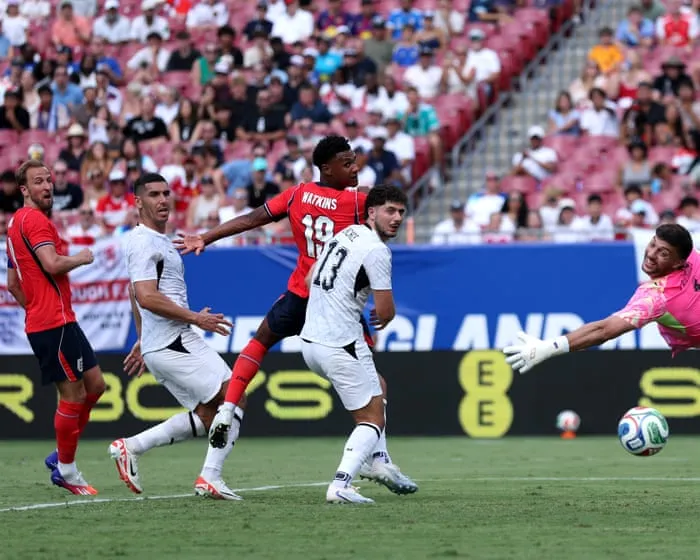
England’s recent friendly against New Zealand served primarily as a warm-up, emphasizing player acclimatization under Thomas Tuchel’s guidance. While the match lacked luster, a victory was still a positive outcome, especially after the unremarkable March internationals that featured a draw with Uruguay and a loss to Japan.
With temperatures soaring to 33°C and humidity around 40%, Tuchel opted for two different lineups across both halves, showcasing a squad too strong for New Zealand, the lowest-ranked team heading into the World Cup.
Though Tuchel likely hoped for a more decisive win—especially in light of New Zealand’s recent 4-0 defeat to Haiti—the match proved beneficial overall. In the end, one goal sufficed, and it came from a reliable source, even amidst challenging conditions.
Harry Kane extended his record tally for England to 79 goals from 113 caps with a deftly executed flicked header just before halftime. It’s noteworthy to highlight Kane’s impressive season: in addition to netting 61 times for Bayern Munich across 51 matches, he has now scored six goals in his last six outings for the national team.
Looking ahead, tougher challenges await. Following the friendly against Costa Rica in Orlando on Wednesday, England will prepare for their World Cup opener against Croatia in Dallas on June 17. This match marked a small yet important step in their quest for a successful summer.
Tuchel aimed for a hot climate to acclimatize his players to conditions expected in North America, and he got his wish. After a few days of overcast skies in Tampa, the sun returned, and his two squads felt the intensity of the heat.
The strategic deployment of players drew attention, with Jarell Quansah starting at right-back and Ollie Watkins, who was out of position on the right wing due to the absence of Bukayo Saka and Noni Madueke. Morgan Rogers played in the No. 10 position, while Jude Bellingham was held back for the second half.
England consistently controlled possession throughout the match. The first-half team exhibited promising build-up play, but their inability to convert chances became a source of frustration. Before the first water break, they squandered two significant opportunities.
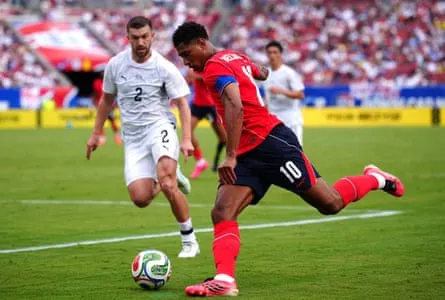
John Stones failed to direct a free header from a corner with power and accuracy, and Watkins wasted a chance, dragging a shot wide after receiving a free-kick from Jordan Henderson on the inside-right.
Marcus Rashford posed a constant threat on the left flank, showcasing both speed and skill. One notable moment came in the 34th minute when he raced to the byline and delivered a deep cross for Kane, whose powerful header was tipped over the bar by Max Crocombe. Rashford’s creativity was apparent, although it often led to near misses.
Despite England’s relentless pressure, New Zealand managed a brief counterattack in the 27th minute. Matt Garbett forced Jordan Pickford into a low save, marking New Zealand’s only serious threat. Kobbie Mainoo had a couple of promising moments, but England was left frustrated in the first half.
Kane, however, had other plans. He connected beautifully with a well-paced inswinging cross from Djed Spence, delivering a perfectly placed header into the far corner of the net.
The state of the recently resurfaced pitch became a talking point. Harder than the typical Premier League field, its seams were visible, and the bounce of the ball appeared unpredictable at times. However, this did not significantly impact play. The stadium’s groundskeeper expressed confidence in the pitch’s condition, stating, “There are zero concerns about the playability and safety of the field,” before the match.
Tuchel’s second-half lineup featured Tino Livramento at left-back and Nico O’Reilly in midfield. Rio Ngumoha made his debut on the right wing, filling in for one of the four training players brought in due to the delayed arrival of Arsenal’s Champions League players. Bellingham took over as captain, and Ivan Toney was given a chance to shine up front.
England increased their intensity in the second half. Ngumoha stood out with his lively play, while Bellingham seemed eager to assert himself against Rogers. The game’s dynamics remained unchanged, with England pushing forward relentlessly while New Zealand focused on defense.
Yet, England’s finishing remained a concern. Dan Burn nearly doubled the lead, looping a header just wide after out-jumping Crocombe. Toney thought he had earned a penalty following a foul by Garbett, only to be ruled offside.