


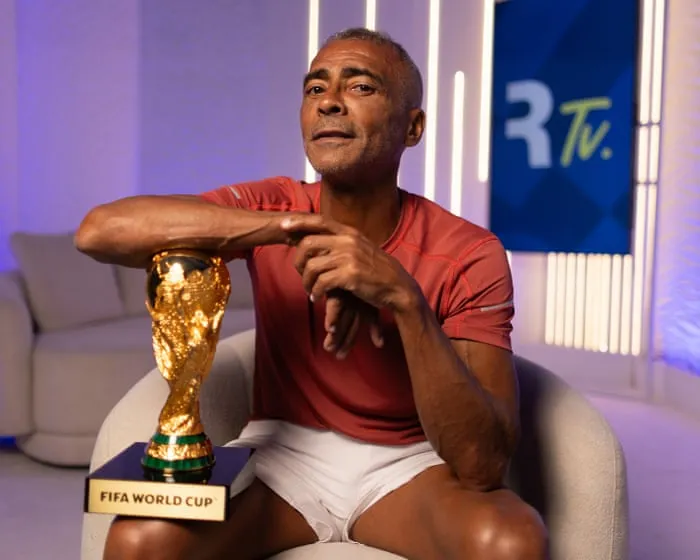
Few interviewers can claim a guest list featuring stars like Neymar, Robert Lewandowski, Xavi Hernández, and Iker Casillas, but Romário stands out as an extraordinary personality. Over thirty years since he celebrated his victory as both the world champion and best player at the 1994 World Cup, the former Brazil striker is capturing attention by engaging with football icons on his YouTube channel.
Last year, Romário launched his venture, named “face to face with the man.” He shares his enthusiasm, stating, “This entire Romário TV experience is something completely new for me. I’m genuinely enjoying it; it’s incredibly exciting.
“It’s a means of reconnecting with my past. Since retiring in 2006, stepping into the interviewer role brings me back to pivotal moments, especially when I converse with figures from my era. That’s a primary reason I find joy in my current endeavors.”
Widely regarded as one of the greatest players in both Brazilian and global football, Romário is candid about his self-evaluation. “I consider myself one of the five best players in history,” he confidently declares.
When prompted to name those he ranks alongside, he mentions, “Pelé, Maradona, Messi, Cristiano Ronaldo, myself, and Ronaldo. That’s my lineup. I’d assess my performance as an 11 out of 10.”
This self-assessment also resonates with the number he wore during various stages of his club career and for the majority of his 71 caps with Brazil, including at the 1994 World Cup. Although he often faced criticism for not dedicating enough time to training, he staunchly defends his approach.
“The perception was that Romário was lazy,” he recalls, echoing a common critique. “I didn’t train like many expected me to, yet I consistently found the back of the net.
“On the field, I was a force to be reckoned with, and I wasn’t concerned with what others thought. Those who didn’t appreciate it had to deal with it.”
Romário’s playing days were markedly different from today, devoid of the pressures of social media, allowing him to enjoy a vibrant lifestyle away from the pitch without constant fan scrutiny. He openly admits his fondness for nightlife and suggests that had he played in today’s digital landscape, he would have needed to modify his behavior, but would likely have received more acclaim for his achievements.
“I would have embraced social media during my playing days. I’m confident I would have enjoyed it back then. The internet reveals one’s true self. For instance, perhaps half of Brazil was unaware of my performances and how well I played. Nowadays, everything is out in the open.
“However, there’s a downside. People remained oblivious to the foolish things I did. That could have been disastrous, but it’s just part of life. If social media had existed in my time, I might have avoided some antics. Still, the little I did would have been widely known.”
With a grin, Romário reflects on his shift from football to politics, a commitment he balances alongside his YouTube pursuits. His political journey started 16 years ago with the PSB, Brazil’s socialist party, and he was elected as a federal deputy in 2010 before taking on the role of senator in 2014.
In 2017, he transitioned to the centrist party Podemos, and four years later, amid a wave of populism under former president Jair Bolsonaro, he accepted an invitation to join PL, the ruling far-right party at that moment. Unlike Bolsonaro, who currently faces house arrest for his involvement in an attempted coup, Romário stands against liberalizing gun ownership, advocating instead for increased investment in education, an area that PL has not prioritized.
“My focus is on education, health, social issues, and sports,” he emphasizes. “I advocate for individuals with disabilities and promote inclusion. I do not pressure anyone to support my initiatives in exchange for something, such as legalizing drugs. Legalizing abortion? I will not support that. Arming the populace? I won’t back that either. I only endorse projects I believe in.”
When asked to evaluate his political performance, he confidently rates himself another 11.
Romário’s independent stance in politics, marked by his party changes and refusal to conform, has sparked criticism from both sides. As presidential elections approach in October, Luiz Inácio Lula da Silva aims for re-election, while Flávio Bolsonaro, Jair Bolsonaro’s son, emerges as the PL candidate with his father ineligible.
Romário expresses a hope that Carlo Ancelotti’s team will secure Brazil’s sixth World Cup title and restore a sense of stability to the nation. “We’re facing a situation reminiscent of 1994,” he observes. “Politically, the country is in chaos. There’s a significant divide between left and right, and violence is rampant.
“Negative news permeates all corners of the nation. From personal experience, I know that a victory for Brazil would provide relief and joy to our suffering populace. I firmly believe it could alleviate tensions. A World Cup title symbolizes hope for better days. I genuinely hope Brazil triumphs, but it will be a challenging battle.”
His doubts about Brazil’s chances stem more from the players’ performances while representing the Seleção than from the overall quality of the squad. Romário feels that the nation has not produced players of the same caliber as during his era, which included Ronaldo and Ronaldinho, and the legends before them, like Zico.
“Brazil does have players who excel at their clubs. They shine in the Premier League and La Liga, becoming idols for their teams. However, when they wear the Brazil jersey, they often struggle to deliver. I hope that’s a thing of the past and that they can at least perform at 80% of the level they achieve for their clubs. If they manage that, Brazil will have a shot at the title.”
Romário believes that the lack of “spectacular” players has heightened his standing. “I feel that I’ve gained even more significance over the years. In the past, you had Romário and Ronaldo, but today there’s no one like us.
“That’s why we retain importance within Brazilian football. In our time, we reached greatness and represented the country. Unfortunately, today, there’s no one else to represent.”
He acknowledges that there are five teams superior to Brazil, yet he does not include England in that group. “Brazil holds a stature, and the Brazil jersey carries a weight that commands respect. England is a solid team, but I consider other sides to be better.
“I appreciate Harry Kane, [Jude] Bellingham, and [Bukayo] Saka. They are intelligent players with exceptional skills who can make a difference. They might create some excitement, but I wouldn’t list them among the favorites. My top picks are France, Spain, Portugal, Argentina, Germany, and Brazil.”
Known as the “short man,” Romário credits his life to football, yet he’s not particularly fond of watching the sport. He generally prefers spending a day at the beach over watching matches, although he makes exceptions for Brazil and the Premier League, especially due to Pep Guardiola, a former Barcelona teammate.
“Pep always possessed a unique kind of intelligence as a player. Even when he was the youngest among stars like [Hristo] Stoichkov, [José Mari] Bakero, [Ronald] Koeman, and [Miguel Ángel] Nadal, he stood out. He knew how to control the game.
“[Johan] Cruyff had immense faith in him. Pep was always attentive during Cruyff’s discussions and focused during training. He carried that dedication into his coaching career, which is why he ranks among the very best—one of the top two or three of all time.”
Romário reflects, “Pep used to say that if I was quiet in the dressing room, it was going to be a bad day. But when I was lively and dancing, nothing could stop me. Everyone has off days, but for me, those were rare.”
As the conversation comes to an end, Romário takes the reins and conducts a self-interview, proclaiming it would be the “greatest interview of all time.”
“Romário, how did you manage to play so much while putting in so little effort?” he asks. “While others were asleep, you were out exploring. While they were eating, you were enjoying ice lollies at the beach. How did you pull it off?
“Now Romário will respond… I’ve always had immense faith in myself. I knew that if I had pursued the conventional path of an athlete, I wouldn’t have achieved what I did.
“I was born in [the favela] Jacarezinho and later lived in Vila da Penha [a suburb]. I often played barefoot and frequently hurt my toes. I had to play football in a way that felt right and made me happy. That’s why I played the way I did.”