


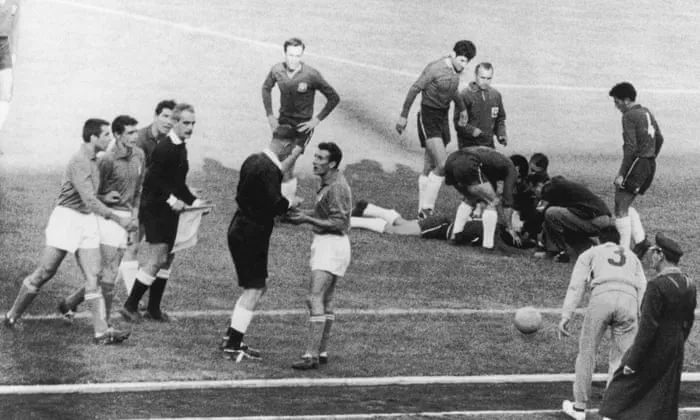
It took a staggering two days for the shocking events that would later be known as the Battle of Santiago to reach British audiences. During this interval, the match transformed into a legend, notorious for its sheer brutality. Observers characterized it as a chilling spectacle, captivating those intrigued by the combination of football and violence. Frank McGhee remarked in the Mirror, “The match is universally agreed by observers as the ugliest, most vicious and disgraceful in soccer history. If you think that is exaggerating, watch the film on TV. But send the kids to bed first – it deserves a horror certificate!”
David Coleman’s opening remarks during the BBC broadcast have become legendary. “Good evening,” he stated. “The game you are about to witness is the most ludicrous, appalling, revolting, and disgraceful display of football ever recorded. This marks the first encounter between these nations; we sincerely hope it will be the last. The national motto of Chile reads, By Reason or By Force. Today, the Chileans opted for force, while the Italians were only prepared to use aggression, resulting in calamity for the World Cup. If this tournament is to endure in its current format, significant changes must be made regarding teams that perform in such a manner. After viewing the footage tonight, you at home may also conclude that teams playing this way should be expelled from the competition altogether.”
Though the Battle of Santiago stands out as an exceptionally chaotic event, it was merely one of several violent clashes throughout a tumultuous tournament. Prior to the match, the Chilean publication Clarin had proclaimed it less a World Cup and more akin to a World War. The Express echoed this sentiment on match day, declaring, “The tournament shows every sign of developing into a violent bloodbath. Reports resemble battlefront dispatches. Italy v Germany was described as ‘wrestling and warfare.’” Players themselves shared this feeling, finding themselves dodging the ball merely to survive, as the essence of football faded amid the turmoil.
The opening matches of the tournament were marked by alarming violence, with eight games resulting in four red cards, three broken legs, a fractured ankle, and cracked ribs. Argentina’s opening contest against Bulgaria saw the South Americans claim victory through what was described as “hacking, tripping, pushing, and any other dirty tricks.” After the match, Bulgarian Todor Diev proudly displayed a cut nose and legs marked by stud impressions, likening Argentina’s aggressive play to that of boxers.
In Russia’s first match against Yugoslavia, a brutal tackle from Muhamed Mujic caused Eduard Dubinski to suffer a broken leg. Mujic was not shown a red card, but his own association was so outraged by the incident that they suspended him for an entire year. The Express lamented, “It is lamentable that Fifa are not equally honest. They have ignored their own ruling that any offenders be dealt with immediately after the offence. With no action against the few out-and-out villains, the ugly situation has been encouraged to spread.”
Donald Saunders, writing for the Telegraph, captured the prevailing atmosphere of violence that loomed over the tournament. “It became evident after only two days that most teams were so eager to avoid an early exit that they had forgotten football was merely a game, and the World Cup its grand showcase,” he noted in his book on the tournament. “Reports from all four venues indicated violence, foul moods, serious injuries, and a lack of artistic soccer expected from the world’s leading professionals.”
Italy had already displayed poor sportsmanship in their initial match, but the stakes were even higher as they faced the host nation, buoyed by passionate supporters, in a match they could not afford to lose. The Observer noted that “the patriotism here for the national team is astonishing,” and this fervor intensified when Santiago learned of Italian newspaper articles that described the hosting of the World Cup as “pure madness.” These articles portrayed the capital as a backward place with unreliable communication, scarce taxis, and a populace afflicted by malnutrition, illiteracy, and poverty. One journalist even described Santiago as “terrible,” emphasizing its issues with prostitution. The authors of these articles were forced to flee the country, while an Argentinian journalist, mistaken for one of them, was beaten and hospitalized.
In light of growing concerns over potential violence and following complaints from the Italian FA regarding the appointment of a Spanish referee, FIFA assigned the experienced English referee Ken Aston to officiate the match. While the Italians were not particularly pleased—having already witnessed Aston oversee Chile’s first match—they had no further recourse.
As the match commenced, Chilean players initiated provocations by spitting at their Italian counterparts, poking, and kicking them. However, when the Italians retaliated, they were penalized. The first foul occurred merely 12 seconds into the game, and within four minutes, the first red card was issued. Giorgio Ferrini of Italy received a red card but refused to leave the pitch, prompting a 10-minute delay as armed police escorted him off. “The pitch quickly became a battlefield as players forgot the ball and focused on kicking the nearest opponent,” reported the Mirror.
Highlights of the chaos included Leonel Sánchez, the son of a professional boxer, breaking Italy’s captain Humberto Maschio’s nose with a left hook, yet he faced no repercussions. Sánchez later scored from a free-kick following a foul, as Jaime Ramírez put Chile ahead in the 73rd minute, with Jorge Toro adding a second goal despite Italy playing with just nine men.
“I had my back to the incident at the time,” Aston insisted regarding Sánchez’s punch that broke Maschio’s nose. “If the referee or linesman sees nothing, nothing can be done. I’m sure the linesman did see it, but he refused to tell me.” The linesman in question, Leo Goldstein, had a remarkable backstory as a Holocaust survivor who volunteered to officiate a match while facing imminent death. Aston described the challenge, stating, “I was stuck with a Mexican and a little American. They weren’t very good, so it became almost me against the 22 players.”
Years later, David reflected, “We weren’t throwing the punches; we were the ones taking them. We Italians were the victims, not the aggressors. Sánchez broke Maschio’s nose, and the referee ignored it, instead sending off Ferrini, who was trying to take revenge on Sánchez but didn’t even touch him. Then, during the game, Sánchez held the ball between his legs, and when I attempted to kick it, I inadvertently kicked him too. He then punched me, but the referee overlooked it. I ended up being sent off for a challenge on Sánchez, and I assure you we fought to the end, even with nine players.”
Jimmy Hill, writing in the Observer, noted, “The Italians could not comprehend—nor could I—why Sánchez had been allowed to remain on the field despite a passable imitation of Rocky Marciano, while one of their players had been expelled for a less serious and far less obvious offense. From that moment, the last vestige of control evaporated for both players and officials. It was an atrocious decision to allow a player to stay on the field after such a blatant disregard for the rules. The players will have to shoulder most of the blame, but the officials must face up to their responsibility for making this grotesque decision.”
Aston recounted, “I anticipated a challenging match, but not an impossible one. It did cross my mind to abandon the match, but I couldn’t be responsible for the safety of the Italian players if I did. I thought that then, and I still think it now. I tell you one thing: I didn’t add on any stoppage time.”
The rising tensions between the nations led to Italians being barred from various establishments in Chile. The team’s training camp was under armed guard, and Jorge Pica from the Chilean FA further stirred controversy by alleging that the Italians had been drugged. “They seemed to go on the field only with the intention of injuring the Chileans,” he asserted, likening it to a rodeo. “Frankly, I think they were doped. Now I can see the necessity for laboratory tests on players after matches.” Meanwhile, the Italians lodged an official complaint against Aston’s officiating, branding the Chileans as “cannibals,” and in Rome, the army was dispatched to bolster security at the Chilean consulate.
The backlash against Aston’s management of the match was particularly severe in Italy. David recalled a journalist labeling him “an unmentionable English vermin,” a sentiment he found agreeable. The former referee and honorary president of the German FA, Peco Bauwens, remarked, “I have never seen an English referee so weak.” In response, Aston defended himself, stating, “I have self-respect; otherwise, I would have taken the easy way out and abandoned the game.”
As violence continued to plague the tournament, Aston and Bob Davidson, the Scottish referee from Italy’s first match, sought an audience with FIFA president Sir Stanley Rous. “All referees who witnessed this match and have seen the general viciousness in most matches want to convey to Rous that they haven’t come all these miles for all this time to handle this sort of stuff,” Davidson stated.
“The World Cup competition is heading for ruin and disgrace unless Sir Stanley Rous and his committee act quickly and decisively to rectify it,” warned the Mirror. Rous listened to the referees’ demands for stringent action against misbehaving teams and assured them of his intentions. Although they departed feeling somewhat satisfied, FIFA’s response proved disappointingly lenient. Ferrini received merely a one-match suspension, while David and Sánchez faced no serious penalties. Rous later summoned representatives from all 16 teams to the Carrera Hotel in Santiago, emphasizing the need for better conduct. “What will the children think when they see the abominable way the top players behave? We have to preserve the reputation of this tournament,” he declared. “This is not about victory at all costs.”
However, FIFA’s attempt to crack down on misconduct fell short. Four years later, Pelé was brutally kicked out of the 1966 World Cup after sustaining an injury in Brazil’s second match in Chile. He later conveyed his belief that Rous had directed referees to overlook the “virile” style of European teams, resulting in players targeting him physically.
Even in Chile, conditions saw little improvement. During the semi-final between Czechoslovakia and Yugoslavia, the Swiss referee had to call the captains together due to the game “developing into a brawl,” cautioning them to eliminate rough play. In another semi-final, Chile faced Brazil, where two players were sent off, including Brazil’s Garrincha, who suffered a head injury from a projectile while exiting the field. He was emotional in the dressing room, stating, “OK, I was sent off, but all afternoon I am kicked. There is a limit to the time when a man must be a man. When I was kicked, I struck back. Maybe I was wrong, but I am prepared to face what may come.”
The Brazilian FA, however, was concerned about his availability for the final, which hinged on the ruling of a FIFA disciplinary committee that would hear from match officials. The referee, Arturo Yamazaki from Peru, received a call from his president urging him to downplay his testimony, making Garrincha’s actions appear minor. The linesman, Esteban Marino from Uruguay, whose contribution was crucial, failed to appear at the hearing.
“He just disappeared. It was like something out of an Agatha Christie novel,” remarked Brazilian journalist Argeu Affonso, who was covering the tournament. “It was Agatha Christie football. He just vanished, and nobody knew where he had gone.” It later surfaced that Brazilian World Cup referee John Etzel had been given $10,000 in cash by his FA to ensure Marino’s absence. Without Marino’s testimony, FIFA lacked sufficient evidence to impose sanctions on Garrincha, who ultimately played a pivotal role in Brazil’s triumph over Czechoslovakia in the final. “It was me who won the World Cup,” Etzel later claimed, having kept part of the cash for himself. A fitting conclusion to an event marred by lawlessness.
What the Observer wrote: Coping with the Rough Stuff
By Jimmy Hill, the Coventry City manager, 10 June 1962
Some suggest that Ken Aston deserves a V.C. for his efforts to quell the mayhem between Chile and Italy last Saturday, while others advocate for a lifetime ban for both nations from international competitions. Can we, 9,000 miles away and well-informed through the magic of television, deliver a reasoned perspective on the week’s events?
The match was rough enough to astonish even Wilf Copping; punches were frequently thrown, and boots were flying faster than in a cavalry charge. While the players displayed a shocking lack of sportsmanship, this should not be taken as a reason to dismiss the integrity of soccer in this country.
Just days prior, English players had been criticized by the Press for being “too gentlemanly” to succeed in the World Cup. A fault suddenly becomes a virtue, and the friendly handshakes exchanged with the Hungarians following their impressive display are now seen as a sign of strength rather than weakness.
Considering the merciless scrutiny players and officials face for national failures, there is understandable provocation for adopting a “win at all costs” mentality.
The World Cup is a brutal competition for men. Football is a physical game that demands skill and artistry. Bodies are meant to clash, and aggressive tactics have historically been a cornerstone of the sport. Yet, tempers should be kept in check, and strategies should not descend into viciousness.
The Italians began the match energetically but quickly descended into hysteria. No professional player, whether Latin-American or European, loses all sense of fair play without reason. Italy needed to win to stay in the tournament. Ferrini had already been sent off when right-back David faced Sánchez, Chile’s outside-left, who was shielding the ball. David struggled to clear the ball, which was rugged yet barely legal.
Sánchez retaliated with a left hook, knocking David to the ground. After the ensuing scuffle, the Italians were baffled – and so was I – as to why Sánchez remained on the field while one of their players was expelled for a less serious offense.
From that moment, control slipped away from both players and officials. Aston’s decision to let Sánchez continue playing was appalling, given his blatant disregard for the rules. While players bear the brunt of the blame, officials must also be held responsible for this grotesque oversight. To complicate matters, David was later sent off for a high boot interception, a dangerous maneuver, albeit one executed while attempting to play the ball.
Aston displayed commendable restraint and determination to see the match through, yet one must wonder if it was worth such effort. His bravery cannot be questioned, but sending off a Chilean player would have been the ultimate resolution.
Typically, a referee can reinforce a decision with a few carefully chosen words to an offending player. However, this becomes impossible when both parties speak different languages, leaving only the whistle to communicate the referee’s authority.
In the future, we must legislate for the use of filmed evidence in inquiries, as seen in racing. If the magic eye of the camera can deter vicious and underhanded players, the sooner we implement such measures, the better.
In my view, the players involved in Saturday’s match should be compelled to watch footage of their disgraceful behavior repeatedly. If that doesn’t shame them, nothing will.