


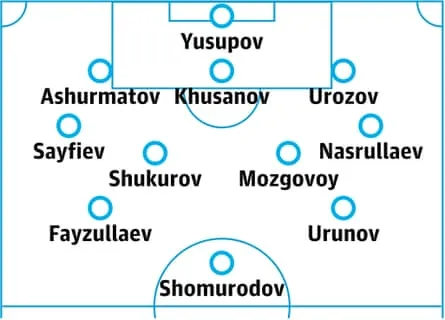
The journey to the 2026 World Cup has been nothing short of remarkable for Uzbekistan. Under the guidance of Srecko Katanec, who took the helm in 2021, the team adopted a successful 3-4-3 formation. His successors, Timur Kapadze and current coach Fabio Cannavaro, have continued this tactical approach.
The qualification process began smoothly for Uzbekistan, as they dominated a four-team group, defeating Turkmenistan and Hong Kong while holding Iran to a pair of draws. The subsequent qualification round proved equally favorable, with Uzbekistan avoiding tough competitors like Japan, South Korea, and Australia. Their away match against North Korea was relocated to Laos, allowing the squad to arrive via chartered flight. Remarkably, the White Wolves lost only one of their 16 qualifying matches, a narrow 3-2 defeat in Qatar, while their four encounters with Iran ended in stalemates. Utkir Yusupov, Uzbekistan’s top goalkeeper, played a crucial role in their historic qualification, notably saving penalties during both matches against North Korea.
Upcoming Matches
Uzbekistan’s fixtures in Group K are set to be exciting:
- June 17: vs Colombia, Mexico City (8 PM local, June 18 3 AM BST, June 18 noon AEST)
- June 23: vs Portugal, Houston (noon local, 6 PM BST, June 24 3 AM AEST)
- June 27: vs DR Congo, Atlanta (7:30 PM local, June 28 0:30 AM BST, June 28 9:30 AM AEST)
The unexpected decline in Katanec’s health during the qualifiers caught everyone off guard. Due to his condition, the Slovenian was unable to travel to Tashkent for several matches. Katanec expressed his determination, stating, “If I leave the national team for the third time due to health reasons, I will never return,” during the summer of 2024. He ultimately resigned in January 2025, with Kapadze stepping in, having previously led the Uzbekistan Olympic team to Paris 2024. Katanec remarked that his successor “finished the meal I started to prepare.”
Following their qualification for the World Cup, the Uzbekistan football association aimed to recruit a foreign coach. Cannavaro was chosen from a pool of candidates and signed a two-year contract. On his arrival last year, shortly after qualification was secured, the 2006 World Cup-winning captain stated, “I’m happy to be given this opportunity, it is a great honour. I came here not to change everything, but to continue the work that has been started.”
Coaching Background
Fabio Cannavaro boasts an impressive World Cup history, having participated in 18 matches across the 1998, 2002, 2006, and 2010 tournaments, lifting the trophy in 2006. He is second only to Gianluigi Buffon in caps for Italy, with 176. Despite his illustrious playing career, his coaching results have been less stellar. During his four-year tenure at Guangzhou Evergrande, he secured one Chinese Super League title, while his time as head coach of China was brief, lasting just two matches. He also had short stints with Benevento, Udinese, and Dinamo Zagreb. Cannavaro reflected, “I have played many games on the field where I thought I had given everything. But after hanging up my boots and starting my coaching career, I realised that 90 minutes on the field can never be compared to the life of a coach.”
Key Player
Abdukodir Khusanov stands out as the most prominent figure in the Uzbekistan squad, being the first player from the nation to compete in the Champions League, Premier League, or Ligue 1. His father, Khikmat Khoshimov, played as a central defender as well. At just 17, Khusanov joined Energetik-BGU Minsk in Belarus, although he could only train since foreign players were barred from competitive play until they turned 18. “In Belarus, I suffered away from my parents – often there were training sessions three times a day. If there was heavy snow in winter, we would clear the field ourselves and then train,” he recounted. In a whirlwind 2023, Khusanov not only won the Under-20 Asian Cup with Uzbekistan but also earned his first senior cap. Lens took notice of his talent, and within a year and a half, the once-shy young player found himself at Manchester City. Pep Guardiola praised him, stating, “He is a top signing. He is so coachable. He is always training well and gives 100%.” The 22-year-old has already secured the FA Cup and League Cup this season.
Rising Star
Behruz Karimov, born in 2007 in the Namangan region, is a player to keep an eye on. “I’ve been playing football since I was six years old. When I was in high school, I was rejected by the under-19 team of Navbahor because I was too young. After that, I started trying to prove that age is just a number.” Last March, the young right-back made his debut for Surkhan in the Uzbek top league and scored his first goal in October. In January, at just 18, he participated in the Under-23 Asian Cup, scoring against South Korea and soon received his first senior call-up. After suffering a toe injury while playing for Surkhan in April, he underwent surgery but managed to recover in time for the World Cup. Reflecting on his journey, he said, “After the injury, I was very depressed, but everyone around me supported me. This also helped me get back on my feet faster.”
Unsung Contributor
Dostonbek Khamdamov has represented Uzbekistan at every youth level throughout his teenage years, from clinching the Under-16 Asian Cup in 2012 to repeating the achievement at the Under-23 tournament in 2018. Following his standout performances for Bunyodkor, where he was named the best young player in Asia in 2015, Khamdamov moved to Anzhi Makhachkala in Russia in 2018 but only appeared in nine matches. Returning to Pakhtakor, he has since claimed five league titles and three Uzbek Cups over two stints. Now, under Cannavaro’s management, Khamdamov has regained his place in the national team.
What to Expect from Fans
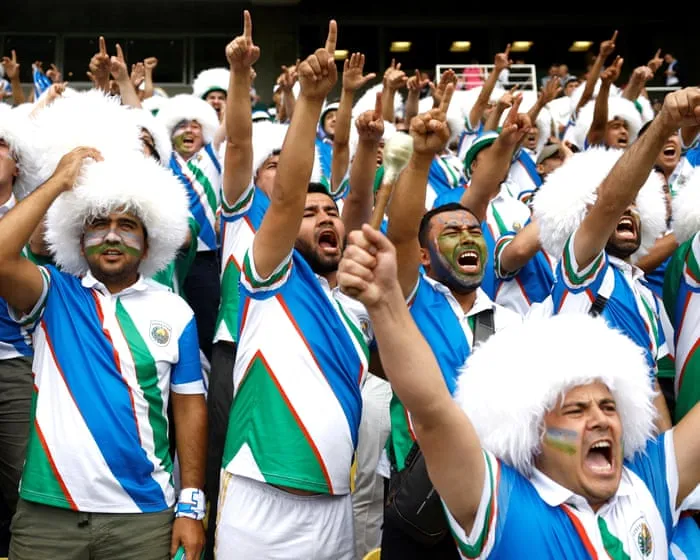
Uzbek supporters made their debut at a global football tournament during the 2024 Olympics in Paris. Regardless of their destination, they create lasting memories. Their most famous chant resonates: “The Temurids have come, the Baburids have come,” referencing the descendants of Timur and Babur, two historical figures from Central Asia, signifying their arrival with purpose.
US-Uzbekistan Relations
In recent years, the leaders of Uzbekistan and the United States have engaged in multiple meetings, fostering a warm relationship. “Shavkat Mirziyoyev is my friend,” Trump remarked during their encounter at the Board of Peace in Washington in February 2026. “He’s got one of the most difficult names in history, but that’s OK, it doesn’t matter. Your country is doing great. You’re doing great and just no problems. Every time I see him, nope, we’re doing good, no problems.” In November, Mirziyoyev told Trump, “In Uzbekistan, we call you the president of the world.”