


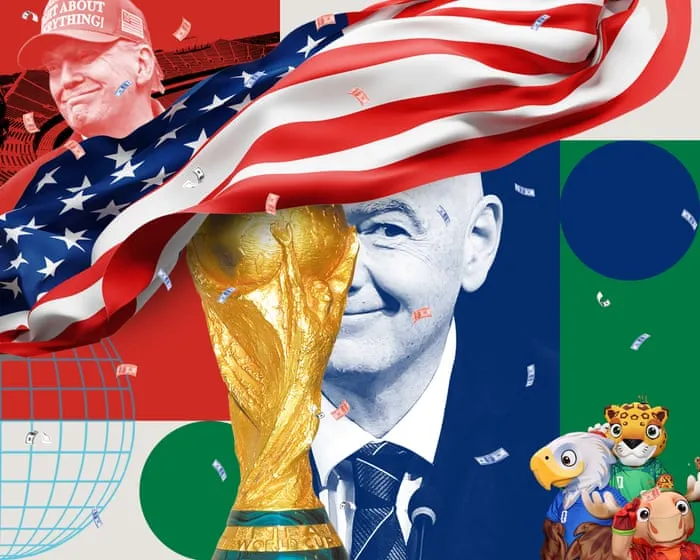
As we approach the culmination of extensive planning and anticipation, the football world is poised for a momentous event. The upcoming World Cup, set against a backdrop of political intrigue, is being orchestrated by a figure who embodies both charisma and controversy, prompting reflection on the state of modern sports governance.
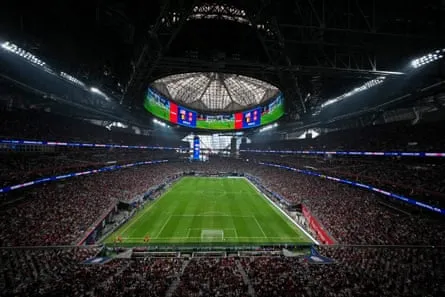
The long-awaited 2026 World Cup is slated to commence on June 11 at the iconic Azteca Stadium, stretching over 39 days, encompassing 16 host cities, and featuring 104 matches. This tournament, spanning from Mexico City to Vancouver and Boston, marks a decade of meticulous preparation, resulting in what is projected to be the largest sporting event in history.
Economically, the tournament is expected to generate an astounding $80 billion (£59.7 billion) globally, a figure that rivals the GDP of nations like Belarus. In essence, the World Cup transcends mere sport, encapsulating a grand display of global influence and power.
This is Gianni Infantino’s era, a man who projects an unsettling blend of bravado and insincerity, captivating audiences with his gestures reminiscent of a magician in Las Vegas. While he presents a vision of joy and unity, the discord in his realm is evident, particularly as global conflicts unfold around him.
The summer of 2026 promises a whirlwind of events, reflecting the complexities of contemporary America, a place teetering on the edge of contradictions while hosting a world-class sporting spectacle.
Despite its modernity, the 2026 World Cup signifies the twilight of an era, marking the decline of football as a game for the masses as commercial interests take precedence. This transition from genuine fan engagement to a spectacle dominated by noise and spectacle highlights a profound shift in the sport’s essence.
The World Cup serves as a lens through which to view America at the close of its century, revealing a nation rich in cultural significance yet grappling with exhaustion and conflicting energies. Pre-tournament excitement is palpable, yet the reality of the situation raises questions about the integrity of the event.
Recent political events, including the controversial assassination of a foreign leader, cast a shadow over the tournament’s atmosphere. The U.S. immigration policies, which have drawn criticism, may further complicate the context of this global event, where ticket prices soar to nearly $33,000 (£24,000) for the final, epitomizing the economic divide.
Moreover, the mingling of sports and politics raises ethical concerns, as FIFA seems to align itself with authoritarian regimes, with Infantino frequently appearing alongside controversial leaders.
In a well-functioning nonprofit, such associations would warrant dismissal from office, yet FIFA operates under different principles, leveraging its financial windfall to solidify Infantino’s grip on power ahead of his re-election next year.
This transformation from a seemingly ordinary administrator to a potent figure in global sports governance reveals the complexities of power dynamics within FIFA, now a monolithic entity bound to the whims of its leader.
So, why engage with this event at all? If there are objections to the tournament, why not abstain from it?
This query deserves thoughtful consideration. Ignoring the World Cup won’t alter FIFA’s actions or the political landscape; football’s prominence ensures it will persist regardless of dissent.
Turning a blind eye allows FIFA to operate unchallenged, potentially stifling critical discourse. The organization has already enlisted a cadre of influencers to propagate favorable narratives, emphasizing the need for independent media to hold power accountable.
Furthermore, the World Cup represents more than just a series of matches; it embodies the beauty and excitement of sport, still regarded as a premier global event even amid the controversies surrounding it.
As the tournament approaches, traditional powerhouses like France, Spain, and Portugal are expected to contend fiercely, with Brazil and Argentina also in the running due to their rich footballing histories.
Emerging teams like Morocco and Norway, boasting formidable talents, could disrupt expectations, while England enters as a strong contender, equipped with a blend of skillful players and tactical acumen under capable management.
The unique tempo of this tournament may favor England, as the games are likely to be physically demanding, requiring strategic adjustments. Harry Kane, rejuvenated after a strong season, may play a crucial role in guiding his team through the challenges ahead.
As the narrative unfolds, football’s luminaries — Lionel Messi and Cristiano Ronaldo — will captivate audiences, while the U.S. football culture, driven by diverse communities, adds depth to the event.
This World Cup serves as a reflection of America’s journey, prompting questions about its identity and values. Is the country still a beacon of hope and optimism, or has it faltered under the weight of its own contradictions?
Ultimately, the allure of this grand spectacle is undeniable, and as the world tunes in, we are reminded that the drama of the World Cup, both on and off the pitch, is impossible to resist.
In summary, the 2026 World Cup is not just a tournament; it is a complex interplay of sport, politics, and culture that will command global attention.