



Elliot Anderson is sprinting. It’s the 88th minute against Croatia, the match is secured, and this marks the 60th game of his season, with more demanding challenges looming ahead. Yet, as long as the ball remains in play, he’s committed to pursuing it: first challenging Josip Sutalo and then Josko Gvardiol, transforming a straightforward defensive possession into a challenging encounter. As the ball moves across the defense, Anderson diligently tracks it across the pitch to the far touchline, ultimately provoking a hasty pass that leads to a turnover.
In a match characterized by emotional highs and lows, amidst a squad reveling in its array of strategic options, it’s remarkable how swiftly Anderson has become crucial. Declan Rice is nursing an injury and appears to be lacking energy. Harry Kane is unlikely to endure the rigors of eight full matches plus extra time. The configurations of the wingers, center-backs, and full-backs remain uncertain. Beyond Jordan Pickford, nearly every aspect of this team is undergoing a careful transition.
Anderson has emerged as the embodiment of the team’s spirit, its constant in a sea of variables, and the dependable anchor that, for better or worse, will largely influence England’s prospects in the upcoming weeks. In essence, to understand England’s performance, one need only observe him. Paradoxically, Anderson’s effectiveness stems from his ability to adapt; his heat map from the Croatia match reveals he spent considerable time in wide positions, facilitating connections with full-backs, establishing overloads and triangles, and executing first-time long balls over the top, a tactic that appears deliberate.
The strategy unfolds as follows: Reece James receives the ball on the right touchline, drawing pressure from the opposing winger. He retreats towards his own goal, waits for Anderson to approach, and then delivers a lateral pass. Anderson, in turn, sends a swift, rugby-style pass into the right channel for a forward to chase. It’s a straightforward maneuver that necessitates coordination, physical strength to fend off challenges, and precise ball contact. Executed correctly, it successfully triggers the opposition press, draws them out of position, and compels them to retreat.
In the 36th minute, we witnessed the consequences of a misstep. Anderson mishandled his lofted pass, allowing Croatia to regain possession, which led to Martin Baturina equalizing moments later. However, shortly after halftime, the same tactic was executed flawlessly: James to Anderson, Anderson’s first-time pass up the touchline, resulting in Jude Bellingham’s exquisite finish as the Croatian defense faltered.
Nevertheless, this success comes with caveats. Anderson’s pass nearly fell prey to Gvardiol, and it likely aimed for Noni Madueke rather than Bellingham. Clearly, Thomas Tuchel has meticulously prepared this tactic against teams willing to press England high. But what will happen against opponents who either press more effectively than Croatia or are already aware of this strategy?
These considerations highlight broader questions regarding Anderson’s role within the team and how best to utilize a player whose skill set may be among the most complete for his age in English football. Anderson can genuinely do it all: pass, tackle, screen, jockey, cross, and shoot. He excels in aerial duels, holds his own in physical contests, delivers quality set pieces, and can run tirelessly. Is there a feasible position in this team that doesn’t somehow underutilize his talents?
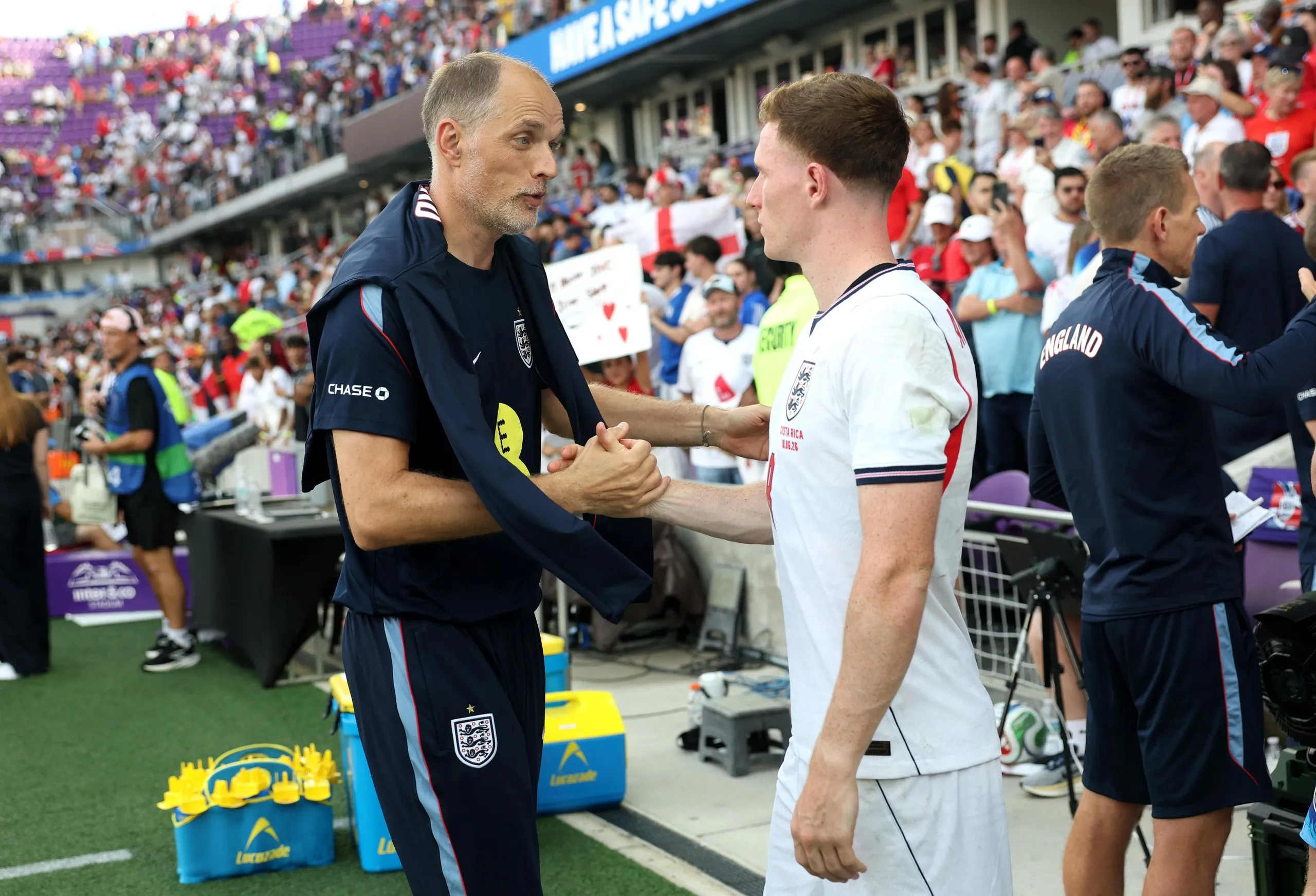
Interestingly, as the second half unfolded, we began to see a response. Rice was substituted; Bellingham and then James stepped in to fill his role, while Anderson shifted from the right side of midfield to the left. As a right-footed player, the first-time ball over the top from Nico O’Reilly was no longer an option, yet he presented a significantly greater individual threat. He surged into the box and pressed higher than in the first half. This shift was partly driven by the game’s momentum, but it served as a reminder that Anderson possesses an extensive array of skills.
In a recent interview with the BBC, Anderson discussed how his role has evolved since his days as a winger or No. 10 at the Newcastle academy, explaining how he perceives his current responsibilities. “Six or eight, I really don’t care,” he stated. “Getting on the ball and finding the attacking players, getting them the ball early in the pockets and letting them do their stuff.”
This adaptability is precisely why Tuchel holds him in such high regard: the capability to receive the ball, navigate challenges, and progress it quickly and forward. Nonetheless, one might question whether launching long balls up the channels truly represents the optimal use of his abilities. In warmer conditions, against weaker opponents who will adopt a defensive stance, and against stronger teams aiming to dominate midfield, where poise and ball control become essential, England must showcase different facets of their game and evaluate risk and reward more prudently.
Ultimately, this boils down to a matter of principles. Should the focus be on maintaining possession in midfield, or expediting its exit? With Bellingham and James stepping in for Rice in the second half, and the decision to leave Kobbie Mainoo on the bench while Adam Wharton remained at home, Tuchel has subtly articulated his priorities. He appears more focused on mobility in midfield than on control, valuing physical resilience as much as technical proficiency.
Anderson possesses an impressive skill set. However, sometimes having such versatility can be a double-edged sword. History is littered with prodigious young midfielders who seemed destined for greatness but ultimately settled for a solid career: Eduardo Camavinga, Saúl Ñíguez, Rúben Neves. Even Gavi and Warren Zaïre-Emery, now 21 and 20, respectively, have faced cycles of peaks and troughs, struggling to balance their evolving game with the immense hype surrounding their teenage years.
At 23, Anderson is a relatively late developer, with just two seasons of consistent top-flight experience and one major tournament match behind him. Already, Manchester City is showing interest, and a nine-figure transfer appears inevitable. This player is poised for a significant breakthrough. Perhaps this is what makes him so fascinating to watch right now. On some level, he must still be developing and vulnerable, yet he rarely appears that way. His significance is monumental, yet he seems unfazed by it. While he will eventually need to pause, one can’t help but wonder: what if he never does?