


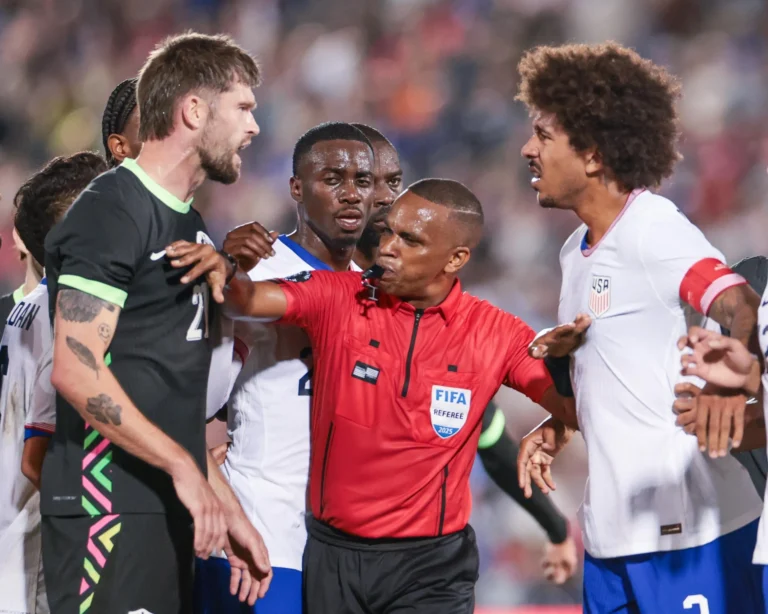
Haji Wright’s composed finish was notable, but it was Mauricio Pochettino’s reaction that truly stood out. During the 35th minute of the friendly match between the US men’s national team and Australia last October, Wright had just equalized after Jordan Bos had scored for the Socceroos earlier in the half. The striker celebrated with a calm demeanor, while his coach displayed a blank expression from the sidelines.
Pochettino may have been preoccupied with Australia’s physical style of play, which included a tackle that forced Christian Pulisic to leave the game midway through the first half. Alternatively, he might have been concentrated on his team’s response.
“[Pochettino] wasn’t too happy with letting them punch us in a way, without punching back,” Wright stated this week.
The Argentine coach expressed his discontent during a passionate halftime address, part of which was featured in a recent docuseries detailing the team’s World Cup journey. The intensity of his speech resonated even with players who were not present to hear it directly.
“You could tell by the reaction of the guys,” said Brenden Aaronson, who was warming up to enter the match at that time.
In the second half, the US matched Australia’s intensity, marking the beginning of a three-match winning streak that propelled them toward the 2026 World Cup with renewed confidence.
“Even though he’s Argentinian, he has that mindset of like, look, this is what we do, you know, and this is who we are, and this is what America’s about,” noted Sebastian Berhalter. “We’re American, and we don’t take shit.”
Fast forward to nearly eight months later, and the US and Australia are set to clash again this Friday on the world’s most prestigious stage.
The World Cup presents a different challenge compared to a friendly, regardless of how fiercely contested that prior match was. The US’s starting lineup is expected to differ significantly; the only players from that October game who will appear in the World Cup opener against Paraguay are Weston McKennie, Chris Richards, and Matt Freese. Cristian Roldan assisted Wright on both goals in the earlier friendly, but it would be unexpected for either to start on Friday, despite the match taking place in Seattle, where Roldan has a strong fan base as a member of the Sounders.
In contrast, Australia made only four adjustments from their friendly to last week’s victory over Turkey. Leicester City center-back Harry Souttar captained the squad after missing the earlier match, while Patrick Beach excelled in goal, succeeding longtime starter Mathew Ryan. Paul Okon-Engstler has been added to the midfield, and Mo Touré is set to lead the attack in place of Nick D’Agostino.
The players who remain highlight the areas of potential threat for the US once more. Nestory Irankunda, who had previously penetrated the US defense multiple times last October, started his World Cup journey impressively with a goal and a Man of the Match award against Turkey. His speed on the counterattack has been identified by several US players as a key concern, alongside Australia’s ability to defend effectively even with reduced possession. In their match against Turkey, the Socceroos controlled just 30% of the ball yet consistently posed a threat against the flow of play—an approach that differs from their tactics in October.
“Speaking to the boys who played in October, they said the game against Turkey looked completely different than how they played them last camp,” shared Antonee Robinson.
“To me, it seems like they’re more fine tuned,” Wright observed. “They looked really good defensively. They look really stable. They didn’t look like Turkey were able to really get behind them very much. That’ll be a challenge for us to break them down.”
Midfielder Tyler Adams labeled the upcoming match as “one of the most difficult games we’ll play,” further asserting that Australia is “unbelievably tactically sound.” “You could see that they were up for it, and they were putting in challenges, and I think that’s when Mauricio had the half-time rant,” and “You like teams that have that brotherhood, you like teams that, when you go against them, you can see, they’re hungry and that they want to fight. It makes you, you know, raise your level that much more.”
The current challenge lies in the US’s ability to replicate their aggressive approach against Australia, similar to what they displayed after halftime during their last meeting.
“You could see that they were up for it, and they were putting in challenges, and I think that’s when Mauricio had the half-time rant,” Berhalter remarked, noting a striking similarity between the US and Socceroos. “You like teams that have that brotherhood, you like teams that, when you go against them, you can see, they’re hungry and that they want to fight. It makes you, you know, raise your level that much more.”