


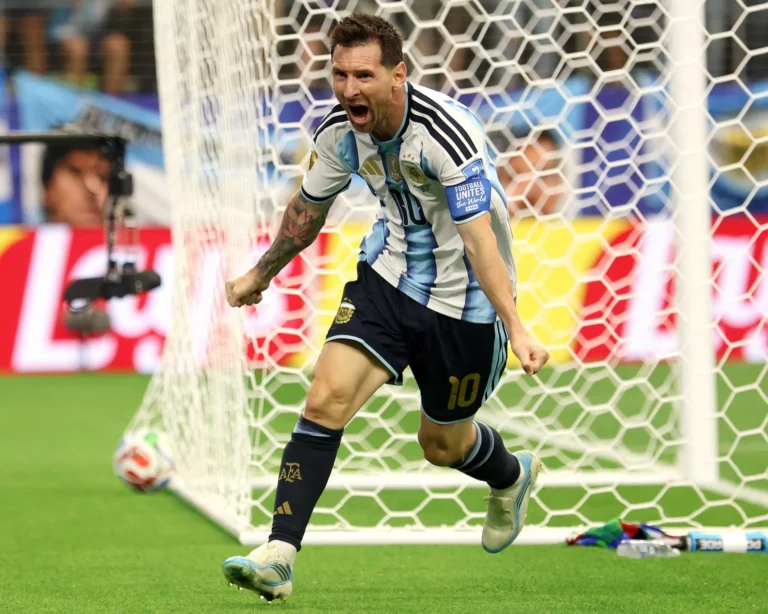
It was inevitable that Lionel Messi would once again etch his name in the annals of football history, and he did so in Dallas, leading Argentina to a decisive victory over Austria. With a stunning left-footed strike, he became the all-time leading goalscorer in World Cup history.
Messi’s scoring spree continued as he netted five goals across just two matches, placing Argentina in a commanding position to top Group J. As he approaches his 39th birthday on Wednesday, the prospect of winning a golden boot seems increasingly likely.
This historic achievement occurred on the 40th anniversary of Diego Maradona’s infamous handball against England, a moment that remains etched in World Cup lore. Initially, doubts lingered when Messi missed an early penalty, a surprising moment that left fans in disbelief. However, he redeemed himself with a goal just before half-time, perhaps laying to rest the ghosts of past controversies.
Despite their pedigree, Argentina faced a competent Austria side that proved to be a tough opponent. The Austrian defense held firm, and their midfield play was effective, showcasing their ability to challenge any team in the knockout stage.
The match itself was a spectacle, with the stands dominated by Argentina fans, their chants echoing throughout the stadium. The atmosphere was electric, embodying the passion of the sport as it transcended typical cynicism surrounding modern football.
Argentina started the match on the front foot, displaying a tempo that belied their status as favorites. An initial penalty awarded to Messi was a turning point, as the referee, Amin Mohamed Omar, reversed his decision after consulting VAR, confirming that Posch had fouled Lautaro Martínez.
However, gasps filled the stadium when Messi unexpectedly missed the penalty. His shot went wide of the left post, a moment few had anticipated. This miss briefly shifted the momentum towards Austria, who sought to capitalize on Argentina’s surprise.
Austria’s confidence surged, with Ralf Rangnick urging his team to deliver their best performance under his management. They pressed forward, forcing Argentina to defend, but Messi quickly regained his composure, assisting Enzo Fernández with a deft play that nearly led to a goal.
As the match progressed, Messi found his rhythm. With a brilliant interplay involving Thiago Almada and Facundo Medina, he received a cutback and executed a masterful finish past the Austrian goalkeeper, Alexander Schlager. This goal, significant in its own right, resonated deeply given its historical context.
The remainder of the first half saw Argentina maintaining their advantage, while Austria struggled to find their footing. After the break, they emerged with renewed vigor, but their efforts were thwarted, including a near miss by Michael Gregoritsch.
Though Austria threatened sporadically, they failed to convert their chances, and as the match drew to a close, Messi once again ignited the game, showcasing his unparalleled talent and determination.